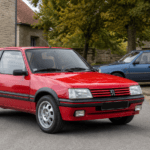
The Peugeot 205 became a hugely adaptable rally platform. Beyond the famous factory Turbo 16, front-wheel-drive 205 GTIs and other production-based shells have served in one-make championships, club rallies, historic events and regularity competition.
Peugeot 205 rally history
Peugeot launched the 205 GTI in 1984, the same year the radically different 205 Turbo 16 scored its first World Rally Championship victory. The T16 went on to secure manufacturers’ titles in 1985 and 1986. Production-based 205s developed a separate competition life: affordable shells, low weight and plentiful mechanical knowledge made the GTI attractive for national championships and club motorsport.
Official Peugeot histories record 205 GTIs in promotional rally series from the mid-1980s. These cars helped drivers gain experience without requiring the budget or engineering of a Group B machine.
205 GTI rally car versus 205 Rallye
205 GTI rally car
A production GTI converted for competition. Its engine, cage, suspension, brakes, seats and safety equipment depend on the regulations and build.
205 Rallye road model
A factory lightweight special edition launched in 1988. It can itself be prepared for motorsport, but “Rallye” is a model identity rather than proof of competition preparation.
Choose the event before the car
Historic stage rallying, regularity rallies, sprints, hill climbs and track events impose different technical and safety requirements. FIA Appendix K dates a historic competition car by its specification, not simply its original build year, and current national or event regulations may demand additional equipment.
Before buying, obtain the latest regulations from the governing body and event organiser. Confirm the eligible engine, induction, gearbox, differential, brakes, wheel size, suspension and body specification. A highly modified car may be unsuitable for the class you intend to enter.
What to inspect on a prepared 205
| Area | Checks |
|---|---|
| Shell and cage | Corrosion, accident repair, mounting plates, weld quality, deformation and evidence of current compliance |
| Safety equipment | Seat and harness dates, extinguisher system, electrical cut-off, fuel system and event eligibility |
| Engine and gearbox | Build invoices, permitted specification, compression, leaks, cooling, ratios, differential and service intervals |
| Suspension and steering | Rear-beam condition, dampers, joints, geometry, travel and damage from impacts |
| Brakes and wheels | Balance, hose age, fluid, disc condition, studs, wheel damage and suitable tyres |
| Documentation | VIN, V5C where applicable, competition logbooks, homologation papers and history |
The 1987 1.6 GTI originally featured here
This page began as a report on a 1987 Phase 1 Peugeot 205 1.6 GTI advertised as prepared for regularity and classic rallying. Its described specification included a roll cage, harnesses, extinguisher, sump guard and auxiliary lamps, alongside Gaz dampers, a Quaife automatic torque-biasing differential, cylinder-head work and a fast-road camshaft.
Those details remain a useful example of how one car was configured, but the expired advert cannot establish its present condition or eligibility. Even apparently reputable parts must be inspected as an installed system, and safety dates must be checked at the time of entry.
Road legality and competition eligibility
A road-registered rally car has two separate obligations: it must be legal and correctly insured for road use, and it must comply with the rules of the competition entered. Modifications should be accurately recorded. Noise limits, lighting, tyres, seats, harnesses and extinguishers may be acceptable in one context but not another.
Never assume an old logbook, magazine feature or previous event entry guarantees current acceptance. Regulations evolve, so use the current rulebook and obtain written clarification where a specification is ambiguous.
Frequently asked questions
Is a 205 GTI a good rally car?
Its low weight, responsive chassis and established parts knowledge make it attractive, but the right car depends on event regulations, shell condition and build quality.
Is a roll cage enough to make it competition-ready?
No. Eligibility covers the entire vehicle and its safety systems. The cage itself must also meet the applicable specification and be correctly installed.
Should I buy a finished car or build one?
A documented eligible car can save time, but only after specialist inspection. Building offers control over specification but usually costs more than the initial estimate.
Is the 1.6 better than the 1.9 for rallying?
Neither is universally better. Class rules, gearing, weight, permitted modifications, parts and intended use should decide.
Research note: model chronology and competition history were checked against official Peugeot heritage sources. Historic eligibility principles were checked against current FIA Appendix K resources. Always consult the latest applicable national and event regulations before purchasing or entering a car.