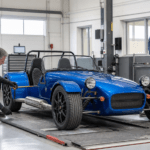
A Lotus Seven-type kit car promises minimal weight, exposed-wheel styling and direct rear-wheel-drive handling. This home-built example used a Ford Pinto engine, but there are many manufacturers and specifications—so identifying what a car actually is matters more than the generic ‘Seven’ description.
At a glance
- Style: Lotus Seven-inspired roadster
- Common construction: tubular chassis with aluminium and GRP panels
- Featured engine: Ford Pinto four-cylinder
- Typical use: road, track days, sprinting and hill climbs
- Priority checks: manufacturer identity, chassis, geometry, wiring and registration
Understanding Seven-style kit cars
The original Lotus Seven inspired Caterham and a large ecosystem of Westfields, Locosts, MKs, Tigers, Robin Hoods and home-built variations. Engines, axles, suspension and brakes can come from different donors. A Ford Pinto is robust and familiar but relatively heavy; the quality of its installation, cooling and carburetion matters more than fashion.
The car originally featured by Unusual Cars
The following details describe the car when it appeared in its original marketplace advert. Availability, asking prices and seller claims are historical and should not be treated as current or independently verified.
The Legacy of the Lotus 7 Kit Car: A Deep Dive into a Home-Built Marvel
The Lotus 7, a name that resonates with car enthusiasts worldwide, is synonymous with lightweight, open-top, and pure driving pleasure. Its iconic design and performance have made it a favorite among both racers and hobbyists. Today, we delve into an eBay listing that showcases a home-built 7, a testament to the enduring appeal of this legendary vehicle.
A Brief History of the Lotus 7
The Lotus 7 was conceived by Colin Chapman, the founder of Lotus Cars, in the 1950s. It was designed with a simple philosophy in mind: maximum performance with minimum weight. Over the years, the Lotus 7 has undergone various iterations, but its core essence remains unchanged – a car that delivers an unfiltered driving experience.
AD – BAY LISTING –> https://ebay.us/7xeayB
While Lotus ceased production of the original 7 in 1972, its spirit lives on through companies like Caterham, which acquired the rights to continue its production. Moreover, the Lotus 7’s design has inspired countless enthusiasts worldwide to build their versions, often referred to as “Locost” or kit cars.
The Home-Built 7 on eBay: A Closer Look
This particular 7, completed in 2001, stands out for its meticulous construction and choice of components. Unlike many kit cars that sometimes appear disproportionate, this one, built to accommodate Caterham components, boasts a well-balanced and aesthetically pleasing design.
Engine & Performance
At its heart lies a 2.1-litre Pinto engine, reminiscent of the Group 1 MK2 Escort RS2000. With enhancements like the Twin Weber 44idf Carburettors, Burton BLF 40.41 Rally Camshaft, and Lumenition Electronic Ignition, this engine promises exhilarating performance. The car’s lightweight nature, combined with a powerful engine, ensures a driving experience that’s both raw and thrilling.
Chassis & Handling
The chassis, inspired by the Lotus S3 and guided by the Ron Champion book, is tailored for Caterham body parts and designed for taller drivers. Weighing in at just 534KG, as corner-weighted at Raw Striker Ltd, this car promises nimble handling and swift responses. The Avo adjustable dampers and HiSpec Aluminium Front Brake Callipers further enhance its driving dynamics.
Interior & Bodywork
The interior features a refreshed alcantara dashboard, new instrument dials, and a detachable Momo steering wheel. The bodywork, adorned with a Caterham nosecone, rear arches, and finished in Rover Nightfire red, exudes a classic charm. However, like any vehicle with a history, it bears the marks of its adventures, evident in the stone chips and blemishes.
Historic Vehicle Status
One of the unique aspects of this 7 is its registration as a 1976 car, thanks to the retained running gear of the RS2000 donor car. This classification grants it the status of a historic vehicle, making it exempt from road tax and MOT.
https://ebay.us/7xeayB


A Tinkerer’s Dream
While this home-built 7 is in commendable condition, it offers ample opportunities for those who love to tinker and enhance. Whether it’s refurbishing the carbs, addressing the water temp sender, or giving the bodywork a fresh coat of paint, there’s potential to elevate this vehicle further.
This eBay listing offers a unique opportunity to own a piece of automotive history. Whether you’re an enthusiast looking to embark on a new project or someone seeking a pure driving experience, this home-built 7 is a treasure waiting to be discovered. And as the seller aptly puts it, while it could serve as a donor for restoring an MK2 RS2000 Escort, it truly deserves its lightweight home.
For those interested in exploring more about this vehicle, the eBay listing boasts a plethora of photos and intricate details, providing a comprehensive view of this automotive marvel.
https://ebay.us/7xeayB



MORE WEBSITE POSTS
- 10 Things You Probably Didn’t Know About the MG XPower SV-R
 The MG XPower SV-R was one of the boldest cars… Read more: 10 Things You Probably Didn’t Know About the MG XPower SV-R
 - Vauxhall Viva GT & Brabham Guide: History, Differences & Buying Advice
 The Vauxhall Viva is easy to dismiss as a modest… Read more: Vauxhall Viva GT & Brabham Guide: History, Differences & Buying Advice
 - Vauxhall VX220 Buying Guide: 2.2, Turbo & VXR220
 The Vauxhall VX220 is one of the most unusual performance… Read more: Vauxhall VX220 Buying Guide: 2.2, Turbo & VXR220
 - Vauxhall Corsa GSi B Guide: 1.6 16v, Problems & Buying Advice
 The first Vauxhall Corsa GSi arrived in Britain in 1993.… Read more: Vauxhall Corsa GSi B Guide: 1.6 16v, Problems & Buying Advice
What to check before buying
- Establish the manufacturer or chassis plans rather than accepting a vague ‘Lotus’ description.
- Check chassis welds, corrosion, alignment and suspension mounting points.
- Inspect steering-column joints, pedal mounts, brake lines and seat-belt anchorages.
- Identify engine, gearbox, differential, uprights and brakes for future parts ordering.
- Make sure the seating position, pedals, wind protection and weather gear suit you.
UK registration, insurance and road use
A replica or kit-converted car must be judged by its actual construction and records. Check that its VIN agrees with the V5C and that the recorded identity and material modifications are accurate. The registration route can depend on whether the original unaltered chassis or monocoque and major donor components remain. Current requirements should be checked against the DVLA INF318 guidance.
Obtain an insurance quotation before agreeing to buy. Give the insurer the complete specification—including body, engine, wheels, suspension, brakes and any forced-induction changes—and do not assume that a current MOT proves every modification is recorded or acceptable.
Frequently asked questions
Is this a genuine Ferrari?
No. It is a specialist conversion inspired by Ferrari styling and must be represented according to its true manufacturer, donor and registered identity.
Are completed replicas all built to the same standard?
No. Builder skill, donor condition, component choice and later maintenance can make two visually similar cars very different to own. Inspect the individual vehicle and its records.
Are replica-specific parts easy to replace?
Mechanical donor parts may be readily available, but windscreens, lights, trim and moulded body panels can be scarce. Identify their source before purchase.
More replica and kit car guides
Continue exploring the Unusual Cars Replica & Kit Car Guides hub for related donor cars, buying advice and specialist builds.