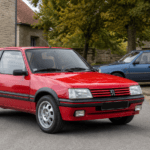
The Peugeot 205 GTI DIMMA became one of the defining wide-body hot hatches of its era. Its dramatically extended arches echoed the Group B 205 Turbo 16, but genuine DIMMA road cars, dealer-approved conversions and later replicas are not all the same thing.
What is a Peugeot 205 GTI DIMMA?
The conversion replaced the standard car’s restrained wheelarch treatment with much wider front and rear arches, deeper bumpers and sill extensions. The visual reference was obvious: the mid-engined, four-wheel-drive 205 Turbo 16 rally car. Underneath, however, most DIMMA conversions remained based on the conventional front-engined, front-wheel-drive 205 GTI.
That distinction matters. “DIMMA” describes the body conversion and its provenance; it does not automatically imply a particular engine output, four-wheel drive or factory T16 mechanical specification.
DIMMA, T16 and ordinary GTI compared
| Model | What it is |
|---|---|
| 205 GTI | Peugeot’s production front-engined hot hatch in 1.6- and 1.9-litre forms |
| 205 GTI DIMMA | A 205 GTI fitted with DIMMA’s wide-body conversion; mechanical specification varies |
| 205 Turbo 16 | A separate mid-engined, four-wheel-drive Group B homologation model |
| DIMMA-style replica | A car using copied, alternative or unidentified wide-body components |
How to identify a genuine DIMMA conversion
Authentication is a chain of evidence, not a single badge. Start with invoices for the kit and installation, period photographs and correspondence. Establish who supplied and fitted the panels and when. Check whether identifying marks, construction details and component shapes agree with documented DIMMA products, while remembering that cars may have been repaired or altered over several decades.
- Match the base car’s VIN, engine and build date to its documents.
- Look for DIMMA invoices, fitting records and historic photographs.
- Inspect the inside of panels and mounting work, not merely the exterior finish.
- Check wheel and suspension clearance through full steering and suspension travel.
- Confirm that body and mechanical modifications are declared to the insurer.
When documentation is incomplete, describe the car conservatively as DIMMA-bodied or DIMMA-style until a marque specialist can verify it.
Mechanical specifications vary
Standard-engine cars
Some conversions retained the original 1.6 or 1.9 GTI drivetrain. Their value lies in the period bodywork and quality of execution rather than additional power.
Turbo and engine conversions
Others gained turbocharging, alternative Peugeot engines or later powerplants. These should be judged as individual engineered builds, with receipts and technical detail.
Wider wheels increase loads and can reveal poor geometry or tired suspension. A powerful engine does not compensate for an ageing shell, inadequate brakes, weak cooling or badly chosen tyres.
What to check before buying
- Shell: inspect sills, floors, inner wings, suspension mounts and boot floor for corrosion and accident repair.
- Body kit: look for cracking, distortion, moisture traps, weak joins and mismatched panel gaps.
- Rear beam: check for inward-leaning rear wheels, noise and uneven tyre wear.
- Wheels and tyres: verify condition, age, correct load rating, rubbing and availability of unusual sizes.
- Cooling and engine: demand maintenance evidence and assess every non-standard component.
- Identity: ensure the V5C, VIN, engine details, modification history and insurance declaration agree.
A sound, well-documented conversion is generally a better prospect than a cosmetically striking car with unknown origins. Recreating missing bespoke trim and correcting badly bonded panels can consume substantial time and money.
Frequently asked questions
Did Peugeot approve the DIMMA kit?
Peugeot’s heritage material states that the polyester wide-body kit was approved by Peugeot in 1989 and available for 1.6- and 1.9-litre 205 GTIs.
Are all wide-body Peugeot 205s genuine DIMMAs?
No. Other kits, copies and one-off modifications exist. Provenance and construction evidence are essential.
Was every DIMMA turbocharged?
No. Body conversion and engine specification are separate questions; many cars retained a normally aspirated GTI engine.
Is a DIMMA a replica 205 T16?
Its appearance was T16-inspired, but a conventional DIMMA conversion does not reproduce the T16’s mid-engine, four-wheel-drive architecture.
Research note: Peugeot approval date and original engine compatibility were checked against official Peugeot and Stellantis heritage material. Individual conversions vary and should be authenticated from their own documentary and physical evidence.