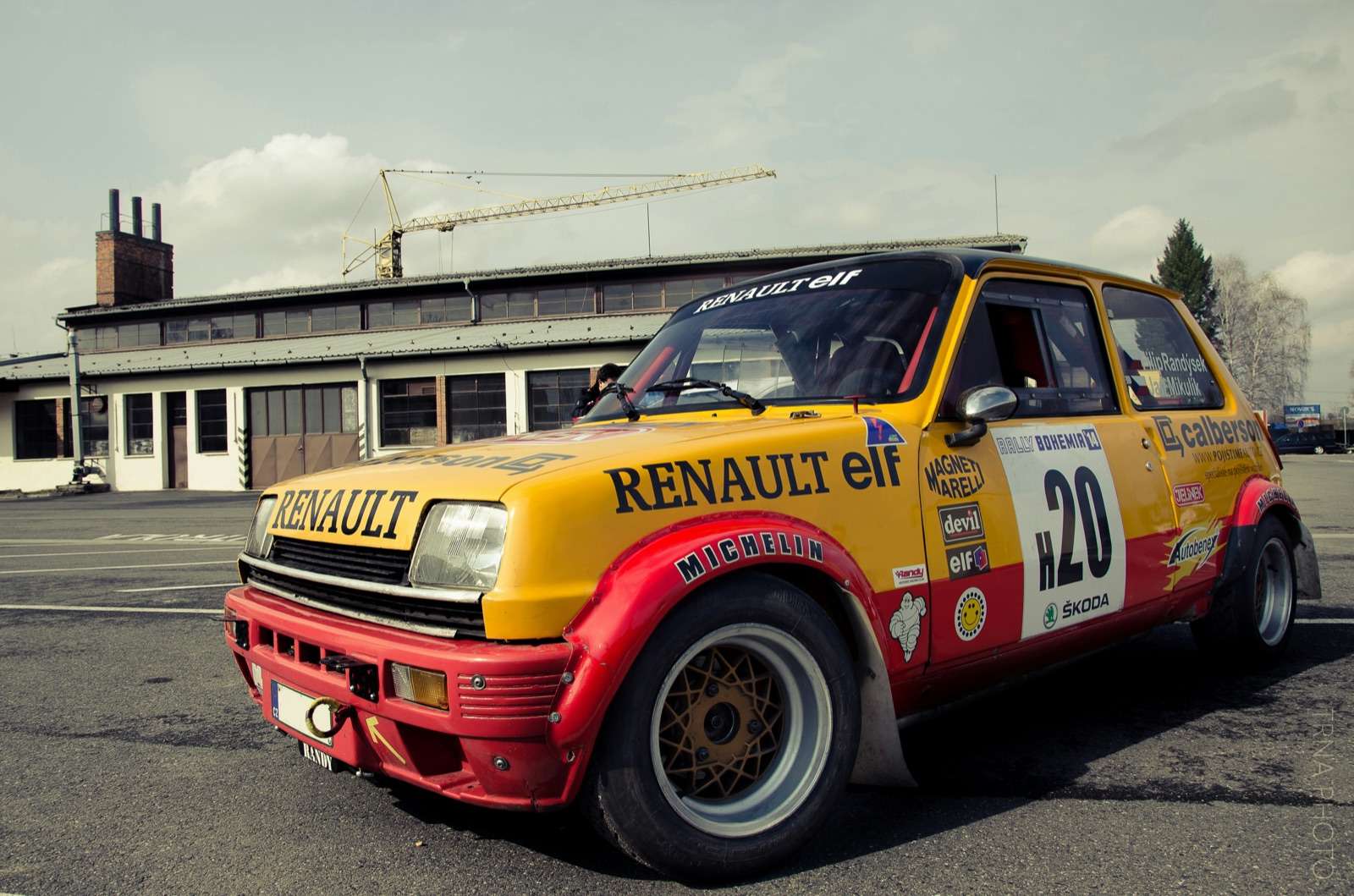
The Renault 5 Turbo wore the outline of France’s friendly little supermini, but almost everything important had been rearranged. Its engine sat behind the seats, power went to the rear wheels and rallying shaped the entire machine.

1. It is not the same car as the later GT Turbo
The front-engined, front-wheel-drive Renault 5 GT Turbo was a rapid hot hatch. The earlier Renault 5 Turbo was a far more exotic homologation car with its engine mounted longitudinally behind the front seats and drive sent to the rear wheels.
2. The public first saw the idea in 1978
Renault displayed a dramatic prototype at the 1978 Paris Motor Show. Production cars followed in 1980, created to take Renault back into top-level international rallying with a compact machine tailored to the job.
3. Three French specialists helped build it
Standard Renault 5 shells began at Flins, body specialist Heuliez carried out major structural work, and Alpine at Dieppe completed assembly. That complicated route helps explain why it never became an ordinary high-volume model.
4. Its tiny engine made 160 horsepower
The 1,397cc Cléon-Fonte four-cylinder used Bosch mechanical fuel injection and a Garrett turbocharger to produce about 160 PS in road form—remarkable output from a sub-1.4-litre engine in 1980.
Love cars you don’t see every day?
Get forgotten cars, surprising motoring stories and the most interesting finds from Unusual Cars by email.
Free to join. No spam. Unsubscribe whenever you like. See our Privacy Policy.
5. The rear seat was sacrificed completely
Opening the hatch revealed luggage space above the powertrain, but there was no rear bench. The engine, five-speed transaxle and cooling hardware occupied the centre and rear of the shell, turning a family hatchback shape into a two-seat sports car.

6. “Turbo 1” was never its official original name
Enthusiasts commonly call the first version Turbo 1 to distinguish it from the later Turbo 2. Renault originally sold it simply as the Renault 5 Turbo. It featured aluminium doors and roof, distinctive Bertone-designed interior trim and more expensive bespoke parts.
7. The Turbo 2 was designed to cost less
Introduced for 1983, the Turbo 2 retained the mid-engined layout and performance but substituted more ordinary Renault 5 components and steel body panels where possible. It made the car cheaper to manufacture without removing its essential character.
8. It won the Monte Carlo Rally
Jean Ragnotti and Jean-Marc Andrié won the 1981 Monte Carlo Rally in a Renault 5 Turbo. That victory proved the radical layout worked before four-wheel drive changed the sport’s competitive order.
9. Competition versions became increasingly wild
Group 4 cars evolved through Tour de Corse specification, while the Group B Maxi 5 Turbo eventually produced roughly 350 horsepower with extreme bodywork and sophisticated suspension. Ragnotti won the 1985 Tour de Corse in one.
10. Fewer than 5,000 road cars were built
Renault records total production of 4,857 cars across the original Turbo and Turbo 2. That rarity, combined with its rally success and outrageous proportions, has made it one of the most collectible Renaults ever made.
Keep exploring
Read our full Renault 5 Turbo guide, or browse the 10 Things hub.
Love cars you don’t see every day?
Get forgotten cars, surprising motoring stories and the most interesting finds from Unusual Cars by email.
Free to join. No spam. Unsubscribe whenever you like. See our Privacy Policy.
Sources and further reading
- Renault Group heritage archive
- Renault Classic competition records
- FIA historic rally documentation