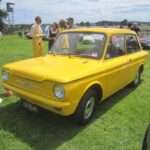
The Hillman Hunter was the durable heart of Rootes Group’s Arrow range: a conventional rear-wheel-drive family car whose long life stretched from 1966 into the Chrysler era. It won the 1968 London–Sydney Marathon, spawned everything from fleet saloons to the twin-carburettor GLS, and continued in Iranian production for decades as the Paykan. In Britain, however, the once-common Hunter has become a genuinely scarce classic.
At a glance
- UK production: 1966–1979
- Body styles: four-door saloon and five-door estate
- Engines: 1496cc and 1725cc Rootes overhead-valve fours
- Layout: front engine, rear-wheel drive
- Gearboxes: four-speed manual, optional overdrive and automatic on selected models
- Related Arrow cars: Singer Vogue, Humber Sceptre, Sunbeam Rapier and Alpine
- International legacy: Iran’s Paykan
The Arrow programme
Rootes developed the Arrow family to replace its ageing Audax-generation saloons with something lighter, cleaner and cheaper to manufacture. The Hunter was the central Hillman version. Its understated body used a modern monocoque structure but retained familiar mechanical ingredients: a longitudinal four-cylinder engine, rear-wheel drive, MacPherson-strut front suspension and a live rear axle on leaf springs.
The formula was conservative, yet the result was spacious, easy to understand and well suited to British roads. The 1496cc engine served early and lower-priced versions, while the 1725cc unit provided the torque most buyers expected from a medium family car. Estates added useful capacity without altering the Hunter’s straightforward character.

London–Sydney victory
The Hunter’s defining competition result came in the 1968 London–Sydney Marathon. Andrew Cowan, Colin Malkin and Brian Coyle won the gruelling event in a works-entered Hunter, surviving more than 10,000 miles across Europe, Asia and Australia. The victory did not turn the road car into a homologation special, but it gave Rootes powerful evidence of the design’s stamina and created one of the marque’s most important sporting stories.
Replica marathon cars exist and are popular in historic events. Buyers should distinguish those tributes from cars with genuine period competition history, which require documentary proof.
Range, GT and GLS
Hunter trim evolved through Deluxe, Super and higher-specification forms. The sporting GT used a twin-carburettor 1725cc engine, additional instruments and appropriate trim. The later GLS combined the Arrow shell with the more powerful engine specification associated with the Humber Sceptre, delivering roughly 93bhp and often overdrive. It was a discreet, capable sports saloon rather than an aggressively styled performance car.
Frequent grille, lamp and trim changes reflected shifting Rootes and Chrysler identities. The Hillman name continued on the Hunter longer than on the Avenger, although late production increasingly reflected Chrysler’s rationalisation. British manufacture ended in 1979. In Iran, locally built Paykans kept Arrow-derived engineering in production into the twenty-first century, making the design’s international lifespan extraordinary.

UK specifications
| Version | Engine | Typical output | Character |
|---|---|---|---|
| Hunter 1500 | 1496cc OHV four | About 54bhp | Economical entry model |
| Hunter 1725 | 1725cc OHV four | About 61–74bhp | More useful torque for everyday driving |
| Hunter GT | Twin-carburettor 1725cc | About 79bhp | Sporting trim and stronger acceleration |
| Hunter GLS | Twin-carburettor 1725cc | About 93bhp | Fastest and best-equipped mainstream version |
Figures vary with year, compression ratio, carburettor specification and market. Many cars have also gained replacement engines or carburettors, so numbers and casting details matter when originality is claimed.
What is it like to drive?
A well-maintained Hunter is easy to place, rides comfortably and feels pleasantly balanced. The steering is not especially quick, but it communicates more clearly than many later family cars. A standard 1725 has enough low-speed pull for relaxed B-road progress, while overdrive makes a major difference to cruising refinement. The 1500 works harder and is best accepted on its own terms.
GT and GLS versions have the pace to exploit the chassis without overwhelming it. Body roll and modest brakes set sensible limits, but the car’s predictability was part of its rally success. An estate makes a particularly appealing practical classic, provided its rear structure is sound.
Hillman Hunter buying guide
Rust and structure
Check the front chassis legs, suspension turrets, inner and outer sills, floor edges, bulkhead, wheelarches and rear spring hangers. Inspect the boot floor and fuel-tank area, and examine estate tailgates and rear quarters carefully. Water can collect around windscreens and hidden seams. Fresh paint should never substitute for photographs or invoices showing how structural repairs were completed.
Engine and cooling
The Rootes 1725 is durable when serviced but can suffer from oil leaks, cooling-system neglect, timing-chain noise and worn valve gear. Watch for blue smoke, low hot oil pressure, coolant loss and mayonnaise beneath the filler cap. Twin-carburettor cars need correct setup; poor balance or air leaks can make a healthy engine seem troublesome.
Transmission and axle
Listen for gearbox bearing noise and differential whine. Overdrive should engage cleanly once warm; electrical faults are common, but slipping can indicate more expensive wear. Check clutch operation, propshaft joints and rear-axle location. Automatics should select promptly and change without flare.
Suspension, brakes and trim
Worn front joints and bushes produce vague steering, knocks and uneven tyres. Seized brake components are common after storage. Hunter-specific exterior trim, dashboards, lamps and good seat material can be harder to obtain than service items, especially for a GLS or early car. Verify badges and equipment before paying for a rare specification.

Ownership and values
The Hunter’s uncomplicated engineering makes it a friendly ownership proposition. Rootes specialists and owners’ clubs are important sources for advice and less obvious components. Engine, ignition and braking consumables are generally manageable; model-specific panels and trim require patience.
Ordinary saloons remain affordable when they appear, but the cheapest car can become costly if corrosion is advanced. Estates, GTs, GLS models and cars with documented period history command more. A genuine London–Sydney works car is in another category entirely; replicas should be valued for build quality, not assumed provenance.
Why the Hunter matters
The Hunter succeeded because it did the basics well. It was neither revolutionary nor glamorous, yet it was durable enough to win an intercontinental marathon, flexible enough to support an entire family of Rootes models and simple enough to be produced abroad for generations. Its disappearance from ordinary British roads now makes a sound example far more unusual than many more exotic classics.