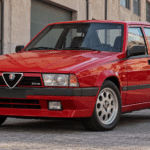
The Alfa Romeo 164 was a sharply dressed executive saloon with one of the finest-sounding V6 engines of its era. In Cloverleaf form it became a front-wheel-drive express; as the exceptionally rare Q4 it gained electronically managed four-wheel drive and a six-speed gearbox.
Here are ten details behind the fastest and most sophisticated 164s.
1. It shared a development programme with three very different cars
The 164 emerged from the Type Four programme that also produced the Fiat Croma, Lancia Thema and Saab 9000. The cars shared broad hard points and development economies, but the Alfa received its own Pininfarina body, chassis tuning and distinctive sporting character.
2. Enrico Fumia’s shape was drawn at Pininfarina
The low nose, rising waistline and neatly integrated boot were remarkably modern in 1987. The design lasted a decade with only careful facelifts, proving that the 164’s appeal was not dependent on spoilers or decorative excess.

3. The Cloverleaf came before the Q4
The 3.0 V6 Quadrifoglio—often called Cloverleaf in Britain—arrived as the high-performance front-wheel-drive model. Early 12-valve cars produced about 200PS; the later 24-valve Quadrifoglio developed 232PS and became the basis for the all-wheel-drive Q4.
4. The Busso V6 was mounted transversely
Alfa’s all-alloy 60-degree V6 sat across the engine bay rather than longitudinally. In 24-valve form it used four camshafts and produced its power high in the rev range, while polished intake runners made the engine bay almost as memorable as the exhaust note.
Love cars you don’t see every day?
Join the Unusual Cars Club for new “10 Things” articles, forgotten cars and surprising motoring stories by email.
5. The Q4 used an electronically controlled viscous coupling
The permanent four-wheel-drive system varied torque distribution between the axles through an electronically managed viscous unit, while a Torsen differential controlled the rear. It was unusually sophisticated for a 1993 executive saloon and substantially more complex than the front-drive Cloverleaf.
6. Every Q4 had a six-speed manual gearbox
Alfa paired the 232PS V6 with a Getrag six-speed transmission; no automatic Q4 was offered. The car also received electronically adjustable dampers and ventilated rear discs, making it a complete flagship rather than a normal 164 with an extra propshaft.
7. The Q4 was slightly slower than the lighter Cloverleaf
Extra transmission hardware pushed weight significantly upwards. Official figures put the Q4 at about 7.9 seconds to 100km/h and 237km/h, while the 24-valve front-drive Quadrifoglio was lighter and capable of roughly 245km/h. Traction and all-weather ability were the Q4’s advantages.
8. Only 1,406 Q4s were produced
Alfa Romeo’s historical production data records 1,406 examples. They were left-hand drive only, so any British-market car will be an import. Rarity, transmission complexity and unique components make documentary history and specialist inspection essential.

9. Its mechanical ideas helped inspire the Scighera concept
Italdesign’s extraordinary 1997 Scighera concept used an Alfa V6 developed with twin turbochargers and four-wheel drive related in concept to the 164 Q4. The aluminium-and-composite supercar never reached production, but it showed how exotic the Q4 hardware could become.
10. Alfa also built a V10-powered 164 silhouette
The 1988 164 Pro-Car looked like an enlarged production saloon but hid a mid-mounted 3.5-litre Formula One-style V10 and composite racing chassis. The proposed series collapsed before it could race, leaving the one-off as a spectacular reminder that almost nothing about a fast 164 is quite ordinary.
Research basis: Alfa Romeo/Stellantis heritage specifications, Museo Storico Alfa Romeo records and period technical data.
Continue exploring: Visit the complete 10 Things hub or browse the Alfa Romeo archive.