
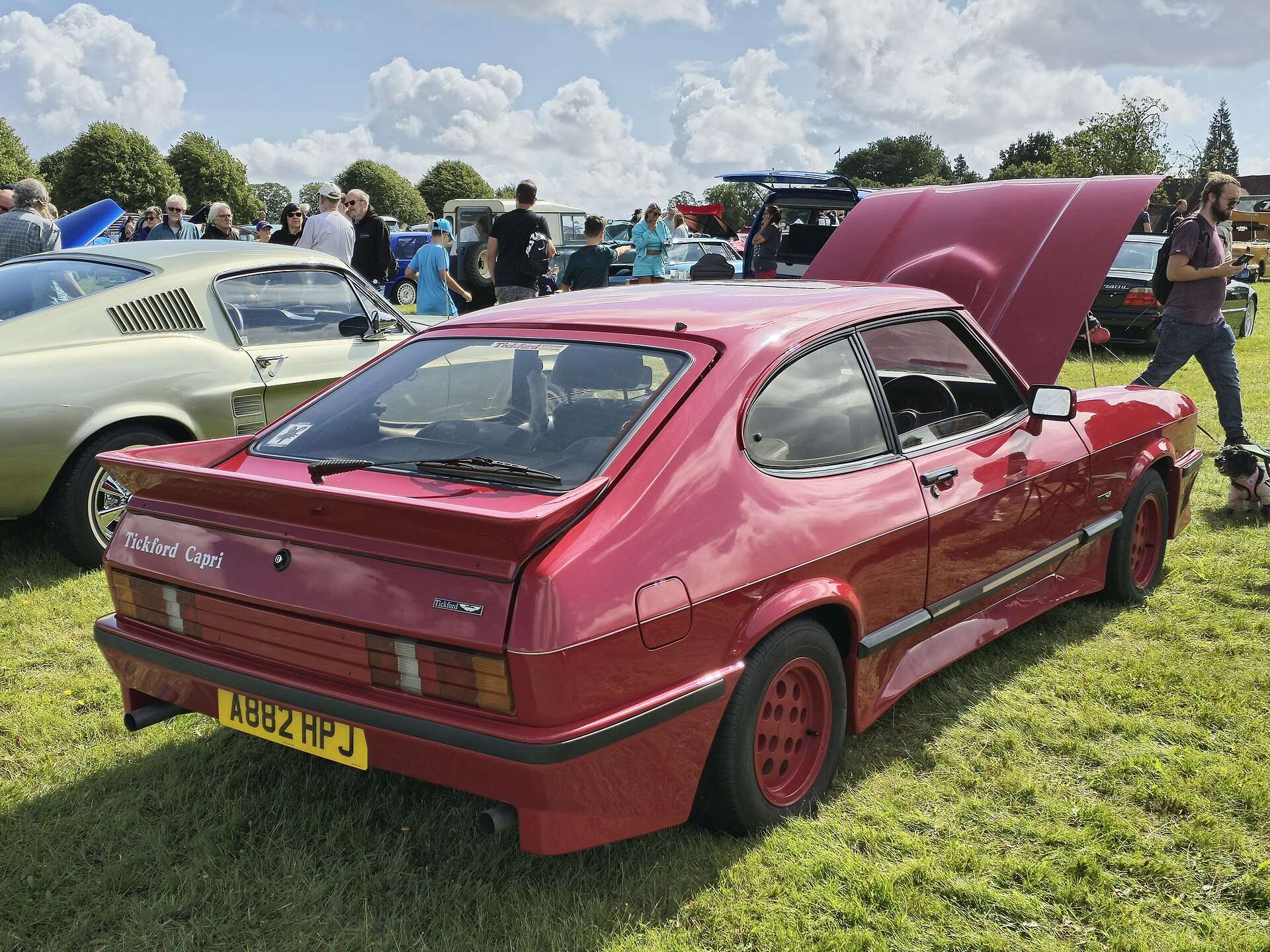
The Tickford Capri was what happened when Aston Martin’s engineering offshoot treated Ford’s ageing coupé like a hand-built grand tourer. It cost almost exotic-car money, received a turbocharged V6 and required hundreds of hours of specialist work.
Here are ten details that separate the real Tickford from an ordinary turbo conversion.
1. The idea began with former Formula One driver John Miles
Miles bought a 3.0-litre Capri from Ford’s press fleet in 1981 and used it as a rolling development car, covering more than 25,000 miles. He believed the Capri could remain credible if its engine, chassis and refinement were developed as one package.
2. Tickford was Aston Martin’s engineering subsidiary
Aston Martin created Aston Martin Tickford in 1981 to sell engineering expertise. The name came from the historic Newport Pagnell coachbuilder acquired by David Brown in the 1950s. The Capri became a conspicuous calling card for that new consultancy.

3. Ford and Tickford initially shared development costs
The project grew from discussions involving Miles, Aston Martin chairman Victor Gauntlett and senior Ford figures including Bob Lutz. Ford contributed to prototype development before withdrawing direct commercial support in 1984, leaving Tickford to continue independently.
4. Its 2.8-litre V6 produced about 205bhp
Tickford added a turbocharger, intercooling and revised fuel and ignition control to the Capri 2.8 Injection’s Cologne V6. Output rose from roughly 160bhp to about 205bhp, with period claims of 0–60mph in around 6.5 seconds and a top speed close to 140mph.
Love cars you don’t see every day?
Join the Unusual Cars Club for new “10 Things” articles, forgotten cars and surprising motoring stories by email.
5. It received rear disc brakes
Tickford did not expect the standard chassis simply to absorb the extra speed. Rear discs, revised front brakes, suspension changes and improved axle location formed part of a complete conversion. Early cars could also receive a special differential before Ford made a limited-slip unit standard on later donor cars.
6. The body kit was functional as well as dramatic
The blanked grille, deep front spoiler, side skirts, flared arches and large rear spoiler gave the Capri a bespoke identity and addressed high-speed lift. Simon Saunders—later creator of the Ariel Atom—is widely associated with the styling work.
7. Wind noise was treated like an engineering fault
Tickford considered the ordinary Capri too noisy at sustained high speed and added extra sealing around the window frames. That small detail captures the project’s intent: this was meant to be a refined 140mph grand tourer, not merely a boost-heavy drag-strip conversion.

8. Around 200 hours could be spent on each car
Contemporary accounts describe roughly 200 man-hours of conversion work. Even reshaping the bonnet to sit correctly against the solid Vantage-style grille could consume several hours. Bespoke leather, carpeting, veneer and customer-selected trim pushed the experience far beyond a normal Ford.
9. Planned production and completed production are not the same
Tickford hoped for about 250 cars and some accounts refer to a round 100, but respected histories place fully completed production in the mid-80s. Different totals may count donor cars and incomplete conversions differently, so provenance is more valuable than a confident internet number.
10. A Turbo Technics Capri is not a Tickford
Turbo Technics, Janspeed and others produced quick turbocharged Capris, but the Tickford combined its own bodywork, cabin, brakes, suspension and development programme. A turbocharger or replica body kit cannot establish identity; a genuine car needs convincing Tickford history.
Research basis: Tickford Owners Club archives, contemporary Motor Sport reporting and established Ford Capri histories.
Read more: Read our full Tickford Capri history, then visit the 10 Things hub.