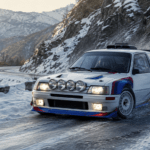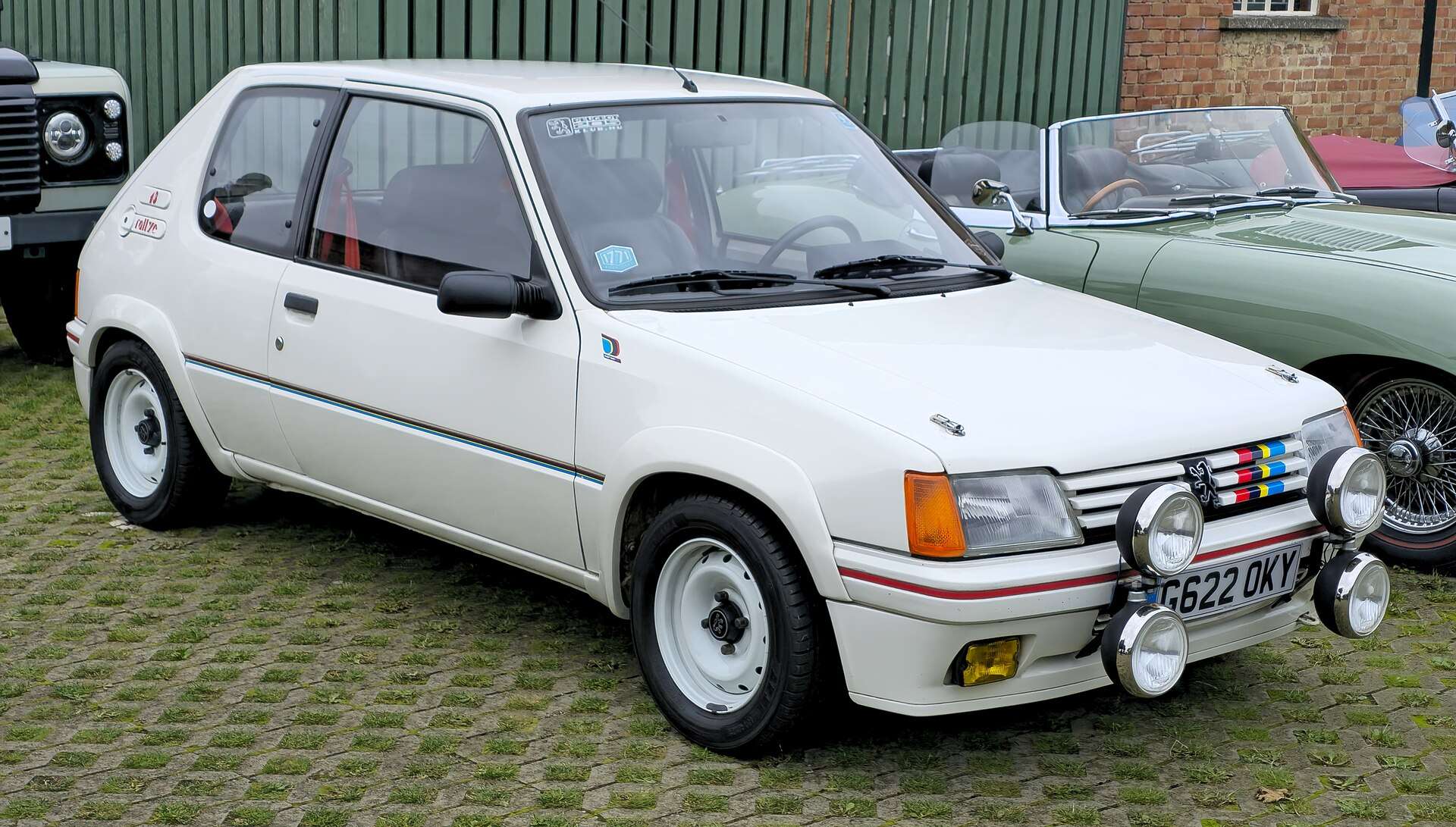
The Peugeot 205 Rallye was not a cheaper GTI with a sticker kit. The original continental European version was a stripped, carburettor-fed homologation special designed for sub-1,300cc competition—and its lack of luxury was precisely the point.
1. It was created around a competition class
Peugeot launched the 205 Rallye in 1988 so that the little hatchback could be homologated for Group N and Group A competition below 1,300cc. The FIA records its 1,294cc homologation under number 5366, giving the road car a genuine sporting purpose.
2. Its engine was not borrowed from the 205 GTI
The TU24 engine was a 1,294cc development with a much more aggressive character than an ordinary 205. It used twin Weber carburettors and produced about 103PS—serious output for such a small naturally aspirated production engine in the late 1980s.
3. Two twin-choke Webers gave it four intake throats
Open the bonnet and the carburettors dominate the view. Their noise and instant throttle response became central to the Rallye experience, but correct balancing and setup require knowledge. A badly adjusted example can run far less sweetly than Peugeot intended.
4. It weighed less than 800kg
Peugeot removed sound insulation and unnecessary equipment, used simple trim and kept the specification deliberately sparse. At roughly 790kg, the Rallye needed no huge power figure: its power-to-weight ratio and lack of inertia made it feel vivid on a narrow road.
Love cars you don’t see every day?
Get forgotten cars, surprising motoring stories and the most interesting finds from Unusual Cars by email.
Free to join. No spam. Unsubscribe whenever you like. See our Privacy Policy.
5. White was part of the identity
The best-known 1.3 Rallye came in white with white steel wheels, Peugeot-Talbot Sport stripes and small Rallye graphics. The red, blue and yellow detailing linked the road car visually with Peugeot’s competition department without pretending it was a 205 Turbo 16.
6. Its wheelarches were simpler than a GTI’s
Unlike the GTI, the Rallye did without the familiar black plastic arch extensions and much of the visual equipment buyers normally associated with an expensive hot hatch. That pared-back appearance is now one of its most distinctive qualities.
7. Close ratios helped keep the engine alive
The little engine delivered its best work high in the rev range, so the gearbox used close ratios to keep it there. The result demanded more participation than a torquey GTI but rewarded a driver prepared to use the gear lever and exploit the light chassis.
8. Britain received a different Rallye
The UK-market 205 Rallye was not mechanically identical to the celebrated left-hand-drive 1.3. British cars used a less exotic 1.4-litre engine and were closer to a lively special edition. That distinction matters enormously when adverts simply describe a car as a “205 Rallye”.
9. Peugeot planned a homologation run, then demand grew
The model began with competition numbers in mind, but enthusiasm for the lightweight formula encouraged Peugeot to build far more than the initial requirement. Even so, corrosion, competition use and hard road lives mean good original 1.3 cars are now scarce.
10. It established a formula Peugeot repeated
The later 106 Rallye followed the same philosophy: low weight, minimal equipment, modest capacity and maximum involvement. In an age when performance models continually become heavier and more complex, the 205 Rallye feels increasingly radical.
Would you choose the raw Rallye or the more usable 205 GTI? Explore every 10 Things article in the Unusual Cars hub →