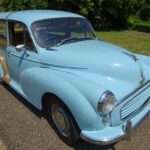
The Morris Oxford Series VI was one of the final and most developed members of BMC’s Farina-styled family-car range. Sold in Britain from 1961 until 1971, it combined a roomy traditional saloon body with the dependable 1.6-litre B-Series engine. Once a familiar sight, the Oxford has become far less common than many sportier British classics.
Morris Oxford Series VI at a glance
| UK production | 1961–1971 |
|---|---|
| Body styles | Four-door saloon and Traveller estate |
| Engine | 1,622cc BMC B-Series four-cylinder |
| Drive | Rear-wheel drive |
| Gearboxes | Four-speed manual; Borg-Warner automatic optional |
| Key buying concern | Structural corrosion and incomplete trim |
What was the Morris Oxford Series VI?
The Oxford name had appeared on Morris cars for decades, but the Series VI belonged to the family of BMC saloons styled by Pininfarina. It replaced the Series V and shared its basic engineering and body architecture with the Austin Cambridge, MG Magnette, Riley 4/72 and Wolseley 16/60. The Morris sat near the practical centre of that range rather than attempting the more sporting or luxurious character of its relatives.
Compared with the Series V, the Series VI gained revised front and rear styling, a new grille and dashboard changes. Its 1,622cc B-Series engine offered a useful improvement over the earlier 1.5-litre unit. A column-change manual with a front bench seat remained available, giving the Oxford a particularly period character, while an automatic transmission appealed to buyers wanting easier family motoring.
Saloon, Traveller and diesel versions
The four-door saloon formed the heart of the range. The Oxford Traveller estate offered considerably more carrying space and is now especially scarce. BMC also marketed a diesel Oxford. Initially aimed mainly at export and commercial use, the diesel reached the British market during the early 1960s. Its performance was modest, but economy and durability mattered more to its intended customers.
The Series VI stayed in production unusually late, surviving until 1971. By then its upright styling and separate front and rear suspension layout felt traditional beside newer front-wheel-drive BMC models. The Morris Marina ultimately replaced it, although the Oxford’s spacious cabin and mechanical simplicity retained a loyal following.
How does a Morris Oxford Series VI drive?
An Oxford is best enjoyed as a relaxed classic rather than a fast one. The B-Series engine delivers useful low-speed torque, the ride is comfortable and the steering has the deliberate feel expected of a substantial early-1960s saloon. Drum brakes and modest acceleration demand anticipation in modern traffic. A well-maintained car should nevertheless cruise happily on ordinary A-roads.
Manual cars may have a column or floor gear change depending on specification. Wear in the column linkage can make selection vague, while neglected synchromesh and clutch components make a test drive important. Automatic cars require smooth engagement and evidence of correct servicing.
Morris Oxford Series VI buying guide
Body and structure
- Inspect the sills, jacking points, floor edges and chassis-strengthening sections.
- Check front suspension mountings, inner wings and the bulkhead for corrosion or old plating.
- Examine rear spring hangers, boot floor, wheelarches and the area around the fuel tank.
- Look beneath door seals and window rubbers for bubbling and water damage.
- On a Traveller, inspect the tailgate, load floor and rear body structure particularly carefully.
Fresh paint can conceal extensive repairs. Uneven panel gaps, thick underseal and overlapping welded plates deserve closer investigation. A structurally sound but cosmetically tired Oxford is usually a safer basis than a shiny car with undocumented restoration work.
Engine, cooling and transmission
- Start the engine from cold and listen for bearing rumble, timing-chain noise and persistent valve clatter.
- Check for blue exhaust smoke, low oil pressure and heavy crankcase breathing.
- Inspect the radiator, hoses, water pump and core plugs; overheating can damage the cylinder head gasket.
- Test every gear and listen for differential and propshaft noise.
- On automatics, check fluid condition and ensure engagement is prompt without flaring between ratios.
Suspension, steering and brakes
Wear in kingpins, bushes, steering joints and wheel bearings can make the car wander. Check that the lever-arm dampers are not leaking and that the car sits level. The all-drum braking system must be correctly adjusted and should stop the car squarely; pulling, long pedal travel or fluid leaks require attention.
Interior and originality
Mechanical parts are generally easier to find than model-specific trim. Check the grille, brightwork, instruments, switches, seats and door furniture are present and correct. A missing rare moulding or damaged dashboard can be more troublesome than a routine engine repair.
Which Oxford should you buy?
A sound 1.6-litre manual saloon is the simplest choice for regular classic use. An original automatic, Traveller or diesel is rarer and potentially more interesting, but condition and completeness should take priority over specification. Verify chassis details and history rather than relying solely on badges, because parts have often been exchanged between related Farina models.
Frequently asked questions
Is the Morris Oxford Series VI the same as an Austin Cambridge?
They are closely related BMC Farina models and share much of their engineering, but their badges, grille treatment, trim and some specification details differ.
What engine does the Oxford Series VI use?
Most petrol cars use the 1,622cc BMC B-Series four-cylinder engine. A diesel version was also offered.
What is the main problem when buying one?
Structural corrosion is the greatest risk. Have the underside and suspension mounting areas inspected before agreeing a price.