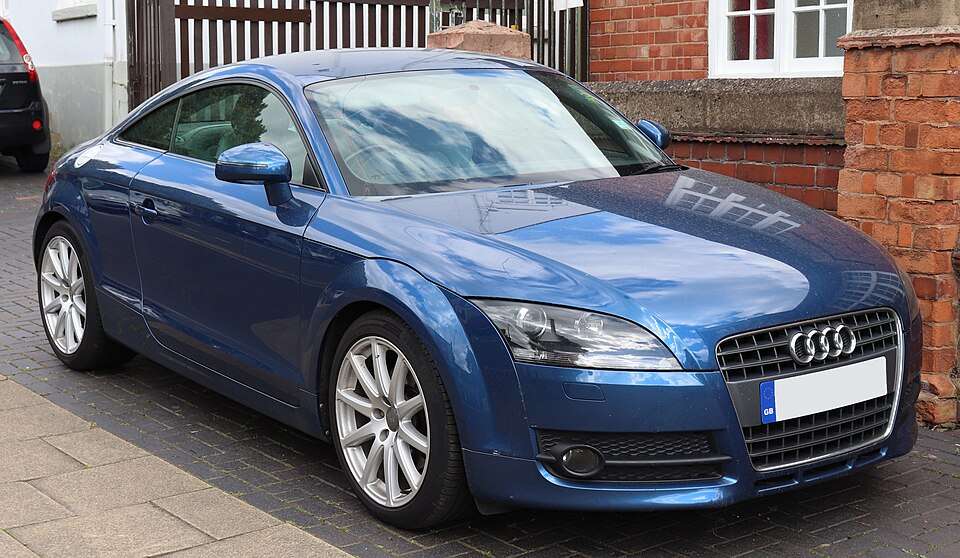
The second-generation Audi TT combines a distinctive aluminium-intensive body with useful everyday refinement and a wide choice of powertrains. That variety is also the trap for used buyers: one badge can cover different engines, timing systems, transmissions and driveline maintenance. This guide helps you identify the right 8J, inspect its expensive details and build a realistic first-year budget.
Our buying verdict
For most buyers we would shortlist a well-documented 2.0 TFSI Coupé with the engine code established and the appropriate timing, oil-use and gearbox checks completed. An early belt-driven car can make sense with strong maintenance evidence; a later car needs its own chain-system assessment. Choose quattro, TTS or a Roadster because you want their abilities and can fund the extra maintenance, not because the asking price resembles a simpler TT.

Choose the engine and body before choosing the badge
Audi’s historical archive dates the second generation from 2006 and the third generation from 2014. The 8J Coupé and Roadster therefore overlap different registration years and equipment updates. Confirm the VIN, build date, engine code, gearbox code, original market and driveline before comparing cars. A 2014 registration alone cannot establish which generation is being advertised.
| Version | Buying appeal | Essential distinction |
|---|---|---|
| Early 2.0 TFSI, generally 200PS | Accessible performance and a widely supported powertrain. | EA113 belt-driven main timing system plus short cam-chain/follower checks. |
| Later 2.0 TFSI, generally 211PS | Revised specification and an appealing daily proposition. | EA888 chain system and oil-use assessment; verify engine code. |
| 1.8 TFSI | A lower-output alternative for buyers prioritising condition and running costs. | Its engine-specific chain and consumption checks still matter. |
| 3.2 quattro | Naturally aspirated six-cylinder character. | Chain condition, cooling and driveline evidence; no generic four-cylinder belt kit. |
| 2.0 TDI quattro | Can suit substantial regular mileage. | Diesel belt/emissions-system assessment and journey suitability. |
| TTS | A distinct higher-performance four-cylinder model. | Its EA113-family maintenance, brakes, dampers and quattro need separate costing. |
| TT RS / RS plus | Five-cylinder performance and a different market. | Requires a dedicated specialist assessment beyond this ordinary-TT guide. |
The labels above are a way to organise your shortlist, not a substitute for identifying the actual engine. Do not decide timing-belt versus chain requirements solely from a registration cutoff. Some sellers use TFSI and TSI loosely, and TTS is not simply an S line trim. S line and Black Edition equipment also vary: verify seats, lighting, wheel size and suspension through the original build record.
A front-wheel-drive 2.0 TFSI avoids Haldex servicing because it does not have the rear coupling. A quattro car adds traction and maintenance hardware. The badge alone is insufficient proof of a functioning system. Manual and S tronic options need their own test and service evidence; identify the actual transmission before quoting fluids or parts.
The Coupé offers a useful hatch and occasional rear accommodation, but try the seating and luggage space rather than imagining a full four-seat family car. The two-seat Roadster adds roof mechanisms, seals and drainage checks. A low price does not make a roof fault a minor inconvenience: obtain a specialist diagnosis before purchase.
TT Mk2 prices: keep variants separate
Parkers’ 2011 TT advertisements checked on 4 November 2026 included a 2.0 TFSI Sport Coupé manual with 100,000 miles at £3,980; a 2.0 TFSI S line Coupé manual with 98,000 miles at £5,395; a 2.0 TFSI Sport Coupé S tronic with 65,000 miles at £6,995; a Black Edition Coupé S tronic with 88,323 miles at £7,495; and a quattro S line Coupé S tronic with 54,000 miles at £8,490.
The same page also included diesel Roadsters, a TTS Roadster S tronic advertised at £9,050 with 79,947 miles, and a TT RS Coupé S tronic at £18,995 with 37,919 miles. Those are different buying propositions, not extra data points to average into an ordinary 2.0 TFSI valuation. Descriptions are the sellers’ claims and need independent verification.
Revisit the live listings before negotiating. The examples are dated asking prices from a dealer-advert page, not achieved sale results or a nationwide valuation model. Compare body, engine, drive layout, transmission, history and accident record before mileage alone.
An attractive TT can need timing work, tyres, brakes, window repairs and suspension attention together. For a Roadster, add any roof or water-entry work; for quattro, add missing Haldex evidence. Obtain written complete-job estimates and compare the total purchase-and-repair cost with a car whose maintenance is already documented. Expensive-looking options can also mean expensive replacements.

Aluminium body repairs, corrosion and water entry
The 8J’s mixed-material, aluminium-intensive construction makes accident-repair quality especially important. A magnet is not a reliable way to assess every panel. Use a body specialist familiar with the model where gaps, paint, distortion or repair history raise questions. A cheap cosmetic estimate may not cover the correct structural repair method.
Match VIN and paperwork, establish the seller’s right to sell, and check finance, theft and recorded damage. Compare MOT and service mileages. A clear database result does not rule out privately funded repairs. Inspect headlamp supports, bumper fit, bonnet alignment, wing fasteners and paint edges; ask for invoices and preparation photographs for disclosed work.
On a lift, inspect jacking points, sill areas, floor edges, subframes, suspension mounts, brake pipes and exhaust supports. Look for impact marks from lowering or poor lifting, corrosion on steel components, damaged fixings and leaks concealed by undertrays. Different materials do not remove the need for an underside inspection.
Lift the Coupé’s boot floor, check carpets and examine the tailgate and lamp areas for moisture. On a Roadster, inspect roof fabric, rear-window attachment, seals, drainage and dampness behind seats and in storage areas. Test the roof through a complete normal cycle using the correct operating procedure. Repeated hesitation, warning messages or water entry need specialist diagnosis rather than a promise that a sensor reset will fix them.
Timing systems, cooling, quattro and suspension
Start with the engine code and the corresponding invoices. For an early EA113 2.0 TFSI or TTS, establish cambelt and water-pump history, the short cam-chain/tensioner condition and high-pressure fuel-pump follower inspection. R-Tech’s first-party EA113 guidance explains why a worn follower can damage more expensive components. Do not confuse that follower with a timing-belt tensioner or assume all TFSI engines share the same arrangement.
For an EA888 1.8 or later 2.0 TFSI, arrange a specialist timing-chain assessment covering the actual hardware, history and relevant diagnostic data. A quiet start cannot prove the tensioner, guides and chain are healthy. Likewise, a registration after a commonly repeated cutoff is not evidence that every revised part is fitted. Ask for the full scope of any previous timing repair.
The 3.2 needs a six-cylinder-specific chain assessment, including cold and hot behaviour and suitable diagnostics. It is not covered by a four-cylinder cambelt invoice. Expensive chain work, cooling and transmission costs can overwhelm the saving on a low-priced example. A specialist should establish whether any noises or timing faults justify further testing before you pay.
Arrange a cold start, inspect oil and coolant before running, and scan stored and pending faults. Ask about top-ups over a known mileage. Persistent blue smoke, coolant loss, rough running or timing warnings require diagnosis. An additive, fresh oil or a recently cleared code does not establish a cure. Compression, leak-down or consumption testing may be appropriate when symptoms warrant it.
Inspect the breather/PCV system, turbo plumbing, diverter valve and intake connections where idle or boost behaviour is wrong. Misfires have several possible causes; do not assume every hesitation needs plugs or carbon cleaning. Haynes identifies breather, window and rear-lamp faults among useful Mk2 checks, but an individual car still needs diagnosis rather than a parts replacement based on a list.
Check thermostat and coolant behaviour, pump areas, hoses and residue. A temperature display alone cannot prove the whole system is healthy. Investigate slow warm-up, unstable temperatures, warnings or an overheating history. An alternator-area repair quote can involve additional access labour; ask exactly what will be removed, replaced and tested.
On quattro cars, identify the installed Haldex generation from the unit and VIN. Early and later 8Js can use different coupling hardware and service parts. Obtain oil/filter invoices and a specialist check of pump operation and fault codes. Do not try to prove rear-drive operation by an unsafe wheelspin demonstration. Haldex, rear final-drive and gearbox oils are different service items, not interchangeable fluids.
A fluid service cannot repair every failed pump, controller or coupling. If the car has warnings, leaks or abnormal driveline behaviour, diagnose them before buying a service kit. Use the relevant Audi schedule and a specialist plan for the actual coupling; supplier recommendations for shorter intervals are not automatically the original UK factory schedule.
For S tronic, establish the exact gearbox code and fluid/filter history, then test engagement, creeping and shifts cold and hot. Delay, shudder, flare or harshness needs a transmission assessment. A service invoice does not establish healthy clutch packs or mechatronics. On a manual, test clutch take-up, slip, flywheel symptoms, pedal return and all gear selections.
Magnetic Ride adds an important option-specific expense. Inspect for leakage, test operation and scan faults. A conversion to passive dampers must be properly documented and assessed as a complete suspension change, including coding, ride height, alignment and insurance disclosure. Resistors or cleared warnings do not prove a correct repair. Inspect bushes, arms, springs, bearings, tyre wear and cracked inner wheel rims regardless of suspension type.
If considering a TDI, request a separate diesel assessment of belt history, DPF condition, regeneration behaviour, EGR faults and suitability for your journeys. Frequent short trips can change the ownership case. A petrol engine’s timing or breather advice is not a substitute. The TT RS similarly warrants a dedicated five-cylinder and performance-driveline inspection.

Windows, rear lights and electrical checks
Check that both frameless windows lower and reseal correctly as the doors open and close. Test full travel, switches and operation from both sides. Crunching, sticking or incorrect positioning needs a regulator/mechanism assessment. Do not force frozen glass or assume every window fault is cured by a reset.
Operate the rear lamps, indicators, brakes and hazards in combination. Unusual flashing, dimming or bulb warnings can point to connector or earth problems; inspect for heat damage and have the circuit repaired correctly. A replacement bulb alone may not resolve the cause. Check headlights, levelling and washers where fitted, and test spoiler operation using the intended controls.
Inspect seat bolsters, adjustment, heating, belts and airbag warnings. Test both keys, locks, mirrors, wipers, audio, navigation, Bluetooth and parking sensors where fitted. Retrofitted infotainment should retain the functions you need without untidy wiring. Compare actual invoices with the service display rather than treating a reset as maintenance evidence.
Run the air conditioning long enough to establish cooling. “Only needs a regas” requires a leak and component assessment if it does not work. Check for water entry before blaming electrical issues solely on a weak battery. On a Roadster, assess wind noise and seals with the roof raised as well as operation with it lowered.
Maintenance, timing kits and vehicle-specific parts
The figures below are editorial planning allowances for parts only, unless a fitted service is explicitly identified. They are not live eBay quotes: brand, specification, availability, delivery and VAT treatment vary. Obtain a registration/VIN-matched written estimate before committing to a repair. Cheap search results can include incompatible parts, deposits or single components rather than a complete kit.
Affiliate disclosure: the parts searches below use our eBay affiliate campaign. We may earn a commission if you buy, at no additional cost to you. Search results are not a recommendation of every seller or product; verify fitment, maker, returns and warranty.
| Maintenance item | Parts allowance / search | What to check |
|---|---|---|
| Oil and filter materials | £50–£100 | Engine code and correct VW/Audi oil approval required. |
| Spark plugs, four-cylinder | £30–£70 | Not a six-cylinder or TT RS kit. |
| Alternator | £130–£300 | Match engine, output, pulley and connector. |
| Early EA113 belt/pump parts | £150–£280 | Verify early 2.0/TTS engine code and included tensioners. |
| Later EA888 chain components | £200–£450 | Not a complete fitted estimate; associated components may add cost. |
| Water-pump/thermostat components | £90–£260 | Different engine arrangements; diagnosis determines parts. |
| Breather/PCV parts | £45–£110 | Match revision and confirm the fault. |
| Front discs and pads | £120–£280 | TT, TTS and RS brakes can differ; match actual hardware. |
| Wet S tronic service materials | £90–£170 | Confirm gearbox code before ordering. |
| Window regulator | £50–£140 | Correct side, motor inclusion and adjustment/fitting separate. |
quattro-only searches: Gen 2 Haldex oil/filter kits and Gen 4 Haldex oil/filter kits should be selected after unit identification. Allow roughly £70–£150 for service materials as an editorial planning range, not a live quote. A pump or controller fault is additional. Magnetic Ride dampers need position- and specification-specific pricing; do not compare a passive damper listing with an adaptive replacement.
Observed EA113 workshop context: R-Tech Pitstop Garage’s page displayed £475 supplied and fitted for cambelt/water-pump work and £60 for a fuel-pump follower on 4 November 2026. Confirm that the offer covers the exact TT engine, current availability, tax treatment and all required parts. It is not a quotation for an EA888 chain job, 3.2 timing repair or Roadster roof problem.
Use the Audi schedule for the VIN, engine, gearbox and coupling. Keep dates, mileage, oil approval, parts and labour detail. Low annual mileage does not stop belts, fluids, tyres and seals ageing. Coordinate overlapping work with a specialist, but do not replace a complete major-service plan with one inexpensive kit whose contents are unclear.
Hidden TT ownership costs
| Often overlooked | Budget implication |
|---|---|
| Mixed-material accident repair | Correct body repair and alignment can cost much more than a cosmetic repaint. Inspect before valuing the car. |
| Engine-specific timing | Belt kits, EA888 chain work and 3.2 repairs are separate jobs. Establish exactly what is due. |
| quattro and S tronic | Two service histories are required where both systems are fitted; one oil-change stamp does not cover them. |
| Magnetic Ride | Adaptive dampers and any conversion need a complete-system assessment, not the price of a basic replacement shock. |
| Roadster roof and water entry | Diagnosis, seals, mechanisms and damaged electrical components can accumulate. Do not buy from an unverified cheap-fix promise. |
| Wheels, tyres and premium equipment | Correct tyres, inner-rim repairs, lamps, keys and infotainment remain expensive relative to an affordable car. |
Add current registration-specific tax, insurance and your realistic fuel use, declaring all modifications. Set a reserve from inspection findings plus contingency, rather than a universal percentage of the asking price. A front-wheel-drive Coupé with modest equipment can be a better purchase than a cheaper quattro Roadster carrying several unresolved specialist repairs.

Audi TT 8J viewing checklist
- Confirm generation, VIN, engine and gearbox codes, body, original market and front-wheel drive/quattro.
- Read engine-specific timing invoices, oil top-up history, gearbox and Haldex records where applicable.
- Check seller identity, finance/damage history, MOT trends and Audi VIN-specific recall status.
- View cold, scan faults and assess hot restart, idle, smoke, coolant behaviour and normal acceleration.
- Test S tronic or manual operation cold and hot; arrange a specialist quattro-system check rather than a wheelspin demonstration.
- Inspect structure, body repairs, leaks, wheels, tyres, brakes, suspension and Magnetic Ride if fitted on a lift.
- Test both windows, all lamps in combination, spoiler, keys, locks, air conditioning and infotainment; inspect damp areas.
- Cycle the Roadster roof correctly if applicable, obtain written repair estimates and compare the complete first-year total before committing.
Audi TT Mk2 buying questions
Does every Mk2 TT use a timing belt?
No. Early EA113 four-cylinder cars, later EA888 cars, the 3.2 and diesel models have different maintenance requirements. Establish engine identity before applying a schedule or ordering a kit.
Is S line the same as TTS?
No. S line is an equipment/trim designation; TTS is a distinct performance model. Verify original specification and engine rather than badges.
Does quattro mean the Haldex is working?
No. Confirm the coupling generation, service evidence, pump operation and diagnostics. A badge and the absence of a dashboard warning cannot establish full system health.
Should I avoid Magnetic Ride?
Not necessarily, but test it and price the exact replacement hardware. A passive conversion needs proper installation and documentation; a warning-light workaround is not evidence of a complete repair.
Coupé or Roadster: which is the safer budget?
A sound Coupé avoids the roof-specific maintenance questions. A Roadster can still be a good choice when its roof, drainage, seals and electrics are properly checked and its extra costs suit your budget.
Sources, scope and research method
Checked 4 November 2026. No car was physically inspected or road-tested. Market figures are dated asking prices; editorial parts allowances and observed workshop offers are identified separately. This is a model-selection and inspection guide, not a diagnosis or quantified reliability study. Engine, gearbox and coupling identity take precedence over generic registration-year cutoffs.
- Audi MediaCenter: TT model history — primary generation and model context; global history is not assumed to be an individual UK build specification.
- Haynes: Mk2 TT inspection concerns — window, rear-lamp, breather, cooling and suspension checks. Broad claims and generic costs are not treated as individual diagnoses.
- Haldexparts: TT coupling service guidance — parts-generation distinctions; identify the actual unit and confirm the correct UK schedule.
- VDS Performance: EA888 timing-system repair and R-Tech: EA113 guidance — engine-family-specific checks, not interchangeable advice.
- R-Tech Pitstop: EA113 services — dated fitted-price context subject to exact-engine confirmation.
- Parkers: 2011 TT advertisements — asking examples separated by variant.
- GOV.UK: MOT history and vehicle recalls — official checks alongside an Audi VIN enquiry.
Photographs show licensed examples rather than the sampled adverts; sources and reuse terms are in the captions. Overseas equipment can differ and no photographer endorses the guide.