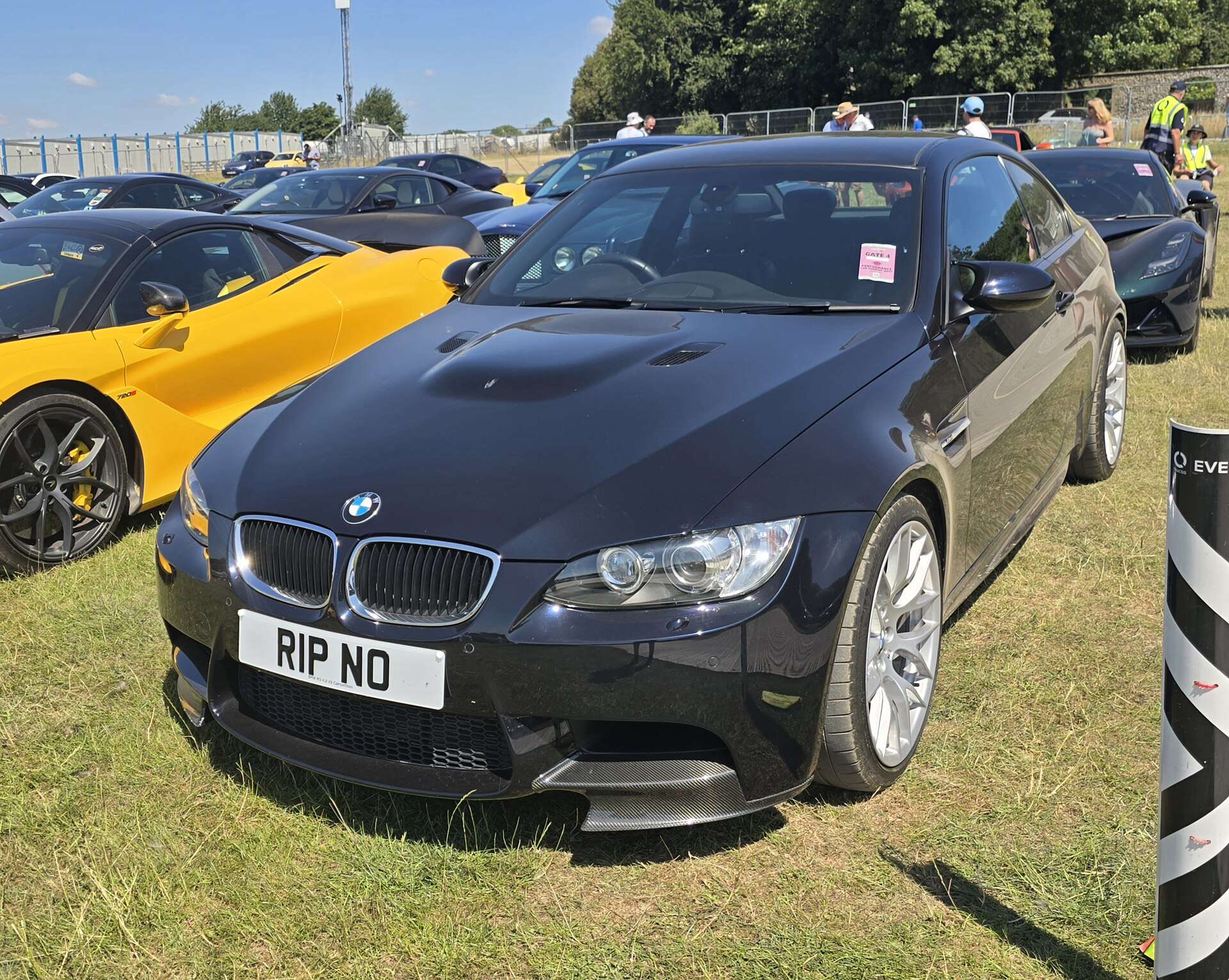
The E90, E92 and E93 BMW M3 offer something no other M3 generation does: a naturally aspirated V8. That makes them compelling used buys, but their maintenance requirements belong to an expensive performance car, whatever the current asking price. This guide puts S65 engine evidence, gearbox behaviour, body condition and realistic ownership costs ahead of badges and glossy photographs.
Our buying verdict
A documented, independently inspected car with money left for maintenance is the right purchase. Choose the body and gearbox you actually want, then compare service quality. Verified bearing work is valuable; an unexplained “bearings done” claim is not. A cheaper E93 convertible can be excellent value for open-air use, but roof condition and extra mechanisms must be assessed separately from the shared V8.

E90, E92 or E93: understand the differences
BMW’s original 2007 material describes the 3,999 cc S65 V8 producing 309 kW, quoted as 420 hp in its European release, with 400 Nm and an 8,400 rpm maximum engine speed. UK advertisements commonly call the same standard output 414 bhp. Unit conventions explain that difference; it is not evidence of an extra-power version. The normal production cars covered here are distinct from the much rarer GTS and CRT.
| Version | Appeal | Checks that matter |
|---|---|---|
| E90 saloon | Four-door practicality with the same basic V8 character. | Verify saloon-specific body condition and specification; rarity alone does not justify any asking price. |
| E92 coupe | Fixed-roof enthusiast choice, with carbon-roof specification dependent on the actual car. | Check roof surface, accident repair, seat access and original equipment. |
| E93 convertible | Retractable hardtop and open-air V8 experience. | Cycle the roof completely, inspect seals and drains, and check luggage-area moisture. |
| Six-speed manual | Direct involvement and a conventional clutch. | Clutch, flywheel, shift quality and evidence of abusive use. |
| Seven-speed M DCT | Fast dual-clutch changes and a different driving experience. | Hot and cold behaviour, leaks, fault memory and credible servicing evidence. |
DCT is not the older SMG transmission. Test-drive both if undecided: changing the gearbox is not a sensible way to improve a purchase you never really wanted. Likewise, an E93’s weight and roof packaging change its character; do not buy one solely because it is cheaper than the coupe you prefer.
Competition Package and special-edition descriptions need verification against build information. Wheels, suspension and software can be changed. Read the VIN specification and invoices together rather than accepting a badge or seller-selected advert category. A standard car with a careful owner can be a better buy than a supposedly rare version needing substantial catch-up work.
Prices: condition and body style change the comparison
On 4 November 2026, the PistonHeads E9x listings included a 2010 DCT convertible advertised at £18,995 with 64,977 miles, a 2012 DCT coupe at £21,995 with 70,233 miles, and a 2013 DCT coupe at £33,995 with 33,500 miles. These are asking prices and unverified seller descriptions. They demonstrate why one headline “E92 M3 price” cannot sensibly value every body, mileage and specification.
Compare cars with the same body and transmission, then inspect the evidence behind premiums. Recent bearing work, quality tyres, sound brakes and healthy dampers have practical value. An expensive exhaust or rare colour has a different value to different buyers. Do not simply add a seller’s modification receipts to the value of an ordinary standard car.
Build a first-year budget before negotiating. Ask the inspector to prioritise required repairs and identify the costs of any uncertain major jobs. A car with no bearing documentation should be priced with that uncertainty in mind; it should not automatically be described as having failed bearings. Avoid buying at the very limit of your available funds.
Body, underside and roof inspection
Inspect the car in daylight and on a lift. Examine sill ends, jacking points, arches, the boot floor, subframes, brake pipes and suspension mounting areas. Look for damaged undertrays, crushed lifting points and corrosion around fixings. Age and winter use matter even when exterior paint looks excellent. Ask whether underside work includes photographs of the metal before coatings were applied.
Compare panel gaps, paint texture and fasteners; check the front structure and rear quarters for repair evidence. These cars have model-specific body parts, and a cheap cosmetic repair can conceal damaged brackets or cooling components. A clear vehicle-history report does not prove the absence of unrecorded accident repairs.

On a carbon-roof coupe, inspect lacquer condition, edges and repair evidence. Confirm whether the actual vehicle has the expected roof or a different factory option. Do not dismiss bubbling, lifting finish or a suspiciously covered roof without a specialist opinion. A carbon-look wrap does not establish what lies beneath.
For an E93, operate the roof through a complete open-and-close cycle on appropriate level ground with the seller’s agreement. Check window indexing, roof alignment, seals, hydraulic operation and warning messages. Inspect the boot, roof-storage area and cabin for dampness or water staining. A roof that works once can still need seal or drain work, so combine operation with inspection and fault diagnosis.
S65 engine: evidence before reassurance
Rod bearings and the quality of previous work
Connecting-rod bearing condition is a central S65 buying consideration. Redish Motorsport documents its bearing replacement process, including clearance measurements and a printed report. Its explanation is a specialist’s technical assessment, not a population-wide failure study. No honest guide can calculate an individual engine’s remaining life from its odometer alone.
For a car advertised as having its bearings replaced, request the invoice, date, mileage, bearing and bolt specification, workshop details and any photographs or measurement report. Establish what else was inspected. Ask whether the repair was preventive or followed noise, oil-pressure trouble or a damaged crankshaft. The phrase “uprated bearings” is less useful than a complete account of the job.
A quiet idle or a reassuring oil sample cannot guarantee that every bearing is healthy. Conversely, missing paperwork does not prove damage. Discuss the uncertainty with an S65 specialist and budget appropriately before buying. Persistent knocking, oil-pressure warnings or metal contamination needs immediate professional diagnosis; do not road-test a potentially damaged engine to see whether it improves.
Throttle actuators, VANOS covers and leaks
Evolve’s preventive-maintenance documentation identifies throttle actuators as an age-related failure point that can leave the car in reduced-power mode. Check invoices for which bank was repaired, what components were used and whether any warranty transfers. Scan the engine management and investigate warning messages rather than accepting an explanation that the battery merely needs charging.
The same specialist describes deterioration of the original plastic VANOS covers. Ask the inspecting workshop whether they have been checked or replaced and what supporting evidence exists. This is not an instruction to replace every part blindly: the inspection should identify what is installed and what further investigation is justified. Neither actuator work nor new covers substitutes for bearing evidence.
Inspect cam-cover areas, the lower engine, oil-cooling plumbing and power-steering system for leaks. Watch coolant temperature behaviour, check fans and investigate a car that takes unusually long to warm or cannot maintain stable temperature. Assess oil consumption from actual owner records where available, rather than an unsupported claim that all examples use the same amount.
Cold start and warming procedure
Arrange a genuine cold start and a long enough drive to reach normal oil temperature. The V8’s high-revving nature is no excuse for hard use while cold. Check the oil-level system and use the correct measurement procedure. Verify the oil specification and servicing chronology with the workshop; this is not an ordinary 3 Series engine to maintain by guesswork.
Look for the early running-in service record and subsequent maintenance, while judging the complete history rather than a single stamp. Long storage or low annual mileage still warrants time-based fluid and condition checks. Ask about track use, overheating, engine replacement and software changes directly, and put important representations in writing.
Manual, DCT, differential and chassis
On a manual, test clean engagement, clutch take-up and slipping under sensible load once warm. Price flywheel and hydraulic work separately if a clutch quote excludes them. On DCT, test selection from rest, reverse, smooth low-speed manoeuvring and shifts after the car is warm. Investigate shudder, delayed engagement, leaks and transmission warnings with a specialist diagnostic report.
Listen for differential noise and drivetrain knocks, then inspect mounts, propshaft components and leaks on the lift. Distinguish normal operating characteristics from a fault by comparison and diagnosis. An additive or a reset should not be offered as a substitute for identifying the cause of a new noise.

Check dampers, bushes, springs, steering and alignment. If Electronic Damper Control is fitted, test its functions and scan for faults; replacement hardware must match the specification. Examine the large compound brake discs for condition and correct replacement parts. Cheap tyres, uneven wear and persistent vibration can signal an owner who has deferred the wrong expenses.
Interior and electrical checks
Test seat motors, heating, bolsters, climate control, navigation, audio, parking sensors, mirrors, lights and both keys. BMW’s launch material describes numerous options, so do not assume every car has the same system. Older navigation and connected functions may be limited by age; check what works today rather than what the brochure once promised.
Look for damp carpets, windscreen or door-seal leaks and amateur wiring from audio, tracker or dashcam installations. A weak battery can cause confusing symptoms, but it should be tested rather than used to excuse every warning. Ask whether replacement batteries were correctly specified and registered where required. Read faults across the car, not only the engine module.
Maintenance and parts costs
Use an M-car specialist to set a plan from the service history, diagnostic findings and your intended use. The S65 has chain-driven camshafts: a generic timing-belt kit is not a routine service requirement. Separate engine accessory belts from the camshaft drive, and obtain a diagnosis before authorising internal timing work.
These are editorial UK parts-only budgeting allowances, not live offers or fitted quotes. Brand, VAT treatment, exchange surcharges and availability can change the total. Obtain a written fitted quote and check part numbers against your VIN, engine and modifications.
Affiliate disclosure: we may earn a commission from qualifying eBay purchases, at no extra cost to you. The links open vehicle-specific searches; they do not certify the suitability or quality of individual listings. Check seller, fitment, warranty and returns.
| Maintenance item | Parts allowance | What to check |
|---|---|---|
| Oil and filter service parts | £100–£180 | Confirm the current approved specification and complete fill quantity. |
| Eight spark plugs | £90–£180 | Allow separately for fitting and any damaged coil or connector. |
| Alternator | £180–£400 | Correct S65 application, output and exchange terms matter. |
| Starter motor | £130–£280 | Access and diagnosis can make fitted cost much higher. |
| Accessory belt and tensioner | £70–£200 | Accessory drive only; not a camshaft timing-belt service. |
| Rod-bearing service components | £450–£900 | Specialist measurement, labour, oil and ancillary work are additional. |
| Throttle actuators | £450–£1,000 per pair | Compare new and rebuilt units, internal scope and transferable warranty. |
| Manual clutch kit | £300–£650 | Not for DCT; flywheel, bolts and hydraulics may be extra. |
| DCT service components | £180–£350 | Only for the correct gearbox; fluid specification and procedure are crucial. |
| Front discs and pads | £400–£750 | Check correct M3 discs and intended road use. |
| Engine mounts | £150–£350 | Consider condition and access alongside bearing work. |
Hidden ownership costs
The complete bearing job: a box of shells and bolts is not a finished repair. Redish’s documented scope includes measurement, seals, oil, filter and labour; other workshops may quote differently. Compare written job descriptions before deciding one garage is expensive or another is a bargain.
Tyres, brakes and dampers: large wheels and performance consumables remain costly even on an inexpensive convertible. Price the correct sizes and ratings for the actual car. A full set of tired suspension components can make a cheap purchase much less attractive than one with recent quality work.
E93 roof repairs: seals, alignment, hydraulic diagnosis and water damage can become separate bills. Keep roof operation and a dry storage area in your inspection requirements. Do not spend the roof-repair reserve on cosmetic upgrades.
Fuel, tax and insurance: BMW’s original manual-coupe release quoted 22.8 mpg under its launch test regime. That is context, not a promise for modern traffic or spirited driving. Verify current tax and insurance from the individual registration, gearbox, use and declared modifications before committing.
Modifications and track history: exhausts, suspension, superchargers and software can affect insurance, road use and repair support. Retained original parts help only if complete and serviceable. Track use is not automatically disqualifying, but it should bring credible maintenance and inspection records.
Downtime and restoration: underside corrosion, seized fasteners and unavailable trim can extend a simple service visit. Use a realistic reserve and ask about parts availability. The most useful upgrade may be a thorough baseline service and sound tyres rather than more power.

Eight-point viewing checklist
- Verify VIN, body style, transmission, factory options and edition claims.
- Read the chronological history, early running-in record and detailed bearing invoices.
- Arrange a genuine cold start, complete warm drive and specialist engine assessment.
- Scan all modules and investigate actuator, VANOS, engine and gearbox warnings.
- Inspect underside, roof surface, body repairs and cooling components on a lift.
- Test manual or DCT behaviour and assess differential, suspension, brakes and tyres.
- On an E93, cycle the roof and inspect seals, drains and luggage-area moisture.
- Obtain a first-year maintenance plan, insurance quote and independent report before payment.
Frequently asked questions
Are all E9x M3 engines destined to fail?
No reliable population-wide conclusion follows from workshop examples. Bearing wear is a material inspection and budgeting issue, but an individual engine needs evidence and specialist assessment rather than a prediction from mileage alone.
Does “rod bearings done” make a car safe to buy?
It is useful only when supported by an identifiable workshop invoice, specification and appropriate records. It does not establish the condition of the rest of the engine, drivetrain or shell.
Is DCT the same as SMG?
No. The E9x M3 DCT is a dual-clutch transmission. Assess it on its own maintenance and diagnostic evidence, and test it fully warm as well as cold.
Does the S65 need a timing-belt change?
Its camshafts are chain-driven. Accessory belts still require inspection, but a routine timing-belt kit is not the correct service purchase.
Which body is the best value?
That depends on how you will use it. E90 practicality, E92 fixed-roof appeal and E93 open-air use are distinct benefits. Compare like-for-like cars and retain money for maintenance instead of choosing solely by the lowest asking price.
Research and sources
Factory documentation establishes the original design. The workshops below document their own services and technical assessments; their repair experience does not provide a statistically representative failure rate. Market examples are advertisements, not cars we have inspected.
- BMW Group: The new BMW M3, July 2007: S65 specification, manual drivetrain, differential, EDC and coupe equipment.
- Redish Motorsport: E9x M3 conrod bearings: documented replacement scope and clearance measurement.
- Evolve Automotive: S65 preventive maintenance package: workshop guidance on bearings, throttle actuators and VANOS covers.
- PistonHeads E9x M3 listings: the dated asking-price examples above; listing details and availability can change.