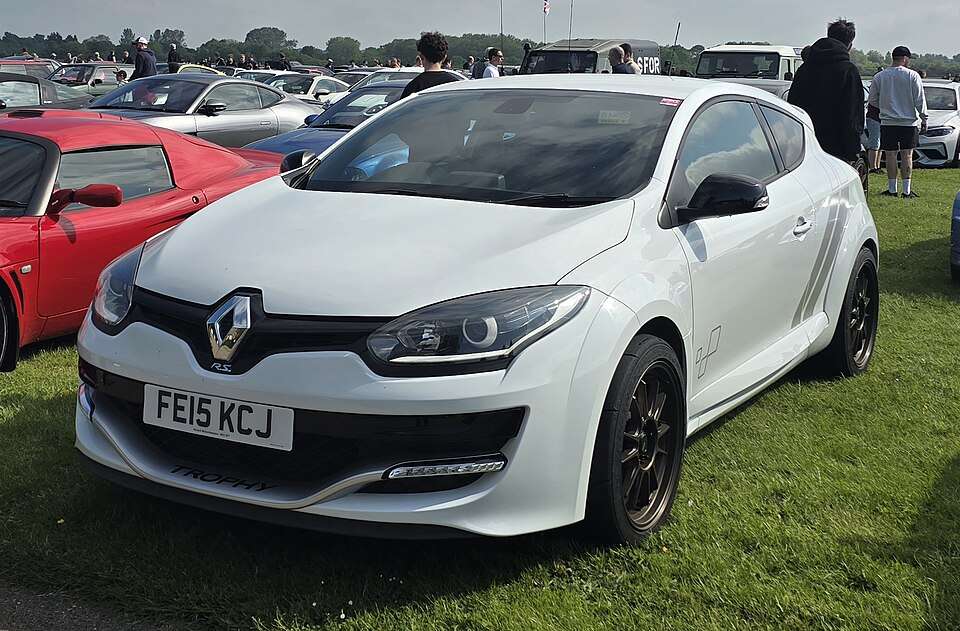
The third-generation Mégane Renaultsport is a compelling choice if steering, traction and a well-sorted chassis matter more than rear-door convenience. The 250, 265 and 275 share a broad family resemblance, but Cup specification, special editions, suspension choices and previous track use change the buying calculation. This guide explains how to separate a rewarding road car from an attractive advert hiding a substantial restoration bill.
Our buying verdict
For most road buyers we would shortlist a well-documented 265 or 275, with the chassis specification verified and recent belt-service evidence. A healthy 250 remains a serious alternative. Pay for sound hubs, brakes, tyres and gearbox operation before paying for a special-edition badge. A Trophy-R is a separate, specialist purchase with its own originality and equipment questions.

250, 265, 275, Cup and Trophy explained
This guide covers the three-door Mégane III Renaultsport with the 2.0-litre turbocharged F4R-family engine and six-speed manual gearbox. It does not cover the earlier 225/R26 or the later five-door 1.8-litre RS. Classifieds sometimes mix generations, while power figures may be rounded or labelled inconsistently. Use the VIN, original order specification and invoices to establish what the car is.
| Model or specification | What matters to a buyer | Our approach |
|---|---|---|
| RS 250 | Early cars can offer the same basic chassis appeal at a more accessible price. | Prioritise belt history, hubs, gearbox and originality. |
| RS 265 | An attractive middle ground for road use. | Verify the chassis and equipment rather than assuming all 265s are identical. |
| RS 275 / Cup-S | Later versions can command more money. | Check the actual suspension, differential, seats and options. |
| Cup chassis / Cup Pack | The chassis specification affects handling, ride and traction. | Establish the original specification; coloured calipers and wheels are not sufficient proof. |
| Trophy | Special-edition provenance and original equipment matter. | Inspect exhaust, suspension and seat condition as well as the engine. |
| Trophy-R | A deliberately more focused specialist variant. | Use a separate originality/equipment assessment and specialist market comparison. |
A Cup-equipped car is especially appealing if you value front-axle response and traction, but try the ride on roads you actually use. The mechanical limited-slip differential associated with Cup specification is a worthwhile feature only when the rest of the chassis is healthy. Poor tyres, worn pivots and inaccurate geometry can spoil the experience more than the difference between headline power figures.
A non-Cup example is not automatically a poor choice for road use. Equally, a very stiff aftermarket setup does not demonstrate that a car has been improved. Ask for part numbers and installation receipts, check bump travel and ground clearance, and establish whether standard parts are supplied. For expensive adjustable dampers, investigate rebuild support and servicing costs before buying.
Our default is a road car with a clear identity, coherent maintenance and no unexplained warning lights. Track use is not inherently disqualifying: regular inspections and sensible preparation can be preferable to neglect on the road. What matters is the quality of the evidence, including heat-related wear, consumable replacement and accident repairs. A lap-time claim or dyno printout cannot replace that evidence.
Mégane RS prices: separate ordinary cars from specials
Parkers advertisements inspected on 4 November 2026 included a 2014 265 with 72,748 miles at £5,990; a 2013 265 with 81,505 miles at £7,200; a 2010 250 Cup with 50,000 miles at £10,999; a 2016 275 Nav with 51,000 miles at £11,995; and a 2016 275 Nav with 45,700 miles at £12,995. Trophy examples on the same page were advertised at £13,995 with 67,500 miles and £15,995 with 54,000 miles.
Those are dated asking-price observations from seven dealer listings, not verified sale results or a valuation formula. The adverts’ power labels have been treated as seller descriptions, not independent proof of specification. Check the live listings and establish condition before using a number in negotiations.
Do not blend Trophy-R collector advertisements into the average for a regular 250 or 265. Nor should you assume that the cheapest advert offers the best value. Missing belt evidence, worn front pivots, a tired clutch, gearbox work and four tyres can outweigh a large purchase-price difference. Build a comparison sheet with the original chassis specification, documented work, imminent consumables and independent inspection cost.
When a seller requests a premium for originality, ask what remains original and what has been replaced. Correct replacement maintenance parts are different from cosmetic changes, a remap or missing special-edition equipment. For a modified car, obtain insurance acceptance and quote the cost of any required return to road-compliant specification before agreeing a price.

Bodywork, corrosion and authenticity
Start with the VIN, V5C, seller identity and the right to sell. Use a reputable history check for outstanding finance, theft and recorded damage, then compare MOT mileage with workshop invoices. A clear database result does not establish accident-free history. Inspect the actual structure and ask about repairs paid for without an insurance claim.
Check the front splitter, bumper corners, undertrays and jacking points for impact damage. A low car can look immaculate above the sill line while being scraped and distorted underneath. Look at bonnet and wing fasteners, paint edges, headlamp supports and front-panel alignment. A fresh bumper does not tell you whether the original damage stopped at the plastic.
Have a specialist inspect sill seams, floor edges, subframes, suspension mounts, brake pipes and exhaust hangers on a lift. Distinguish surface corrosion from weakened structure, damaged fixings and poorly executed repairs. New protective coating is useful only if preparation and underlying condition can be verified. Inspect rear wheel arches and the area around suspension attachments rather than assuming a relatively modern body is immune to age.
Examine door hinges and seals, window operation, rear-quarter trim and the boot well. Check for damp carpets or condensation and investigate the source, not just the smell. Recaro wear, damaged special-edition decals, cracked trim or missing original equipment can be expensive to put right. Photograph and price such issues before deciding that they are merely cosmetic.
Mechanical checks: belts, hubs, gearbox and brakes
Ask for the last timing-belt invoice before viewing. It should identify the car, date, mileage and the parts and labour supplied. “Belt done” without an invoice cannot establish whether tensioners, auxiliary drive, water pump and coolant were renewed. Use Renault’s schedule for the actual VIN and build date; if the work cannot be established, obtain a full belt-service quote and treat it as due in the purchase budget.
K-Tec’s first-party belt-service description specifies cambelt and pulleys, auxiliary belt and tensioner, water pump and coolant, and camshaft end caps. It also identifies cam-cover oil leakage on the F4R as a reason to consider resealing while the belt is off. Ask whether the quoted job includes that repair if needed. Do not assume a generic belt-only kit or an unrelated Clio package is equivalent to the complete Mégane service.
Inspect the engine cold for oil around the upper cover and timing end, coolant residue, damaged hoses and untidy wiring. Start from cold and listen for sustained abnormal noise. Check that idle stabilises and that warning lamps illuminate during the self-test and extinguish appropriately. Hot restarting matters too. Persistent misfires, blue smoke, unexplained coolant loss or an overheating history require diagnosis before purchase.
Examine the turbo plumbing, intercooler and clamps for damage or improvised fixes. A warm engine should deliver smooth, consistent acceleration rather than hesitation, misfire or repeated warning messages. Do not repeatedly provoke a fault with full-load runs. A diagnostic scan and specialist examination are more useful than the seller clearing a code and promising it will not return. Where symptoms justify it, agree compression, leak-down or boost-leak testing before payment.
Ask what software and hardware are fitted. Require installer invoices, calibration identity, fuel requirements and maintenance records. A large power claim does not establish correct fuelling, cooling or driveline condition. Returning the intake or exhaust to standard does not prove standard software. Missing emissions components and an excessively noisy exhaust can create inspection, insurance and reinstatement problems.
Pay close attention to the front suspension’s separate steering-pivot arrangement. Have a Renaultsport specialist check swivel/pivot bearings, joints and the rest of the hub assembly for play, tightness and noise. A vague or reluctant steering response should not be dismissed as a tyre characteristic without a lift inspection. Ask whether the repair quote covers the bearing or a larger assembly, both sides if required and subsequent geometry.
Test the manual gearbox from cold and hot, with ordinary changes through all six ratios and reverse. Baulking, crunching, jumping out of gear or pronounced noise needs a gearbox assessment. Check clutch engagement, pedal return and slip under normal load. A replacement clutch invoice should reveal whether the release system and flywheel were inspected or renewed; gearbox-removal labour makes incomplete repairs an expensive false economy.
Inspect the front Brembo brake hardware for seized movement, damaged bleed screws, uneven pad wear and heat damage. Check the inner as well as outer disc faces. Repeated track use can consume discs, pads and fluid quickly, while long periods parked can produce corrosion and sticking components. Confirm rear-disc/bearing requirements and axle-set contents before ordering. Test the parking brake and look for dragging or uneven braking.
Four good, compatible tyres and accurate alignment are fundamental. Inspect inner shoulders, wheel cracks, spring damage, damper leaks and bush condition. For adjustable or premium dampers, record the make and part numbers and seek evidence of any required rebuilding. A basic toe adjustment and a full geometry setup are different jobs; obtain a measured report rather than accepting “tracking done” as proof of a healthy chassis.

Cabin, key cards and electronics
Test both key cards, locking, windows, mirrors, wipers, washers and every exterior lamp. Check that the windows meet their seals cleanly and that doors lock consistently. Ask how many working keys are actually included: replacing a missing card and programming it is a real ownership cost, not an incidental promise to sort later.
Check Recaro bolsters and seat adjustment, seat-belt operation, airbag warnings and under-seat wiring. Wear may be repairable, but damage to a seat frame or restraint system needs qualified attention. Confirm original seating specification on special editions, particularly a Trophy-R, before assuming a missing component is simply an option.
Test infotainment, navigation, Bluetooth and any RS Monitor functions fitted. Allow the system to boot and pair your own phone rather than accepting a demonstration of the radio alone. Verify any retrofit and ask whether original equipment is supplied. Run air conditioning long enough to establish cooling, and investigate leaks or compressor issues before accepting “just a regas”.
A low battery can create misleading faults, but it cannot explain every electrical warning. Request a charging-system test and a full diagnostic scan where symptoms recur. Check boot and footwell dampness before replacing modules. On a normal-length drive, assess visibility, seat support, ride and rear-seat access: the qualities that make an RS special may not suit every daily journey.
Maintenance, timing kits and replacement parts
The figures below are editorial planning allowances for parts only, unless a fitted service is explicitly identified. They are not live eBay quotes: brand, specification, availability, delivery and VAT treatment vary. Obtain a registration/VIN-matched written estimate before committing to a repair. Cheap search results can include incompatible parts, deposits or single components rather than a complete kit.
Affiliate disclosure: the parts searches below use our eBay affiliate campaign. We may earn a commission if you buy, at no additional cost to you. Search results are not a recommendation of every seller or product; verify fitment, maker, returns and warranty.
| Maintenance item | Parts allowance / search | What to check |
|---|---|---|
| Oil and filters | £60–£130 | Use the engine’s required Renault oil approval and verify kit contents. |
| Spark plugs, set | £40–£85 | Confirm specified type and calibration requirements. |
| Timing-belt kit | £140–£230 | Belt/tensioner scope varies; this is not the full installed job. |
| Complete belt-service parts | £330–£460 | Check auxiliary tensioner, pump, caps and coolant contents; match the exact engine. |
| Alternator | £150–£330 | Verify output, mounting, pulley and exchange terms. |
| Front brake discs and pads | £180–£380 | Confirm road compound, axle set and actual brake fitment. |
| Rear discs/bearing assemblies | £110–£240 | Check bearings, rings and fasteners supplied; match VIN. |
| Swivel/pivot bearings | £70–£180 | Do not confuse a pivot repair with a wheel bearing or complete hub. |
| Clutch kit | £200–£380 | Release system, flywheel and fitting may be extra. |
| Auxiliary belt and tensioner | £70–£150 | Coordinate with the timing-belt job rather than paying twice for overlapping work. |
Observed supplier benchmark, 4 November 2026: K-Tec’s exact “Megane 3RS 250 | 265 | 275 Complete Belt Service Kit” variant was £414.20. Its listed contents were cambelt kit, auxiliary belt/tensioner kit, cam caps and water pump. The catalogue’s lower starting price applied across several other Renault variants; it was not the price of this Mégane kit. Confirm tax, delivery, contents and availability before ordering.
The same specialist’s major belt-service page, with the Mégane 3RS option selected, displayed £786.80 with tax included. Its scope included the belt/pulleys, auxiliary drive, pump/coolant, cam caps and a health check. Additional repairs are separate: the page described cam-cover resealing at approximately £175 plus VAT alongside the job. Confirm that the workshop will honour the current offer for your car and whether additional parts are required. A major belt service is not automatically an oil-and-filter service.
Preserve invoices and agree the Renault VIN-specific schedule with a specialist. Annual oil servicing and frequent inspection are prudent for an ageing performance car; track use warrants a tailored plan for fluids, brakes and cooling. Low mileage does not stop rubber, coolant and belts ageing. A service-history spreadsheet recording each operation is more useful than a string of stamps without detail.
Hidden costs beyond the advertised price
| Cost trap | How to budget |
|---|---|
| Belt-service overlap | Agree whether pump, auxiliary drive, caps, coolant and any cover reseal are included. Avoid comparing a belt-only kit with a complete fitted job. |
| Front pivot repairs | Inspection and dismantling may reveal more than one worn component. Obtain a scope covering bearings, associated damage and geometry. |
| Brakes after track use | Pads, discs, caliper work and fresh fluid can arrive together. Assess heat damage and both disc faces. |
| Premium suspension | Check rebuild availability, turnaround and replacement cost for the exact dampers, particularly on special editions. |
| Seats and special-edition equipment | Correct trim, exhaust and missing original components can cost disproportionately more than ordinary maintenance items. |
| Tyres, insurance and contingency | Quote tyres in the fitted size, disclose modifications and obtain registration-specific running costs before committing. |
The best reserve is an itemised one. Add the inspection findings to the asking price, then retain contingency for faults not visible during a viewing. A lower advertised price is not a bargain if it leaves no funds for the belt service and chassis work. Rebuilding a track-focused car to a comfortable road specification can also cost more than choosing a suitable standard example initially.

Mégane RS pre-purchase checklist
- Establish generation, VIN, original chassis specification and special-edition provenance; do not rely on badges or caliper colour.
- Read actual belt-service invoices for dates, mileage and full scope, then confirm the schedule for that VIN.
- Check finance/damage history, MOT mileage/advisories, both key cards and any outstanding Renault recalls.
- View cold, inspect upper-engine oil leaks and coolant condition, and scan the car before and after a normal warm road test.
- Test all gears, clutch action, braking stability and steering response; investigate noise or reluctance rather than treating it as character.
- Have a Renaultsport specialist inspect front pivots, hubs, tyres, dampers, brakes and structure on a lift.
- Identify software and hardware changes, track preparation and missing original equipment; confirm insurance and road compliance.
- Obtain written prices for the full first-year work list, including belt-related extras, geometry and consumables, before negotiating.
Mégane RS buying questions
Is a 275 always a better buy than a 250?
No. Version and equipment matter, but a documented 250 with a healthy chassis and recent maintenance can be a better ownership proposition than a neglected later car. Compare condition and total first-year cost.
How can I prove a car has Cup specification?
Obtain the original build/order record and inspect the fitted hardware with a Renaultsport specialist. Wheels, badges and painted calipers can be changed and are insufficient proof by themselves.
What timing-belt evidence should I request?
An invoice identifying the vehicle, date, mileage and work performed. Establish whether tensioners, auxiliary drive, water pump, caps and coolant were included, and check the next due date against the correct schedule.
Should I avoid every car used on track?
No. Inspect the standard of preparation, servicing, brakes, tyres, suspension and repair history. Traceable careful use can be preferable to undocumented road neglect, but track consumables and specialist components affect the budget.
Can I compare Trophy-R prices with ordinary RS cars?
Treat it as a separate specialist market. Original equipment, specification and provenance can dominate its price; those advertisements are not a sensible average for a normal 250, 265 or 275.
Sources and research method
Research checked 4 November 2026. The market examples are advertised asking prices, not achieved sales. Maintenance allowances are editorial estimates for parts and are distinct from the observed supplier kit and selected workshop service. No physical inspection or road test was conducted for this article; checks identify questions for an independent specialist, not failure-rate statistics.
- K-Tec: genuine complete belt-service kits — exact Mégane 3RS option, price and contents checked through the supplier catalogue.
- K-Tec: major belt service — Mégane 3RS selected price, included work and cam-cover reseal guidance.
- K-Tec: Mégane 3RS workshop services — first-party workshop context; generic starting prices are not individual repair estimates.
- Parkers: Mégane Renaultsport 2010–2016 advertisements — dated seven-listing market sample.
- Renault UK: January 2015 Autosport announcement — contemporary confirmation of the 275 Trophy-R’s distinct positioning; not evidence that a particular used car has its equipment.
- GOV.UK: MOT history and vehicle recalls — official checks alongside a Renault VIN enquiry.
Photographs show licensed examples and are not the advertised cars sampled above. Sources and reuse terms appear in the captions. Foreign-market details can differ. No photographer or supplier endorses the guide.