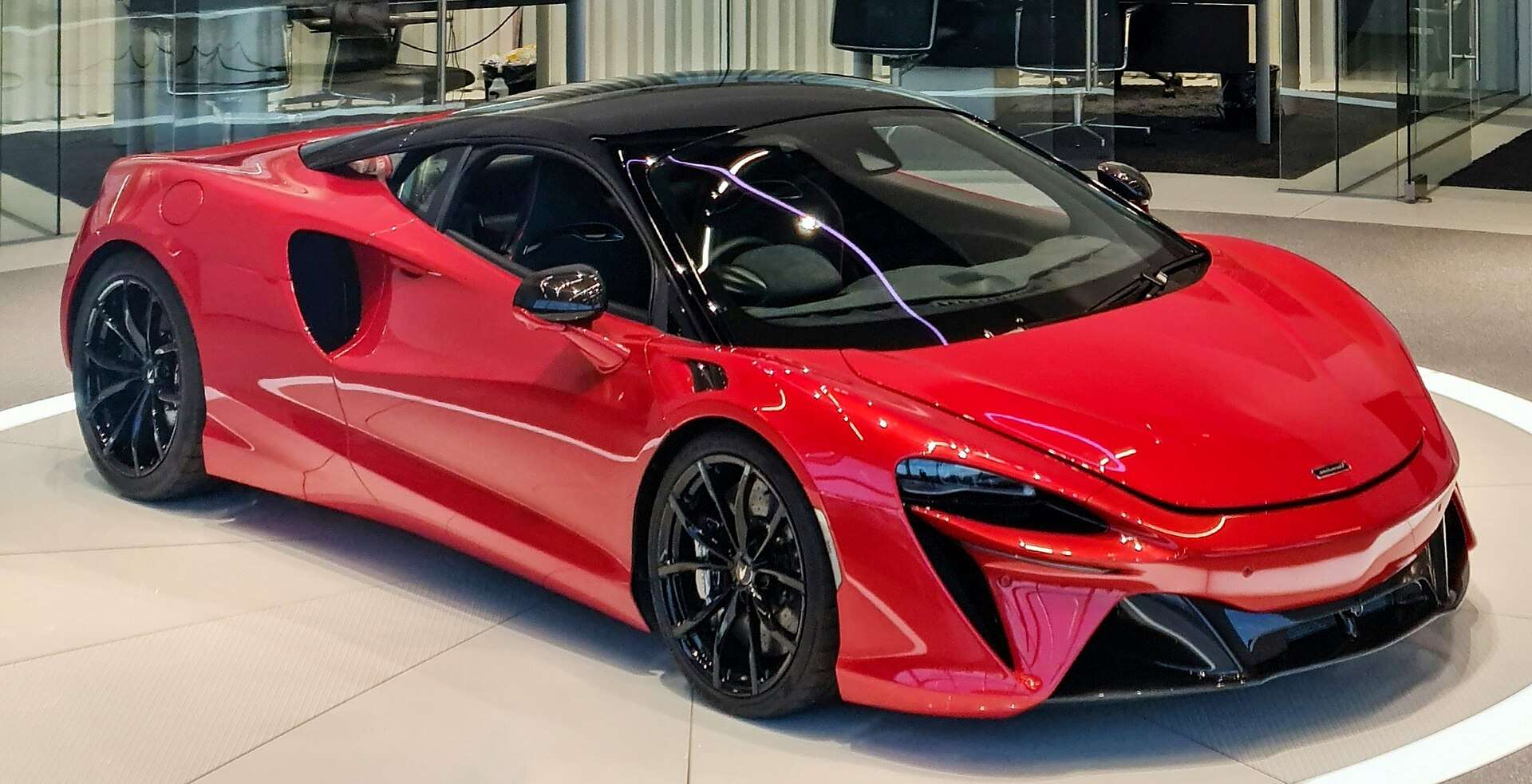
The McLaren Artura marked the biggest technical change in McLaren Automotive’s modern history. Revealed in 2021, it replaced the familiar V8 with a compact 120-degree V6, added plug-in hybrid assistance and introduced an entirely new carbon-fibre architecture.
Its name was intended to suggest “art” and “future”, but the important story was engineering. The Artura was not a limited hypercar like the P1. It brought electrification into regular McLaren production and established the platform for a new generation of road cars.
A clean-sheet McLaren
Previous modern McLarens were related through versions of the MonoCell carbon tub and twin-turbo V8. The Artura introduced the McLaren Carbon Lightweight Architecture, or MCLA, designed from the outset for hybrid powertrains and produced at McLaren’s composites facility in Sheffield.
The architecture integrated the battery, electronics and crash structures while preserving a low seating position and excellent visibility. Aluminium body structures were attached around the carbon passenger cell, allowing damage in outer areas to be repaired without compromising the central tub.
V6 hybrid powertrain
The 3.0-litre M630 engine used an unusually wide 120-degree bank angle. This lowered the centre of gravity and allowed the turbochargers to sit inside the “hot vee”, shortening pipework. An axial-flux electric motor was housed within the eight-speed dual-clutch transmission.
At launch the combined output was 680PS; later factory updates raised it to 700PS (690bhp) with 720Nm. The electric motor improved response before the turbochargers reached full boost and allowed short journeys without starting the petrol engine.
- Engine: 3.0-litre twin-turbo V6 plus electric motor
- Later combined output: 700PS / 690bhp
- Torque: 720Nm
- Transmission: eight-speed dual-clutch
- 0–62mph: 3.0 seconds
- Top speed: 205mph
- Battery: 7.4kWh
- Official electric range: about 21 miles
Design and driving character
The Artura’s styling evolved McLaren themes rather than abandoning them. Deep door channels guided air towards the engine, while compact overhangs and flying rear buttresses controlled airflow. The exhaust exited high between the rear lights, helping shorten the system.
Inside, the instrument display and handling controls moved with the steering column, placing key settings within reach. A new rear suspension and electronically controlled differential helped combine stability with the agility expected of a mid-engined McLaren.
Artura versus earlier McLarens
Compared with a 570S, the Artura is more refined, more efficient and much more advanced electronically. Compared with the P1, its hybrid system is less exotic but far more important to McLaren’s volume production. It normalised electric assistance rather than presenting it as a hypercar novelty.
The car’s early life was not completely smooth. Production delays and technical updates affected the launch period, and McLaren subsequently extended support and introduced revisions. Those developments are part of the Artura story: it was an ambitious reset rather than a cautious evolution.
Why the Artura matters
Hybrid assistance gave McLaren a way to improve response and emissions without sacrificing the low mass and compact dimensions central to its identity. The later Artura Spider demonstrated the platform’s flexibility, while the power update showed that software could materially improve an existing car.
In historical terms, the Artura sits alongside the 12C and P1 as a turning point. The 12C relaunched McLaren road cars, the P1 demonstrated hybrid performance at the highest level, and the Artura brought that thinking into series production.
Ownership snapshot
Prospective owners should verify service history, software updates, battery warranty coverage and completion of factory campaigns. Charging equipment and cables should be present and the car’s electrical functions checked carefully. A separate buying guide will cover these details and long-term running costs.
Image via Wikimedia Commons under Creative Commons licence. Specifications referenced against McLaren’s official Artura model information.