The Caterham Seven JPE was the car that proved a Seven could embarrass almost anything with number plates. Introduced in 1992, the Jonathan Palmer Evolution combined Caterham’s featherweight chassis with a highly developed 2.0-litre Vauxhall engine and a specification that owed more to contemporary touring cars than ordinary road cars.
Its name came from racing driver and former Formula One competitor Jonathan Palmer, whose performance-driving operation helped Caterham turn the familiar Seven into a genuine early-1990s supercar slayer. The result was raw, scarce and spectacularly quick: the JPE became one of the defining Caterhams of its era.

What does Caterham JPE stand for?
JPE means Jonathan Palmer Evolution. Palmer had already established a reputation as a technically minded racing driver and instructor, and his name gave Caterham’s new flagship useful credibility. This was not simply a graphics package: the JPE was conceived as an exceptionally focused, road-legal development of the Seven.
It arrived at the 1992 British Motor Show when the performance-car world was still dominated by Porsche, Ferrari and increasingly sophisticated Japanese coupes. Caterham took the opposite route. There was no four-wheel drive, no electronic chassis control and very little mass. Instead, the company concentrated on power-to-weight ratio, response and mechanical connection.
The Vauxhall engine and touring-car influence
At the heart of the JPE was a 1,998cc Vauxhall twin-cam four-cylinder engine prepared by Swindon Racing Engines. Contemporary Caterham material described it as producing about 250bhp, an extraordinary figure in a car weighing roughly half as much as a conventional sports coupe.
The engine’s specification reflected British Touring Car Championship thinking, with dry-sump lubrication, aggressive breathing and a character that became more urgent as the revs rose. Drive went to the rear wheels through Caterham’s close-ratio transmission, while a limited-slip differential helped deploy the performance. The combination was far removed from a relaxed grand tourer: the JPE was immediate, loud and deliberately demanding.

Record-breaking acceleration
The headline figure was a claimed 0–60mph time of 3.4 seconds. Caterham used the JPE to set a production-car acceleration record, giving a small British manufacturer a statistic that could be compared with the world’s most expensive machinery.
Those numbers mattered, but they do not fully explain the car. With tiny dimensions, exposed front wheels and almost no separation between driver and road, even ordinary speeds feel intense. The steering is unassisted and direct, the pedals are close together and the view over the front cycle wings makes every corner feel like the beginning of a qualifying lap.
Why the JPE looked so distinctive
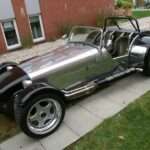
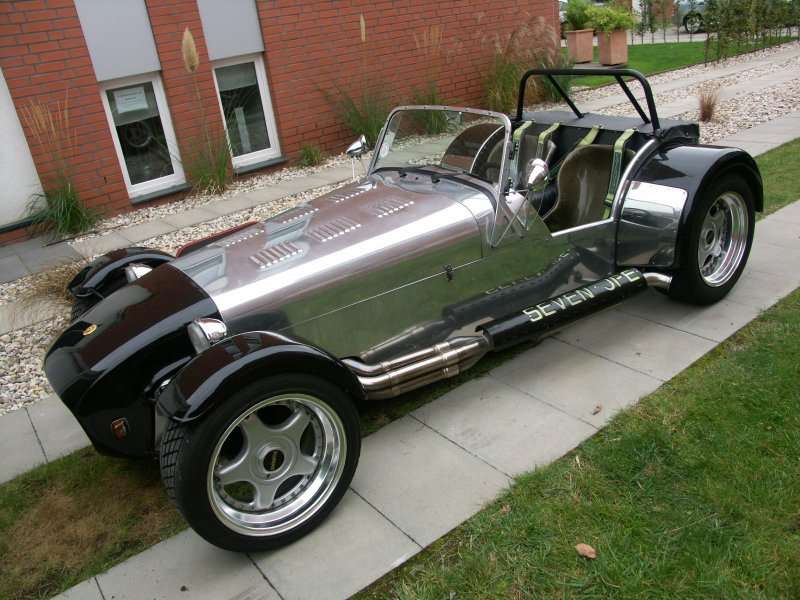
Most JPEs are remembered for their dramatic yellow-and-green paintwork, prominent branding and exposed side exhaust with a perforated heat shield. The visual treatment was unapologetically early 1990s and suited a car built to attract attention. Lightweight bodywork, an aeroscreen and minimal weather protection reinforced the impression that comfort was secondary.
As with many hand-built Caterhams, individual specifications varied and some cars have changed considerably over the decades. Period-correct details therefore matter to historians, but the essential JPE recipe is easy to recognise: Vauxhall power, ultra-low mass and a competition-minded cabin.
How rare is the Caterham JPE?
Production was extremely limited. Registers and marque specialists generally identify around 50 cars, with surviving examples known individually by chassis or JPE number. That makes it far rarer than later high-performance Sevens and explains why enthusiasts often treat it as a landmark model rather than merely another engine option.
Caterham JPE specifications
| Engine | 2.0-litre Vauxhall twin-cam four-cylinder |
|---|---|
| Preparation | Swindon Racing Engines, dry-sump lubrication |
| Power | Approximately 250bhp |
| Drive | Rear-wheel drive |
| 0–60mph | Approximately 3.4 seconds |
| Introduced | 1992 |
| Production | Approximately 50 cars |
The JPE’s place in Caterham history
The JPE established a template Caterham would revisit repeatedly: take the Seven, add an unusually powerful engine, remove anything unnecessary and chase a power-to-weight target that makes conventional supercars look cumbersome. The later R500, CSR 260 and 620R all follow that line of thought, even though their engines and chassis technology differ.
More than three decades after its debut, the Jonathan Palmer Evolution remains one of the most charismatic Caterhams. It captures a moment when a tiny company used simplicity, specialist engineering and a memorable name to create one of Britain’s most startling performance cars.
Enjoy unusual British performance cars?
Join the Unusual Cars newsletter for new model histories, forgotten-car features and specialist guides.
Frequently asked questions
Was the Caterham JPE road legal?
Yes. It was sold as a road-going production Caterham, although its uncompromising specification and limited weather protection made it much closer in spirit to a competition car.
Who was Jonathan Palmer?
Jonathan Palmer is a British former Formula One driver and motorsport entrepreneur. His name was used for the Evolution model developed around Caterham’s extreme performance brief.
What came after the JPE?
Caterham continued to build increasingly powerful flagship Sevens, including the Superlight R500, CSR 260 and supercharged 620R.
Research sources: Caterham Cars “50 at 50”; Hagerty UK; The Caterham Register; GP Sevens; period Caterham material.