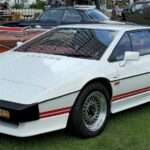
The Ford Orion 1600E revived one of the most evocative badges in Ford’s back catalogue, then attached it to an upmarket front-wheel-drive saloon. That made it controversial when new, but the leather, wood, injected CVH engine and spectacular rarity now give it enormous period charm.
Here are ten things you probably didn’t know about the Ford Orion 1600E.
1. The Orion began as an Escort with a separate boot
Ford launched the Orion in 1983 as the three-box saloon partner to the front-wheel-drive Escort. The company gave it a separate name and positioned it above the hatchback, initially restricting the range to better-equipped models. Only in the 1990s did Ford abandon the Orion identity and sell later saloons simply as Escort models.
2. The 1600E badge came from a celebrated Cortina
The original Cortina 1600E of the late 1960s combined stronger performance with lowered suspension, sports wheels, extra instruments and a more luxurious cabin. Reviving the name for the Orion created enormous expectations. Ford was deliberately borrowing the emotional value of a rear-wheel-drive classic for a very different kind of 1980s executive compact.

3. It arrived near the end of the second-generation Orion
The Orion 1600E appeared in the late 1980s, after the Escort and Orion had received their substantial Mk4-era facelift. That timing gave it a short showroom life before the all-new 1990 generation arrived. Its brief production window is one reason genuine examples are now so scarce.
4. The engine was the injected 1.6-litre CVH
Rather than using an RS powertrain, Ford fitted the familiar fuel-injected 1.6-litre CVH engine from the upper Orion range. It produced roughly 105bhp, enough for respectable performance but not enough to turn the car into a homologation special. The 1600E was intended to be a brisk luxury model rather than a four-door XR3i.
Join the Unusual Cars Club free
Get forgotten cars, surprising motoring stories and the most interesting finds from Unusual Cars by email.
Free to join. No spam. Unsubscribe whenever you like. See our Privacy Policy.
5. Leather and wood were central to the specification
Grey leather seats, a leather-wrapped steering wheel and wood cappings across the dashboard and doors gave the cabin an unusually lavish atmosphere for an Escort-derived Ford. Those parts are now critical to authenticity because they were model-specific, easily damaged and frequently removed when the cars were simply inexpensive used transport.
6. It wore distinctive RS-style alloy wheels
Cross-spoke alloy wheels, discreet coachlines and restrained badging helped separate the 1600E from a normal Orion Ghia. The treatment was deliberately more sophisticated than an XR body kit. Ford was selling an image of compact executive motoring, with sporting details used as jewellery rather than an announcement of raw performance.
7. The colour choice was extremely limited
Period references list the Orion 1600E in black, white and metallic grey. That narrow palette reinforced the sober executive image and makes the model easy to picture in its late-1980s setting. A brightly coloured example therefore deserves especially careful checking for a repaint or reconstruction.

8. It was expensive beside the ordinary Orion
Contemporary pricing placed the 1600E at about £12,500—roughly £1,500 more than a 1.6i Ghia. Buyers were paying heavily for the badge, leather, wood and exclusivity rather than a dramatic mechanical transformation. Some road testers criticised that strategy, which only adds to the car’s fascinating period story.
9. It was not universally admired when new
The motoring press questioned whether a luxurious Orion truly deserved the 1600E name. Comparisons with the original Cortina made the new car’s front-wheel-drive layout and modest performance easy targets. Time has changed the argument: the Orion is now interesting precisely because it represents Ford’s unapologetic late-1980s approach to branding and aspiration.
10. Survival, not performance, defines it today
Rust, theft, modification and ordinary family use eliminated most Orions, while model-specific leather and trim deteriorated or disappeared. Mechanical components are comparatively familiar; finding a sound shell with the correct interior, wheels and badges is the difficult part. A genuine complete 1600E is now far rarer than many faster Fords.
Why it matters
The Orion 1600E matters because it captures a very particular Ford moment: heritage marketing, injected front-wheel-drive engineering and compact executive luxury meeting in one sharply dressed saloon. Its controversy has become part of its appeal.
Enjoyed this one?
Join the Unusual Cars Club free for more forgotten performance cars, surprising motoring stories and new 10 Things articles.
Free to join. No spam. Unsubscribe whenever you like. See our Privacy Policy.