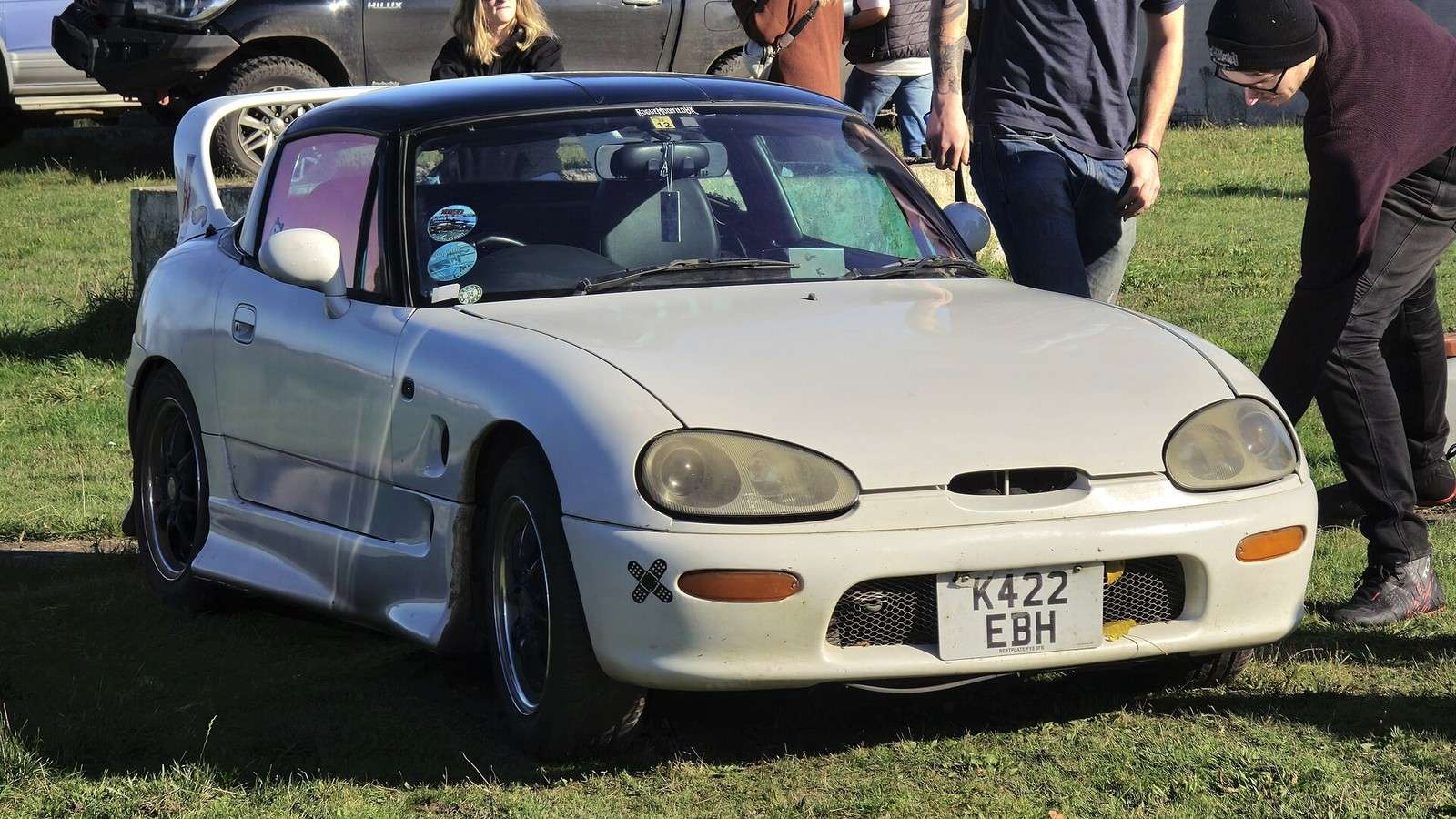
The tiny Suzuki Cappuccino squeezed rear-wheel drive, turbo power and four different roof configurations into Japan’s kei-car dimensions, creating one of the most ingenious sports cars of the 1990s.
Here are ten things you probably didn’t know about the Suzuki Cappuccino.
1. It was designed to comply with kei-car rules
The Cappuccino measured within Japan’s miniature-car limits and used a 657cc turbocharged three-cylinder engine. Suzuki launched it in November 1991 as a two-seat convertible that delivered sports-car engineering with lower Japanese tax and ownership costs.
2. The engine sat longitudinally
Unlike most kei cars, the Cappuccino placed its engine lengthways and drove the rear wheels. The compact powertrain sat behind the front axle line, helping create near-even weight distribution and a genuine front-mid-engine feel.

3. Its roof could create four different bodies
Two removable aluminium panels and a separate rear section allowed closed coupé, T-top, targa and fully open configurations. The panels stored in the boot, while the rear glass section folded behind the seats.
4. It weighed only about 725kg
Aluminium was used for the bonnet, roof panels and other components to keep mass low. With 64PS—the Japanese kei-car power ceiling—the Cappuccino depended on lightness, short gearing and driver involvement rather than a large output figure.
Join the Unusual Cars Club free
Get forgotten cars, surprising motoring stories and the most interesting finds from Unusual Cars by email.
Free to join. No spam. Unsubscribe whenever you like. See our Privacy Policy.
5. Early and late cars used different engines
EA11R models used the belt-driven-cam F6A engine, while later EA21R cars adopted the lighter chain-driven K6A. Both were 657cc turbocharged triples, but their construction and service requirements differ.
6. It formed the enthusiast-named ABC trio
Fans group the Autozam AZ-1, Honda Beat and Suzuki Cappuccino as the ‘ABC’ kei sports cars. They shared a brief and an era, yet used radically different solutions: gullwing mid-engine coupé, mid-engine roadster and front-engine rear-drive convertible.
7. Britain officially imported it
Suzuki sold the Cappuccino in the UK rather than leaving every example to grey importers. Type approval changes and limited demand kept numbers modest, helping the car develop a cult following beyond Japan.

8. The tiny body still included double wishbones
Independent double-wishbone suspension was fitted at all four corners. That ambitious layout, together with rear-wheel drive and low mass, explains why the car feels far more sophisticated than its dimensions imply.
9. Rust is its greatest enemy
Sills, floor sections, arches, suspension mountings and the area beneath roof seals can corrode seriously. Mechanical parts can be repaired, but extensive structural rust quickly overwhelms the value of an apparently cheap example.
10. Its modest power is part of the point
The Cappuccino can be enjoyed at sensible speeds, with turbo lag, narrow tyres and a busy gearbox providing drama. Chasing large power figures can undermine the balance and strain a drivetrain designed around the kei limit.
Why it matters
The Cappuccino matters because it is a packaging masterpiece: miniature dimensions, four roof modes, rear-wheel drive and sophisticated suspension. It proves that engineering imagination can be more memorable than raw speed.
Enjoyed this one?
Join the Unusual Cars Club free for more forgotten performance cars, surprising motoring stories and new 10 Things articles.
Free to join. No spam. Unsubscribe whenever you like.
Explore every 10 Things article in the Unusual Cars hub →