
Buying Guides / Mazda CX-5 KE, 2012–2017 · UK buying advice
For buyers making mainly local or mixed journeys, the 2.0 petrol is our first CX-5 KE comparison. The 2.2 diesel can suit regular longer-distance use, but it needs convincing oil, DPF, service and campaign evidence. Do not buy a cheap diesel on its economy claim alone, or assume that choosing petrol removes the need for a thorough inspection.
This guide covers the first-generation KE CX-5, including its facelift. It excludes the later KF and subsequent generations. Registration years overlap, and overseas versions differ. Identify engine, gearbox and two- or four-wheel drive from the VIN and original specification before comparing parts, maintenance or road-test behaviour.
Affiliate disclosure: qualifying eBay purchases may earn us commission, at no additional cost to you. Results are comparisons, not fitment guarantees. Confirm engine code, drivetrain, oil approval and original part numbers before ordering.
2.0 petrol or 2.2 diesel?
The right answer starts with the route. A school run, short errands and occasional weekend travel make the petrol worth seeking out even if diesels dominate the advertisements. A regular long commute or frequent motorway driving can give the diesel a more suitable operating pattern. Calculate total ownership rather than comparing headline fuel figures.
A diesel that has been regularly driven, correctly maintained and properly repaired is a different proposition from one with a recently cleared DPF light and missing oil invoices. Equally, petrol cars need checks for oil use, cooling faults, ignition problems and ordinary age-related wear. Neither engine choice turns a neglected car into a good purchase.
| Choice | Why it appeals | What must be established |
|---|---|---|
| 2.0 SKYACTIV-G petrol | A strong starting point for shorter and mixed journeys without diesel DPF demands. | Correct oil history, cold/hot running, coolant condition and the actual drivetrain specification. |
| 2.2 SKYACTIV-D diesel | Longer-distance performance and potential fuel economy. | Oil-level history, DPF health, correct servicing, injector-related repair evidence and campaign status. |
| Manual | Direct control and a familiar driving experience. | Clutch/flywheel behaviour, gear selection and a properly warmed-up test. |
| Automatic | Convenient daily driving. | Exact gearbox, clean cold/hot changes and correct maintenance evidence. |
| AWD | May suit particular traction needs. | Actual four-wheel-drive specification, matched tyres and transfer/rear-drive condition. |
Try both engines if you can. The naturally aspirated petrol’s response differs from a turbo diesel’s low-speed torque delivery. A petrol engine needing a downchange is not automatically underpowered or faulty; decide whether its character suits your normal loads. Do not accept pronounced hesitation, misfiring or warning lamps as merely a characteristic.
Compare a facelift on condition and useful equipment, not the assumption that every concern vanished at a particular registration year. Build dates and VIN-specific campaigns are more meaningful than an advert saying “later model”. A written inspection and itemised history should support any premium.

2.2 diesel: oil level, dilution and maintenance
The dipstick’s X mark matters
Mazda’s published SKYACTIV-D guidance explicitly tells owners to check oil level and replace the oil if it exceeds the dipstick’s X mark. It also stresses the specified oil and the required control-unit reset after an oil change. Treat those instructions as important ownership evidence, not an optional detail. Use the handbook appropriate to the exact KE build for the checking procedure and schedule.
A rising level needs explanation. Do not accept an overfilled or diluted oil condition as reassurance that the engine has “plenty of oil”. Ask what investigation was carried out, whether the correct oil and quantity were used and whether the car’s operating pattern is suitable. Simply draining the level without addressing why it rose may leave the cause unresolved.
Ask the seller how frequently the level is checked and whether extra oil changes have been needed. Read the invoices for actual specification and mileage chronology. Oil viscosity by itself does not prove suitability for the diesel and its emissions system. A generic kit shared with the petrol is not an adequate basis for selecting lubricant.
DPF history and short journeys
Mazda’s own DPF explanation identifies repeated short running, cold operation, prolonged idling and very low-speed use as conditions in which soot may not be cleared normally. This is why your expected journeys matter. A diesel bought for repeated short errands can be a poor match even if the asking price is attractive.
Ask about warnings, forced regenerations, oil-level changes and any DPF replacement or cleaning. Repeated forced regeneration is not a service badge of honour; the workshop should establish why normal operation was insufficient. A purchase inspection should assess relevant stored faults and live data in context, including temperature and operating conditions.
Do not attempt to cure an unknown warning during a viewing by blindly following a high-speed internet routine. Mazda distinguishes a soot-accumulation message from a malfunction or flashing warning that requires professional attention. Follow the actual car’s handbook and obtain diagnosis where needed. A fault caused by another system will not necessarily be cured by another drive.
Injector sealing, oil supply and previous engine work
Ask a Mazda dealer to check all outstanding recalls and service programmes against the VIN, and obtain evidence of completed actions. For an early diesel, request a careful review of injector-related work and lubrication complaints rather than relying on the seller’s belief that every campaign was done. Completion of a recall and assessment of today’s mechanical condition are separate questions.
If the history includes injector, oil-strainer, vacuum-pump, camshaft, turbo or engine work, establish why it was required and what the final repair included. A replacement component invoice does not automatically prove that contamination or an oil-supply problem elsewhere was addressed. Ask the inspector whether the supporting records answer that question.
Have abnormal mechanical noises, oil-pressure warnings, hard starting, smoke or reduced braking assistance investigated before purchase. Stop safely if oil pressure or braking safety is in doubt. Do not turn a seller’s cheap-parts suggestion into a diagnosis. Suitable specialist testing may include oil-pressure measurement or further mechanical investigation when the symptoms justify it.
A replacement engine can mean new, rebuilt or used. Ask for supplier, source mileage, ancillary work, warranty and whether the original cause was established. An engine swap without a clear account of associated oil, fuel or emissions-system work is incomplete purchase evidence. Keep a written record of the claims made in the sale.
2.0 petrol: the alternative still needs inspection
Arrange a cold start, check fluid levels using the correct procedure and ask about oil additions between services. Look for coolant staining, leaks and evidence of overheating. A clean engine bay is presentation; inspect it again after driving for fresh traces. Any persistent loss needs diagnosis rather than a bottle of top-up fluid in the boot.
The petrol uses a chain-driven camshaft system, so do not apply a generic diesel cambelt replacement quotation to it. Correct maintenance remains important. Sustained rattling, misfiring, smoke or warning lamps should be investigated. Do not assume every direct-injection engine needs the same preventive repair at an arbitrary mileage.
Try normal acceleration once warm, including an ordinary incline and a faster road. Assess whether you are comfortable using the gearbox and rev range. Hesitation, a flashing engine lamp or a marked flat spot is a fault to investigate. Ignition, fuel, intake and control problems can produce overlapping symptoms.
For mostly urban use, the petrol can avoid the diesel-specific DPF operating issue, but it still needs time-based servicing, a healthy battery and good brakes. Low mileage after years of standing is not inherently preferable to regular use with strong records. Inspect tyres, corrosion and electrical equipment as carefully as the engine.
Manual, automatic and AWD checks
On a manual, check clutch engagement, reverse and every forward gear cold and warm. Test normal load response without abusive stall tests. Slip, persistent vibration or noises need a diagnosis that distinguishes clutch, flywheel, mounts and other possible causes. A clutch kit price online is not a complete fitted repair estimate.
The automatic should engage consistently and change smoothly through a proper drive. Test reverse, gentle traffic-speed progress and warm acceleration. Repeated shunts, delayed engagement, flare or warnings should be investigated. Ask a workshop to identify the transmission and appropriate maintenance rather than booking a generic dual-clutch service.
For AWD, check all four tyres for matching specification and broadly consistent wear. Listen for driveline noises and assess binding or vibration during ordinary low-speed turns. Have transfer and rear-drive areas inspected for leaks and condition. AWD is useful traction equipment, not an excuse for worn tyres or an assurance of shorter braking distances.
Love cars you don’t see every day?
Get forgotten cars, surprising motoring stories and the most interesting finds from Unusual Cars by email.
Free to join. No spam. Unsubscribe whenever you like. See our privacy policy.
Body, corrosion and practical family checks
Inspect the underside on a lift, including suspension mountings, brake pipes, subframes and accessible seams. Surface corrosion and structural deterioration are different findings; ask the inspector to explain severity and repair requirements. Age, environment and previous protection matter more than how shiny the roof looks.
Look for consistent paint and panel gaps around the bonnet, doors, tailgate and bumper corners. Review any recorded damage and repair invoices. Replacement windscreens, cameras and sensors may require additional checks or calibration. A clean vehicle-history report is useful, but it does not prove a car has never been repaired.
Try your normal luggage and passenger arrangement. Inspect rear-seat latches, boot floor, luggage cover and supplied tyre equipment. Check beneath mats and load-floor panels for water or missing components. If dampness is present, establish the source rather than accepting a recently shampooed carpet as the whole explanation.
Test every lock, window, mirror, seat adjustment, heater, camera and parking aid fitted. Run the air conditioning long enough to judge performance and ask for diagnosis if cooling is weak. Pair your phone and confirm the actual multimedia functions. Facelift and pre-facelift systems differ; today’s Mazda equipment list does not describe every KE.
Ride, steering and brakes
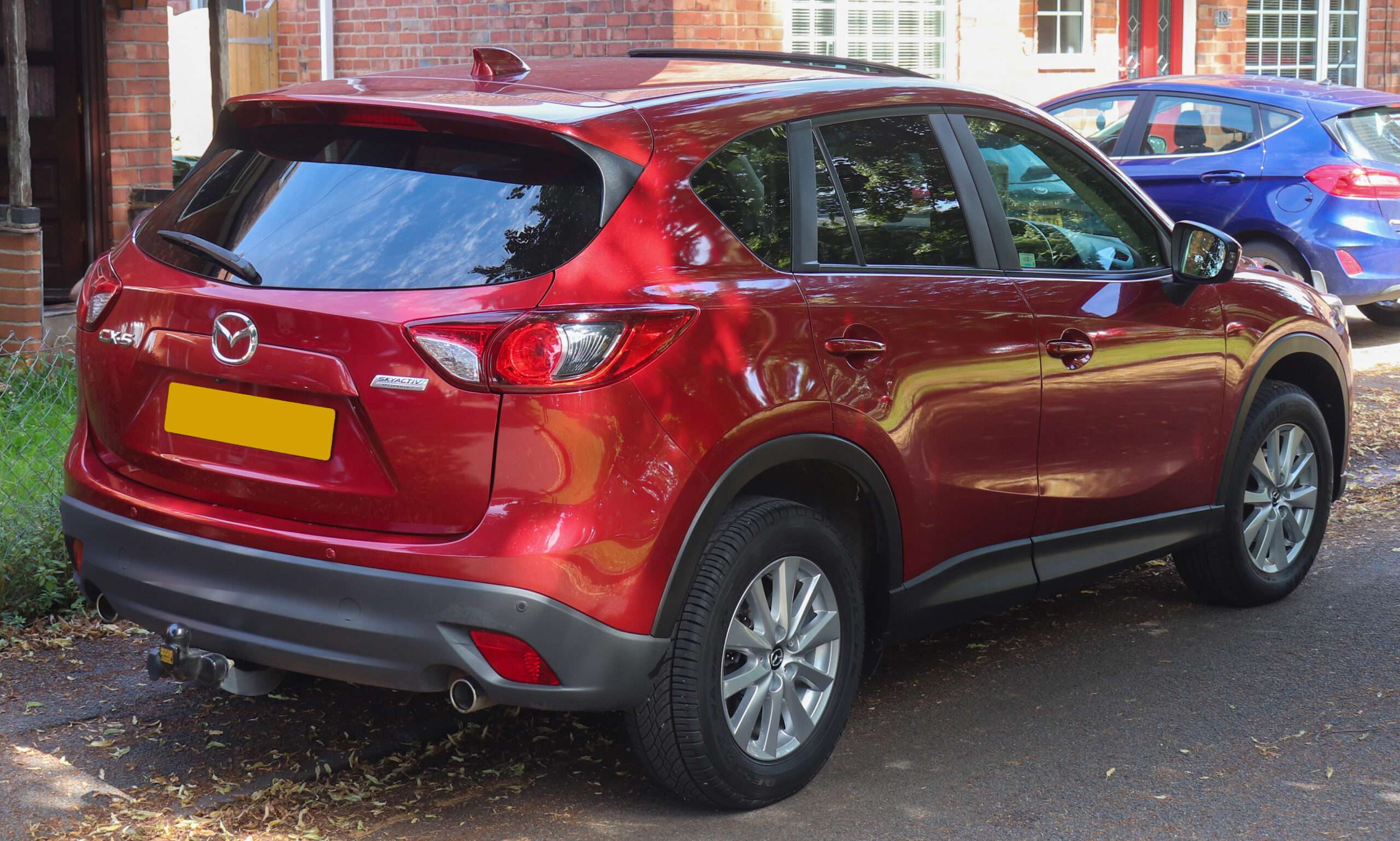
A CX-5 should feel stable on a mixed-road test. Listen for knocks over small bumps, wheel-bearing hum and driveline vibration. Check that the steering wheel is straight and the car tracks sensibly. Large wheels can influence comfort, but they do not excuse looseness, wandering or a persistent pull.
Inspect tyre age, damage and wear across the tread. On AWD cars, confirm the suitability and consistency of the full set. Do not price four premium tyres as if they were a pair of budget replacements. If a seller has fitted one fresh tyre after an impact, ask whether the wheel and suspension were checked.
Request brake measurements and inspect for uneven wear, corrosion and sticking calipers. Check parking-brake operation according to the actual build; do not assume every KE uses identical hardware. A fitted quote should include the correct axle, required procedures and any additional caliper work, not simply an online pad set.
UK parts, labour and fitted service costs
ClickMechanic publishes model-year-specific full-service estimates for early KE cars, including parts costs and labour time. Its stated included items are engine oil, oil filter and air filter. That is useful scope information: it should not be described as a complete answer to every diesel maintenance, DPF or AWD requirement.
| Application / job | Parts and labour evidence | Estimated fitted total |
|---|---|---|
| 2013 CX-5 2.0 full service | Parts £57–£85; labour time 1–2 hours. | Independent £151–£175; franchise £250–£285. |
| 2013 CX-5 2.2 full service | Parts £51–£100; labour time 1–2 hours. | Independent £146–£179; franchise £247–£287. |
| 2012 CX-5 2.0 full service | Parts £57–£85; labour time 1–2 hours. | Independent £151–£174; franchise £250–£285. |
| 2012 CX-5 2.2 full service | Parts £51–£101; labour time 1–2 hours. | Independent £146–£179; franchise £248–£287. |
| 2.2 diesel online service kits | Observed examples around £50–£92 depending on oil and filters. Compare diesel service kits. | Parts only; confirm oil approval, quantity and all required operations. |
| DPF, injector or lubrication complaint | Diagnosis and confirmed cause required. | Obtain a written complete repair quote; a cleaning or replacement-part price alone is insufficient. |
| AWD / automatic maintenance | Exact drivetrain and correct fluids required. | Ask for parts, labour, fluid quantity and VAT separately; do not transfer another generation’s estimate. |
These are the provider’s published estimates, not quotes for your registration or proof that every garage will charge within the range. The source does not publish a standalone hourly rate, so the parts range must not be subtracted from the total to invent one. Location, extra work and the exact build can change the price.
Ask for a written service scope, including the diesel’s required reset where applicable and any additional scheduled operations. For major work, separate diagnostic time, parts, labour, fluids and VAT. Establish who warrants customer-supplied parts before ordering. A small advertised component price can bear little relation to the completed job.
CX-5 KE service-parts comparison table
The petrol and diesel need separate kits and approvals. Verify VIN, original numbers, two- or four-wheel drive and gearbox before buying. High-cost engine or emissions parts should follow diagnosis. These searches are model-specific comparisons, not endorsements of every returned listing.
| Item | What to verify | eBay UK comparison |
|---|---|---|
| 2.0 petrol oil/filter kit | Correct petrol oil approval, quantity and filter. | Petrol oil/filter kits |
| 2.2 diesel oil/filter kit | Specified diesel oil, quantity and reset procedure. | Diesel oil/filter kits |
| Diesel fuel filter | Engine/build application and installation procedure. | Diesel fuel filters |
| Petrol spark plugs | Correct specification and set quantity. | Petrol spark plugs |
| Air filter | Different engine applications must be checked. | Diesel air filters |
| Cabin filter | Correct dimensions and pollen/carbon option. | Cabin filters |
| Auxiliary belt / tensioner | Engine-specific components and routing. | Belts and tensioners |
| Alternator | Engine, output, connector and charging system. | Diesel alternators |
| 12-volt battery | Correct stop-start technology, size and setup. | Stop-start batteries |
| Front brake discs and pads | Actual diameter, caliper and build. | Front brake parts |
| Wiper blades | Front/rear lengths and correct fittings. | Wiper sets |
| AWD / transmission service supplies | Correct component, fluid specification and quantity. | Drivetrain service supplies |
Hidden ownership costs
Diesel fuel savings can be outweighed by the wrong use pattern or unresolved maintenance. Build a first-year budget that includes a detailed inspection, service due, tyres, brakes and the actual diagnosis of any warning. Do not regard a discounted asking price as compensation for an engine whose condition has not been established.
AWD, large wheels, navigation equipment, key replacement and air-conditioning faults add costs beyond the basic service. Check both keys and ask for a fitted replacement quote if one is missing. A key shell, used compressor or electronic module advertised online does not include configuration, diagnosis or installation.
Check current tax, insurance and clean-air-zone compliance against the registration using official information. Earlier and later diesels may not have the same emissions classification. Do not infer compliance from a facelift badge or assume every example of an advertised year is identical.
A dealer warranty should be read for pre-existing faults, diagnostic responsibility, claim limits and servicing conditions. Confirm whether a previously replaced engine or major assembly has its own transferable cover. A short written warranty with clear responsibility can be more useful than an impressive headline whose exclusions remove the work you are concerned about.
Putting the CX-5 petrol-versus-diesel decision into practice
Compare complete ownership positions
Take the asking price of each candidate and add the same inspection scope, immediately due service, tyres, brakes and any confirmed repair. The early-KE service estimates above are relatively close between petrol and diesel, but they do not price an unresolved DPF or oil-supply complaint. Do not use a small routine-service difference to dismiss a much larger uncertainty about engine condition.
If a diesel has recent major repair invoices, ask what caused the work and whether the replacement parts addressed the complete problem. A documented, successful repair can be valuable. An engine swap with unclear source, incomplete ancillary work or no transferable warranty is a different proposition, even if the car currently starts quietly.
Ask for an inspection brief specific to the diesel
Request review of the oil-level history, specified lubricant, service resets, regeneration complaints and relevant fault records. Ask whether symptoms justify additional mechanical testing. The inspector should say what has been established, what remains uncertain and what further work is needed. A generic “no codes” statement cannot answer every question about oil contamination or earlier damage.
Verify campaign status directly with Mazda using the VIN. A clean dashboard and a recent MOT are not substitutes for that check. Conversely, a completed campaign does not mean every component needs replacement again: it is evidence to consider alongside present condition and the scope of any earlier work.
Try the petrol under your normal load
Bring your regular passengers where practical and use a representative route. The petrol’s response may require more revs and downchanges than the diesel you are comparing. Decide whether that suits you before paying a deposit. Do not confuse its different torque delivery with a fault, but investigate actual hesitation, misfiring or warning messages.
Check whether the drivetrain you want is genuinely fitted. An SUV shape does not establish AWD, and an overseas brochure may list combinations absent from the UK range. Ask for build information and have the inspector identify the drive layout. Budget for the tyres and maintenance of the actual car rather than a generic model description.
Make the handover test worthwhile
Repeat any manoeuvre or operating condition that previously caused a complaint, review the completed repair invoice and check the car for new warning messages. Confirm both keys, tyre equipment and luggage cover are included. Keep the written service forecast and repair records together so future oil checks, servicing and resale evidence continue the same clear chronology.
Viewing checklist: the order that matters
- Before travel: obtain registration, VIN, engine, gearbox and drive layout. Request oil/service invoices, diesel DPF and oil-level history, repair details and campaign records. Arrange a cold start.
- Identity and paperwork: check finance, damage and mileage chronology. Ask Mazda to confirm outstanding recalls and service programmes by VIN.
- Fluids: follow the actual handbook. On the diesel, establish the oil’s position relative to the correct dipstick marks and investigate an excessive or rising level.
- Static checks: inspect tyres, body repairs, boot dampness and equipment. Test both keys and air conditioning. Request an underside inspection on a lift.
- Cold-to-hot drive: assess starting, smoke, warning messages, temperature, acceleration, brakes and transmission. Include ordinary manoeuvres and uneven roads.
- Diagnostics: preserve relevant fault and operating data. Investigate repeated regenerations, unusual mechanical noises or lubrication concerns rather than clearing the evidence.
- Decision: obtain written fitted quotes and distinguish confirmed defects from further investigation. Walk away if oil-pressure, braking-assistance or engine-condition concerns remain unexplained.
Frequently asked CX-5 KE buying questions
Is the petrol the better buy?
It is our starting point for mostly local or mixed use. A diesel can suit regular longer journeys, but its oil, DPF and service evidence needs close attention. Choose the inspected car that fits your use.
What does the diesel dipstick X mark mean?
Mazda’s guidance says oil above that mark must be replaced by an appropriate repairer. Establish why the level rose and follow the exact car’s handbook rather than merely draining it to hide the condition.
Does a DPF warning mean it only needs a motorway drive?
No. The meaning depends on the warning and underlying condition. Mazda distinguishes soot accumulation from a malfunction requiring professional attention. Use the actual handbook and diagnosis.
Does campaign completion prove the engine is healthy?
No. It is important evidence, but current condition and any earlier damage still need assessment. Ask for both a VIN campaign check and a mechanical inspection.
Should I buy AWD?
Only if its benefit suits you and the actual system is sound. Include matched tyres, drive-system inspection and correct maintenance in the ownership budget.
Is a cheap diesel service kit enough?
No. Correct specified oil, all required operations, proper inspection and the appropriate reset are part of the service. A parts kit alone does not provide them.

Love cars you don’t see every day?
Get forgotten cars, surprising motoring stories and the most interesting finds from Unusual Cars by email.
Free to join. No spam. Unsubscribe whenever you like. See our privacy policy.