A Yeti can give you a surprising number of warning lights for a problem at one wheel. It can also drive quite normally while a rear lamp or the four-wheel-drive system stores a fault that a basic engine scan never mentions. If you like the car and plan to keep it, a reader that can ask each system what happened is a useful investment. You can take a garage something more specific than a photograph of a glowing dashboard, and you can do it while the evidence is fresh.
Consider what actually happened on one 2017 Yeti. An owner posted a scan showing faults in the engine, brakes, all-wheel drive, steering assistance and headlight range systems. Among them, the brake electronics identified a particular rear wheel. Five warning systems did not automatically mean five failed components. The value of the scan was the chance to sort out which controller had spotted a local fault and which had received bad information from elsewhere. Read the original Yeti scan.
Decide which Yeti you are buying for
A UK Yeti might be a front-wheel-drive petrol car, a diesel with a particulate filter, a four-wheel-drive car or a version with DSG. The front and rear bodywork also changed during production. Give a scanner supplier the engine, build year, driven wheels, gearbox and actual equipment. Asking “does it work on a Yeti?” may get you a perfectly honest yes from somebody who has only demonstrated engine fault reading on one. Ask which of your specific questions it can answer.
For an all-wheel-drive example, the rear coupling generation matters. Earlier and later cars use different equipment, and registration year alone can be misleading around the changeover. For a front-wheel-drive owner there is no point paying extra solely to see an AWD menu. ABS wheel speeds, central electrics and the fitted climate system may be much more useful. One advantage of a first whole-car scan is that it gives you a record of the controller identities already installed on a car that may have had repairs or retrofits.
What a basic engine reader contributes on the diesel
If a diesel Yeti lights its engine warning, begin with the basic report if you have one. The standard emissions functions can identify a powertrain code, show whether monitoring has completed and save engine conditions associated with a fault. P2452 is a good illustration. A Yeti owner reported this code after pressure sensors had already been changed. It relates to the particulate-filter pressure sensor circuit. Buying another sensor on the strength of the same number would repeat the question the first repair left unanswered. See the Yeti pressure-signal case.
The filter traps soot. The engine uses information about the difference in pressure across it as one input when assessing its condition. A pressure signal that appears unreasonable raises several questions: what do the hoses and connections look like, is the signal electrically plausible, and does it change sensibly with operating conditions? Ask a specialist to establish which sensor and circuit the exact engine uses. Different pressure senders in the engine bay can have different jobs even when a parts listing makes them sound interchangeable.
Here a Škoda-aware reader can justify itself without uncovering a secret code. On a supported engine it may show the relevant differential-pressure value alongside calculated soot loading and regeneration information. Ask the seller exactly which values it exposes, including units. A high calculated load and an unreliable pressure signal require interpretation together. A technician may need an independent measurement to distinguish genuine restriction from a measuring fault. A code referring to pressure is weak grounds for buying a filter; a completed regeneration does not prove every sensor circuit healthy.

Why an ABS scan can explain several warning lamps
The 2017 owner’s report included 00290 for the left rear wheel-speed signal in the ABS controller. Two entries had different details. One was classed as a mechanical failure, the other as an electrical circuit fault, both intermittent. The engine also reported a data-bus error, and the AWD unit had recorded a received error message. From the driver’s seat the engine could feel fine throughout. Standard engine mode might show the downstream message or nothing useful about the wheel itself. Inspect the Yeti ABS and AWD entries together.
At the garage, ask for the four individual wheel speeds where supported. A technician comparing them under safe, controlled conditions can see whether one drops out or diverges. The next steps can include inspecting that corner’s sensor, wiring, connectors and the components from which the signal is generated. A wheel-bearing or hub job in the recent history is worth mentioning. It is not evidence that the workshop caused the problem. A code naming the left rear corner narrows the search geographically without proving which part belongs on the invoice.
The owner reported the lights going out after attention to the sensor area and ordered a replacement. That is useful owner experience, but it cannot establish the eventual repair on your car. Preserve the original report and ask what actually changed after the physical work. A comparative test showing four consistent wheel-speed signals and a functioning system is better evidence than a dashboard that went clear as soon as someone erased its memory. Follow the handbook for any brake warning and arrange professional assessment if braking or stability is affected.
Rear drive on a 4×4 — when the Haldex pump is named
For this example take a facelift UK Yeti 5L 2.0 TDI 4×4 with the fifth-generation Haldex coupling, as found in the later Yeti Outdoor range. The gearbox may be manual or DSG depending on the version. Give the seller the actual engine, gearbox, build date and rear-drive unit identification. There were front-wheel-drive Yetis, and early four-wheel-drive cars used an earlier coupling. Outdoor trim or a rugged-looking bumper cannot tell you which diagnostic procedure applies. Use the VIN and unit identification to settle a changeover car.
Think of three separate jobs. The driveline must deliver rotation towards the rear axle. The coupling needs a command and hydraulic actuation to engage its clutch plates. The rear driveline then has to transmit the resulting torque to the wheels. From the driver’s seat, problems in different parts of that chain can feel much the same. A scanner can show you the electronic controller’s view of demand and operation where supported. It cannot directly tell you how much useful grip a particular patch of ground offered.
A generic engine-emissions scan is a poor test of this system. In the vehicle-specific menu look for all-wheel drive, usually address 22. Save the identity of the module, its full fault list, status and any available operating data. Also keep the ABS and stability-control report. Wheel-speed information and traction interventions form part of the wider picture. A brief flicker of the traction lamp tells you that the car intervened. It does not tell you that the back axle was disconnected.
Like our guides and unusual cars?
Get forgotten finds, useful motoring content and the most interesting car stuff from us by email.
Free to join. No spam. Unsubscribe whenever you like. See our privacy policy.
Imagine that address 22 responds and stores C1112 13 for the coupling pump circuit. The suffix matters. The specialist Gen 5 reference gives this variant as an open circuit. It separately lists C1112 07 for a mechanical failure description and C1112 04 for an internal-system description. Saving only “C1112 Haldex pump” throws away precisely the information that helps the workshop plan its first checks. Preserve the scan in the tool’s own wording, including whether it was sporadic or currently present. See the Gen 5 fault-code examples.
An open-circuit description is a reason to check the circuit. Ask the technician to establish whether the connector, wiring, supply and pump itself have been assessed on the fitted unit. This is especially relevant if the trouble appeared after work around the rear axle. With a confirmed supply and a demonstrably faulty pump, the quote is addressing a measured problem. With a damaged connection, a new pump attached to the same wiring could leave the owner exactly where they started.
One important distinction follows from the ABS case. A wheel-speed error received by AWD and a direct electrical finding about its pump are different observations. If a workshop suggests a new pump because “four-wheel drive is showing a code”, ask which of those observations it has. If there are both kinds of entry, ask about their status and timing. Several faults can coexist on an older Yeti. It is as unwise to assume that one new wheel sensor will explain every stored entry as it is to order all the components mentioned.
A workshop can inspect tyre sizes, condition and pressures, check the driveline and the coupling service history, and verify delivery of drive using a suitable controlled method for that vehicle. If the scanner shows a request to engage and a pump response, the electrical side has contributed useful evidence. The technician still needs to establish that the coupling develops the required effect and that the mechanical drive path is intact. Hearing a motor run or seeing a command on a screen cannot establish either by itself.
Central electrics — three exterior lights, three useful locations
A separate published 5L scan gives an everyday example far removed from diesel filters and four-wheel drive. Its central electrics unit, address 09, recorded 00985 for the right tail light, 00988 for the right brake light and 01518 for the left reversing light. The entries were intermittent and included an electrical description. This was an earlier Yeti, so compare against the lamps, wiring and controller on your build. The principle is valuable: the car was able to identify monitored outputs that a basic engine reader does not interrogate. See the earlier Yeti central-electrics report.
Think how differently you would approach a faulty rear lamp with that information. Two functions on the same side make it sensible to inspect the bulb holder, connections and local wiring as well as the lamps themselves. A reversing lamp on the opposite side may have a separate cause. Ask what was physically illuminated or missing, whether any aftermarket bulbs have been fitted, and whether the entries are current. Keep the lamp description exactly as the car reports it. A parts counter’s idea of left and right can be remarkably variable when people stand facing the tailgate.
A useful scanner may let the technician see whether the controller recognises the request to switch a light on. That still leaves a physical question about what reaches the lamp. A recorded electrical fault with a bulb that works today may reflect intermittent contact. Conversely, a light you can see is out deserves attention even if the reader displays no fault. Before using the vehicle, have required safety lighting restored. The investment here is locating an intermittent circuit problem without blindly replacing a rear lamp assembly.
A clean report is a finding only if the module answered
On another Yeti the engine and brake electronics respond, but address 22 does not. A fault elsewhere may mention lost communication with the all-wheel-drive clutch controller. Save the name of the unit that made that complaint. A module saying it cannot hear its neighbour is giving you a different piece of evidence from the neighbour reporting a pump fault. That distinction can disappear if an app displays all the fault descriptions in one undifferentiated list.
Before pricing a controller, have the scan repeated with equipment known to communicate with that generation. Then ask the workshop whether the unit has an appropriate power supply, earth and connection to the vehicle network. Did the failure follow battery or rear-end work? Does the unit answer intermittently? A report captured while it is still answering may contain identification and fault details unavailable later. Saving those details is a genuine advantage of owning the reader even if the repair requires specialist equipment.
This point matters when shopping online. An illustration with engine, brakes, airbags and transmission on four large buttons tells you which broad categories a reader advertises. It does not demonstrate central electrics or address 22 on your particular Yeti. Ask for the report header and the list of units that actually answered. If the retailer can show a scan from a front-wheel-drive car, it may be good evidence for that car’s brakes and of no help at all for your rear coupling.
Keep reports that a garage can compare
For an intermittent fault, save the untouched full scan before clearing a single entry. Add the odometer, exact dashboard message and what you noticed from the driver’s seat. If several controllers show supply problems, record recent battery work. If an engine code appeared after a filter or pressure-sensor repair, add what the invoice actually says: a service, a measurement, a part replacement or a reset. These are different interventions and the technician needs to know which one took place.
Now make a short summary in normal language. For example, “ABS and stability lamps on during the morning commute. Engine ran normally. Report attached. ABS names rear left with two intermittent fault details. No parts fitted since last wheel-bearing work.” That is a more useful booking request than a demand for a new ABS sensor. If the repairer finds that the signal is healthy on arrival, the original report gives a reason to inspect a particular location instead of returning the car with no direction for the next visit.
Compare the handheld, phone and laptop routes
For a handheld, start with iCarsoft’s VAWS vehicle and function list. Match the build and system, then ask the supplier to show a sample report from the software version being sold. With a used unit, establish who can update it and what you need to do that. A tool that shows the full report on its own screen may still make it awkward to get that information to the person fixing your car. Ask to see the exported file as well as the menu.
OBDeleven’s Škoda coverage is worth checking if you prefer using a phone. The interface and app work together. Confirm the phone is compatible and which functions are included in the plan you intend to use. Reading fault memory and viewing supported live data are the features to compare first. Credits for convenience modifications have little bearing on whether you can capture the evidence behind a warning lamp.
For a Windows laptop, Ross-Tech VCDS is another route. A genuine compatible interface and an appropriate licence are part of the purchase. Check any vehicle limit if you plan to use it across the household. One advantage of a clearly labelled scan is being able to take the same file to an independent Volkswagen Group specialist. Ask that specialist what information they find useful before spending extra on functions you may never use.
What I would pay for on a Yeti
For a diesel 4×4 I would shortlist a reader that can identify the engine and its filter measurements, compare all four wheel speeds and communicate directly with the fitted AWD controller. Then I would check central electrics. A single saved lamp or supply fault can be more useful in everyday ownership than a long menu of service resets. For a petrol two-wheel-drive car the buying order changes immediately: take the diesel filter and coupling requirements off the list.
For one current loss of rear drive or a serious brake warning, book a specialist who can measure the system physically. For an older Yeti you will maintain through several winters, keep your reports in date order. An inexpensive reader that reliably captures the right unit at the right moment is a better investment than a more expensive one that cannot export the evidence you need.
Browse all Škoda diagnostic scanner guides
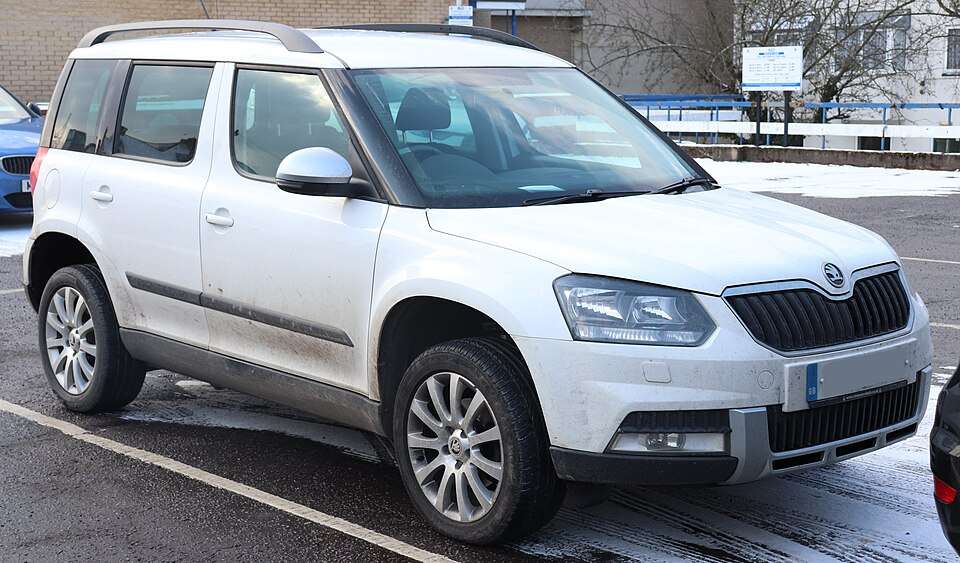
Model photograph by Vauxford, CC BY-SA 4.0. Resized for display.
Like our guides and unusual cars?
Get forgotten finds, useful motoring content and the most interesting car stuff from us by email.
Free to join. No spam. Unsubscribe whenever you like. See our privacy policy.