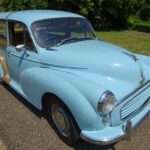
The Morris Minor Traveller made a small British family car useful in a way that still looks good today. Its ash frame mattered to the structure, and its two back doors made it a thoroughly practical estate.
1. The Traveller arrived in 1953
Morris added it to the Series II Minor range after the saloon. That timing explains why the first Travellers have details you do not see on the much more familiar Minor 1000. A split windscreen makes an early one particularly easy to spot.
2. The ash was part of the body
The visible wooden framework carried the rear body panels and framed the doors. Aluminium panels filled much of that framework. The familiar varnished lines were part of how the body was made.

3. It shared the front half of a saloon
The Traveller used the front structure and floorpan of the two-door Minor as its starting point. Behind the central pillars the design changed to accommodate the longer roof and wooden rear section. From the driver’s seat there was plenty a saloon owner would recognise.
4. Its first engine displaced 803cc
The earliest version shared the Series II’s A-series engine. The first bump brought 948cc and the Minor 1000 name in 1956. That meant a Traveller could look broadly the same from the back and still belong to a very different mechanical specification.
Love cars you don’t see every day?
Get forgotten cars, surprising motoring stories and the most interesting finds from Unusual Cars by email.
Free to join. No spam. Unsubscribe whenever you like. See our Privacy Policy.
5. The familiar 1098 arrived in 1962
The later 1,098cc engine is what many people remember from driving Travellers. The National Motor Museum quotes 48 bhp for its 1970 example. The distinction is useful whenever someone describes every Minor 1000 as a literal one-litre car.
6. The rear doors opened sideways
Two separate doors gave access to the load area. The arrangement is particularly handy to see beside a later estate with a single hinged tailgate. Morris had found a practical way to make a tall opening with the materials it already used.

7. The back seat could give way to luggage
Folding the rear seat made room for larger loads without turning the car into a permanent commercial vehicle. That was a good fit for motorists whose weekday work and weekend family trips had to share the same car.
8. An estate and a Minor van are separate things
The Traveller paired passenger accommodation with its wooden rear body. The Minor family also included dedicated commercial vans and pick-ups with their own construction. A familiar bonnet and front wings are only the beginning when telling them apart.
9. More than 200,000 Travellers were built
The British Motor Museum puts Traveller production above 200,000 within a total Minor run of roughly 1.6 million. The famous million-car milestone belongs to the entire Minor family. The estate earned a substantial place in that total in its own right.
10. The Traveller outlasted the saloon
The National Motor Museum dates the last Traveller to April 1971, five months after the last saloon. The Minor van remained in production into 1972. For the wooden-bodied passenger version, that gave the story an unusually long ending.
Explore more 10 Things articles
Browse the Unusual Cars 10 Things hub.
Sources and further reading
- National Motor Museum’s Traveller collection record
- British Motor Museum’s Minor Traveller history
- British Motor Heritage Minor body parts and model history
- Morris Minor Owners Club history of the ash-framed body
Featured image: A green Morris Minor 1000 Traveller. Photo by Peter Trimming via Wikimedia Commons (CC BY-SA 2.0, resized).
Join the Unusual Cars Club
Get more forgotten performance cars, surprising motoring stories and new 10 Things articles by email.
Free to join. No spam. Unsubscribe whenever you like. See our Privacy Policy.