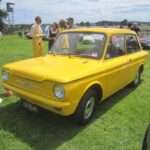
The Hillman Husky was Rootes Group’s compact dual-purpose estate, sold in Britain in three distinct forms between 1954 and 1970. The first two generations were shortened Minx-based utility cars; the final version was a tall, rear-engined estate derived from the Imp van. All combined four-seat practicality with modest running costs, and all have become considerably rarer than the saloons that supplied their mechanical parts.
At a glance
- UK sales: 1954–1970, with a break after 1965
- Generations: Minx Mk VIII-based, Audax Minx-based and Imp-based
- Body: compact three-door estate or dual-purpose utility
- Engines: 1265cc, 1390cc, 1592cc and 875cc four-cylinders
- Layout: front-engine/rear-wheel drive on Minx cars; rear-engine/rear-wheel drive on the Imp Husky
The original 1954 Husky
Hillman introduced the first Husky alongside the Minx Mk VIII in 1954. It shared much of the Minx’s front structure and running gear but used a shorter wheelbase and a practical estate body with a side-hinged rear door. Its rear seat folded to create a flat carrying platform, allowing Rootes to market it as both family transport and a light commercial-style load carrier.
Early cars retained the 1265cc side-valve engine before the 1390cc overhead-valve unit improved performance. More than 41,000 of this first post-war generation were built, yet corrosion and hard working lives have left very few survivors.
Audax-based Husky: 1958–1965
The second generation adopted the modern Audax Minx front end and a slightly longer wheelbase. The 1958 Series I gained the 1390cc overhead-valve engine, a floor-mounted gearchange and useful increases in load space and payload. Series II and III updates brought more power, revised styling and ultimately the 1592cc engine.
It remained a deliberately simple car: two side doors, a large rear opening and a cabin that could switch quickly between passengers and luggage. It was not fast, but its light controls and compact dimensions suited towns, tradespeople and families who did not need a full-sized estate.
The rear-engined Imp Husky
After a short gap, the Husky name returned in 1967 on a very different vehicle. Rootes converted the Commer Imp van into a four-seat estate by adding side windows, interior trim and a folding rear seat. The 875cc aluminium overhead-cam engine remained beneath the rear load floor, while strengthened suspension components helped it carry up to roughly 50 cubic feet of luggage.
The Imp Husky was Britain’s only rear-engined estate of its generation. It combined excellent steering and an eager engine with a remarkably boxy, useful body, but survived for only three years. Fewer than 11,000 were built before Chrysler rationalised the Rootes range in 1970.
UK specifications
| Generation | Engine | Years | Character |
|---|---|---|---|
| Husky Mk I | 1265/1390cc four | 1954–1957 | Short-wheelbase Minx utility |
| Husky Series I–III | 1390/1592cc four | 1958–1965 | Audax styling and greater capacity |
| Imp Husky | 875cc OHC four | 1967–1970 | Rear-engined high-roof estate |
What is a Hillman Husky like to drive?
The Minx-based cars feel sturdy and straightforward. Their gearing is low, performance modest and ride firmer than a full-length Minx, but visibility and compact dimensions make them approachable. The later 1592cc cars are best suited to modern traffic.
The Imp Husky is livelier. Its precise steering, independent suspension and free-revving aluminium engine give it real charm when unladen. A heavy load changes the balance and demands sympathetic driving, particularly in crosswinds and on wet roads.
Hillman Husky buying guide
Body and corrosion
Inspect sills, floors, door pillars, wheelarches, suspension mountings and the rear load area. Minx-based cars can corrode around the bulkhead, chassis rails and spring hangers. Imp Huskies need close attention around the front suspension, inner wings, screen surrounds, floor seams and rear structure. Tailgates and model-specific side panels are difficult to replace.
Engines and cooling
On Minx-based cars, check for low oil pressure, smoke, timing-chain noise and neglected cooling systems. The Imp engine must have effective cooling: examine the radiator, water pump, hoses and fan-belt arrangement, and investigate any history of overheating. Cylinder-head and block corrosion can become expensive.
Transmission and suspension
Listen for gearbox and differential noise, check universal joints and ensure the clutch releases cleanly. Imp gear linkages can become vague, while worn suspension bushes or wheel bearings spoil otherwise accurate handling. Brakes commonly suffer after storage.
Completeness and identity
Unique glass, rear doors, seats, trim and badges matter more than easily sourced service parts. Some Imp vans have been converted into Husky lookalikes; check the chassis identity, factory window apertures and interior structure before paying for originality.
Ownership and values
A Husky offers unusual practicality without complex engineering, but restoration is rarely cheap. Minx-based cars benefit from shared mechanical components; the Imp version has particularly active specialist support. Scarcity means prices vary widely according to completeness and structural condition. An honest, usable survivor is normally preferable to a dismantled rarity missing Husky-specific parts.
Why the Husky matters
The three generations show how Rootes repeatedly reinvented the same sensible idea. The Husky evolved from a shortened family saloon into a technically adventurous rear-engined estate, providing a continuous thread of affordable British utility motoring across two very different eras.