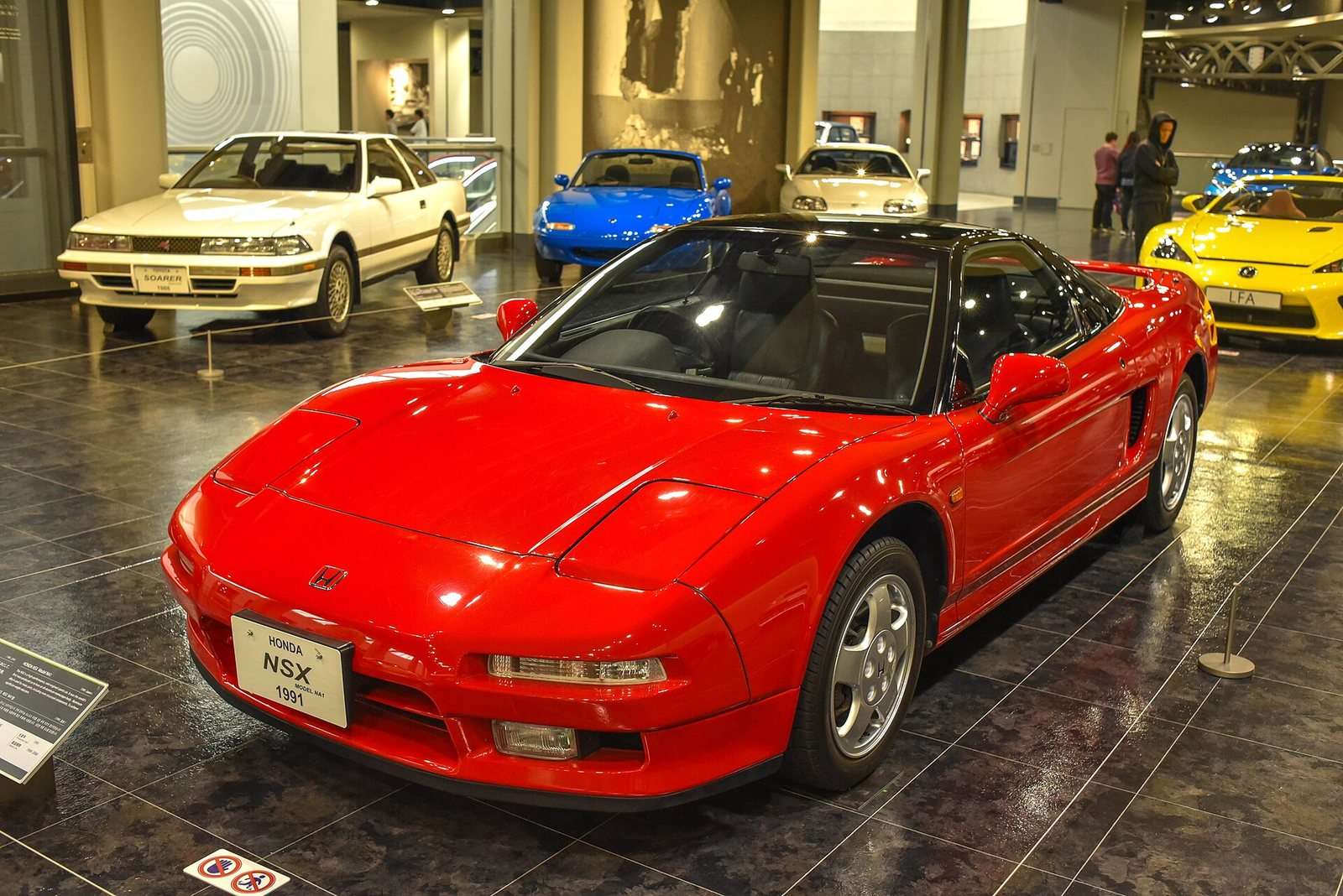
The original Honda NSX challenged the assumption that a mid-engined supercar had to be intimidating, fragile or awkward. Its aluminium structure, high-revving V6 and extraordinary visibility were impressive, but the deeper story is how Honda applied racing discipline to create a car that worked every day.
1. Honda began exploring the idea in 1984
Honda’s engineers first investigated a new mid-engined layout during 1984. What began as an experimental project developed into the NS-X prototype shown at the 1989 Chicago Auto Show, where its low nose, glassy cabin and clean proportions already looked remarkably close to production.
2. It pioneered a mass-produced aluminium monocoque
Honda described the NSX as the world’s first mass-produced car with an all-aluminium monocoque body. Aluminium was also used extensively in the suspension. The body alone saved roughly 140kg compared with an equivalent steel structure and demanded new manufacturing and repair techniques.

3. Its V6 used titanium connecting rods
The 2,977cc C30A V6 combined double overhead camshafts, VTEC variable valve timing and titanium connecting rods—technology associated more readily with racing engines than road cars. The manual car’s engine was designed to thrive at high revs without sacrificing ordinary drivability.
4. Ayrton Senna influenced it—but did not design it
Senna tested a prototype at Suzuka and told Honda that the body needed greater rigidity. Engineers responded with structural improvements, but the NSX remained the work of a large development team. His input was important without being the single-handed creation often suggested online.
Love cars you don’t see every day?
Get forgotten cars, surprising motoring stories and the most interesting finds from Unusual Cars by email.
Free to join. No spam. Unsubscribe whenever you like. See our Privacy Policy.
5. The cockpit was designed around visibility
The low scuttle, slim pillars and expansive windscreen gave the driver an unusually clear view of the road. Honda compared the human-centred cockpit thinking with a fighter aircraft, helping the NSX feel far less intimidating than many contemporary supercars.
6. The engine sat transversely behind the occupants
Unlike several longitudinally engined European rivals, the NSX mounted its V6 across the car. The compact installation helped free cabin space while retaining the mass-centralising benefits of a mid-engined layout.
7. NA1 does not simply mean pop-up headlights
NA1 identifies the 3.0-litre first-generation NSX family. The later NA2 designation is principally associated with 3.2-litre manual cars introduced in 1997, not merely the 2001 fixed-headlamp facelift. Some later-looking automatic cars remained NA1.
8. The first Type R appeared in 1992
Honda removed sound insulation and comfort equipment, fitted lighter components and sharpened the chassis to create the Japanese-market NSX Type R. The result was more focused and less forgiving, establishing a Type R philosophy later applied to much cheaper Hondas.

9. It was assembled in specialist facilities
Early NSXs were produced at Honda’s Tochigi plant before assembly moved to Suzuka. The aluminium construction and low volumes demanded specialist processes, reinforcing the car’s status as far more than a conventional Honda with an exotic body.
10. Its long production run disguised constant development
Production continued until 2005. During that time Honda introduced the open-roof NSX-T, 3.2-litre engine, six-speed gearbox, Type S derivatives and a fixed-headlamp redesign while preserving the original car’s essential balance and usability.
The NSX changed supercars by proving that precision and excitement did not require poor visibility, heavy controls or temperamental engineering.
Explore every 10 Things article in the Unusual Cars hub →
Join the Unusual Cars Club
Get more forgotten performance cars, surprising motoring stories and new 10 Things articles by email.
Free to join. No spam. Unsubscribe whenever you like. See our Privacy Policy.