The Hillman Avenger Tiger was Rootes’ vivid answer to the Escort Mexico: a rear-wheel-drive family saloon with twin carburettors, rally-inspired stripes and enough attitude to make an ordinary Avenger genuinely memorable.
Here are ten things you probably didn’t know about the Hillman Avenger Tiger.
1. The first Tigers were built by the competition department
Early Mk1 cars were prepared at Chrysler Competitions Centre rather than flowing unchanged down the normal Avenger line. The semi-specialist construction and limited numbers help explain both their desirability and the difficulty of authenticating restored examples.
2. The engine remained a 1.5-litre Avenger unit
The 1,498cc overhead-valve four gained twin Weber carburettors, a revised cylinder head, stronger valve springs and freer exhaust. Output rose to roughly 92bhp—modest now, but lively in a compact early-1970s rear-drive saloon.
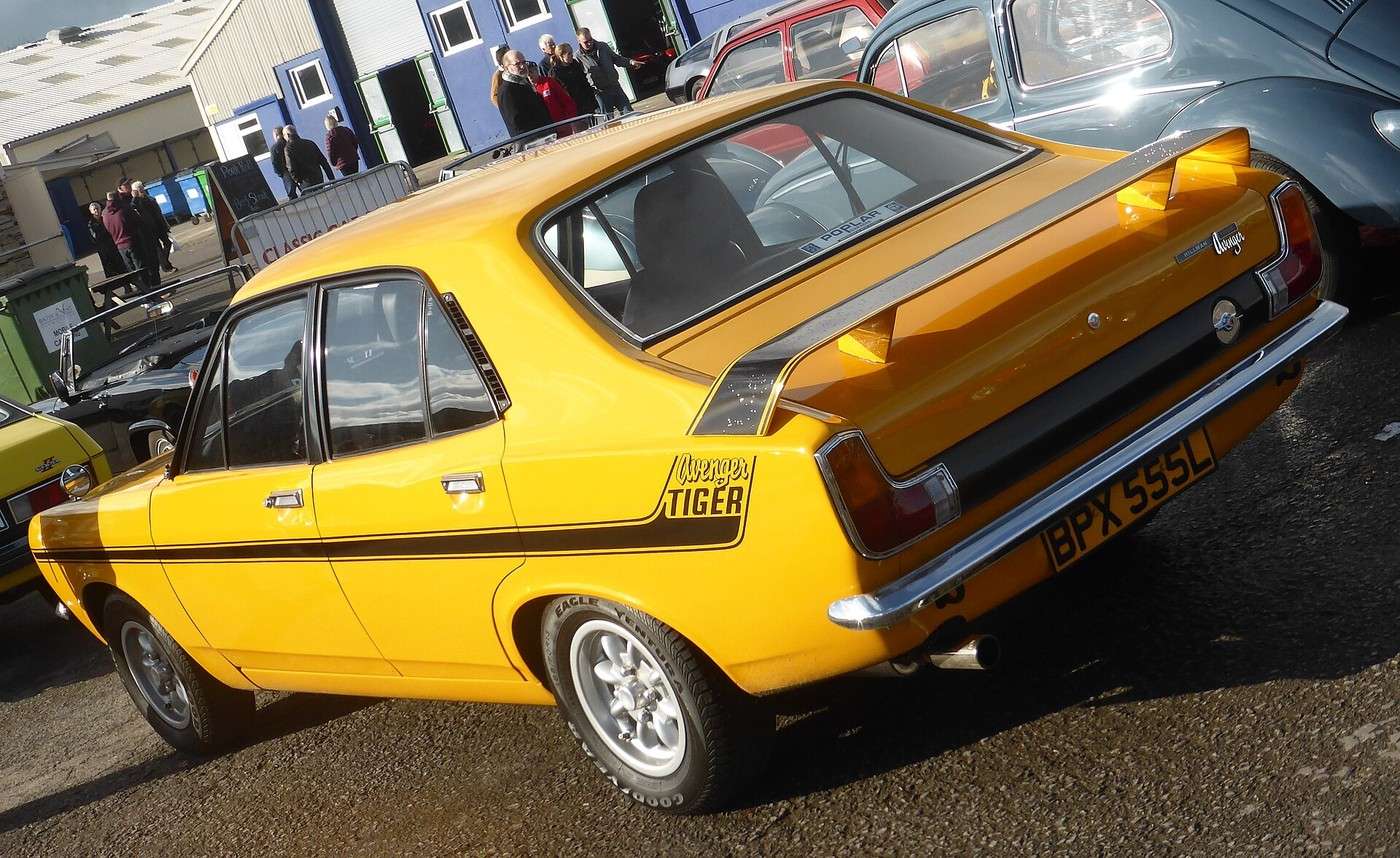
3. Sundance Yellow made it impossible to miss
The Mk1 Tiger is strongly associated with bright Sundance Yellow, black bonnet treatment, side stripes and a rear spoiler. The visual package referenced Chrysler’s American muscle cars while fitting the scale and budget of a British family saloon.
4. It was aimed directly at Ford’s fast Escort audience
The Escort Mexico proved buyers wanted affordable road cars carrying competition credibility. Hillman answered with a similarly simple recipe: tuned four-cylinder power, rear-wheel drive, uprated suspension and styling that looked ready for a rally stage.
Join the Unusual Cars Club free
Get forgotten cars, surprising motoring stories and the most interesting finds from Unusual Cars by email.
Free to join. No spam. Unsubscribe whenever you like. See our Privacy Policy.
5. The Mk2 changed both appearance and production method
Later Tiger IIs used the facelifted four-door Avenger body and were assembled more conventionally. They appeared in different colours and lost some of the first version’s competition-department mystique, but remained rare and visually distinctive.
6. FIA paperwork confirms its motorsport purpose
The FIA historic database lists the Chrysler Hillman Avenger Tiger as a 1,498cc rear-wheel-drive Group 2 car under homologation number 1656. Extensions covered items including an oil cooler, final-drive ratio, clutch, spoiler and underbody protection.
7. The ordinary Avenger became a serious competition car
Works Avengers achieved major international rally results, while locally produced derivatives competed around the world. The Tiger was not identical to the works machines, but it gave showroom buyers a credible connection with that programme.

8. Its cabin was more serious than the stripes suggested
Sports seats, additional instruments and a compact steering wheel helped the driver, while the basic Avenger dashboard and four-door practicality remained. It was a usable saloon first and a homologation-flavoured special second.
9. Badge changes complicate the family history
The Avenger began as a Hillman, later wore Chrysler branding and eventually appeared as a Talbot. Tigers belong to the early Hillman/Chrysler period, so later shells and parts can create convincing-looking but historically incorrect recreations.
10. A genuine car requires evidence, not just paint
Tiger stripes, spoilers and wheels can be reproduced far more easily than identity. Correct chassis details, period documentation and known history are essential because ordinary Avengers have long been converted into replicas.
Why it matters
The Avenger Tiger matters because it captures Britain’s early-1970s appetite for affordable competition-inspired saloons. It is colourful, simple, rare and connected to a much larger international motorsport story.
Enjoyed this one?
Join the Unusual Cars Club free for more forgotten performance cars, surprising motoring stories and new 10 Things articles.
Free to join. No spam. Unsubscribe whenever you like.
Explore every 10 Things article in the Unusual Cars hub →