At the 1971 Spa 24 Hours, the car that made AMG famous lost to a Ford Capri. The Ford’s victory made perfect sense. What took some explaining was how a Mercedes luxury saloon with four doors, a vast chrome grille and enough room in the back for a pair of company directors had come second. Imagine turning up at an athletics meeting in a dinner jacket and finishing on the podium. Even the winner might want to know where you got the suit.
The car acquired the nickname “Red Pig”. Fifty-five years later, Mercedes-AMG sells an electric four-door with three motors, and once again the interesting question is what on earth the engineers have put under a perfectly respectable set of doors.

Two engineers and a spare-time Mercedes
The letters on the boot come from two surnames and a village. Hans Werner Aufrecht and Erhard Melcher worked on Mercedes’ 300 SE racing engine. When the factory programme ended, the pair carried on in Großaspach, where Aufrecht lived. In 1965 their former colleague Manfred Schiek won ten races in the German Touring Car Championship with the engine they had prepared. Weekend work had begun to look like a viable profession.
In 1967 the pair set up in an old mill in Burgstall. Their business was building and testing racing engines, an important distinction for anyone picturing a neat row of AMG saloons awaiting customers. A customer in those days was much more likely to arrive with a Mercedes and a particular ambition for it. The now-famous address at Affalterbach came later, when the growing firm moved there in 1976.
The Red Pig earns its dinner
Mercedes had already done something fairly outrageous with the 300 SEL 6.3. It put the V8 from the enormous 600 limousine into a smaller luxury saloon. AMG took that idea a stage further, enlarged the engine to 6.8 litres and went endurance racing. The flared arches and extra lamps gave the red Mercedes a purposeful air, although no amount of race preparation could disguise quite how much car there was.
At Spa, Hans Heyer and Clemens Schickentanz had to make the Mercedes’ speed pay for its appetite for fuel and tyres. Over a qualifying lap, horsepower might settle an argument. Over 24 hours, every minute spent stationary gave the opposition another chance. Winning its class and finishing second overall was the sort of result a small engine shop could dine out on for years. Better still, a single photograph could explain why anybody should care.
The Hammer makes a family saloon supercar news
By the mid-1980s, the W124 Mercedes was becoming part of the European street scene. It had upright glass, four useful doors and that solitary windscreen wiper describing its peculiar arc. You could watch one pass without giving it a second glance. AMG realised what a splendid place this would be to hide a V8.
Erhard Melcher had developed four-valve cylinder heads, giving the big Mercedes engine more room to breathe at high revs. The resulting conversions became known as the Hammer. Capacities varied, as did the cars customers started with, so there is no single definitive Hammer specification. There is, however, a marvellous contemporary yardstick. In December 1986, Car and Driver reported reaching 60mph in five seconds flat in a four-door Hammer with an automatic gearbox.
Today that figure might describe a quick electric crossover. In 1986 the magazine was reaching for the Porsche 911 Turbo and Ferrari Testarossa as points of reference. The most subversive thing about the Hammer was that, after giving its passengers a tale about a Ferrari, it could drop three of them at their own front doors.
There was an awkward side to building cars this way, at least for anyone trying to identify one forty years later. A modern Mercedes leaves the factory with a specification that can be looked up. An early AMG might have left Mercedes as an ordinary saloon and acquired its most interesting parts some time afterwards. The invoice from the customer who paid for the work can tell you more than the three letters on the boot. An authentic set of period wheels makes a lovely addition to a W124. It takes rather more paperwork to establish that there is a Hammer in the garage.
The little 190 takes the fight to BMW
For a rather different picture of AMG in the late eighties, look at the Mercedes 190 on a German touring-car grid. Here was the smallest saloon Mercedes made, surrounded by cars such as the BMW M3 and being asked to change direction, brake and accelerate all afternoon. With the big red car at Spa, the question had been how fast AMG could make a luxury saloon go. With the 190, the question was how many times a lap it could do it, and how close the driver could get to the same braking point next time round.
AMG counts 50 DTM race victories for the works-supported 190 between 1988 and 1993. Look at the high rear wing and deep front air dam of the 190 E 2.5-16 Evolution II and you can see what the competition did to the shape of the road car. The best part is the centre section. Cover up the wing and the wheels with your fingers and there, quite distinctly, is the little Mercedes that used to queue outside the school gates.
The C36 brings AMG to the Mercedes showroom
By the late 1980s Mercedes and AMG were working together on the 190 touring-car programme. A 1990 agreement opened Mercedes’ sales and service network to AMG products. Then, in 1993, the first production car jointly developed under that agreement arrived. Anyone expecting another outrageous V8 got a surprise. The C36 AMG used a 3.6-litre straight-six.

Look at the C36 today and the restraint is part of its appeal. The deeper bumpers and broad wheels suit the square little W202 C-Class, yet it still looks like something a conscientious fleet manager might sign off. The real revolution was how you bought it. The Hammer belonged to a world of specialist commissions. The C36 put a recognisable AMG model on the showroom floor, with a dealer to look after it once you took it home.
The next C-Class makes a good pub quiz question. What engine did the original C43 AMG have? In 1997 the answer was a 4.3-litre V8. Ask the same question about the C43 saloon Mercedes announced in 2022 and the answer is a turbocharged two-litre four. Both answers are correct, which is a splendid way to lose an evening arguing over the scoresheet. It also illustrates how quickly the C36 had changed expectations. Within four years of its arrival, a customer could walk into a Mercedes dealership and reasonably enquire about taking the compact saloon with eight cylinders instead of six.
The CLK GTR takes a much stranger route to the road
Just four years later AMG produced something that would have given that fleet manager palpitations. The 1997 CLK GTR borrowed the family resemblance of the CLK coupé, then placed a V12 behind the driver. According to Mercedes, the motorsport team designed its GT1 racer in just 128 days. Bernd Schneider went on to win that year’s FIA GT drivers’ championship.

GT1 regulations also required a road-going counterpart. That explains the delicious oddity of the CLK GTR road car. Most fast Mercedes started with something civilised and acquired bigger brakes, wider tyres and more power. Here the engineers started with a racing car and had to work out how someone might use it on the road. Of all the unlikely machines to wear a familiar Mercedes face, this one takes some beating.
The V8 years give Britain a favourite second-hand AMG
DaimlerChrysler took a majority stake in AMG in 1999 and completed the takeover in 2005. Enthusiasts wondering whether corporate ownership would calm the engineers down soon had their answer. Consider the W211-generation E55 AMG estate. A supercharged V8, 700Nm of torque and a load bay big enough for the family holiday all came on the same order form. Few cars have made such a persuasive case for taking the dog.
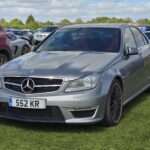
Then came the W204 C63 AMG. Its naturally aspirated M156 V8 displaced 6,208cc, a useful early warning against reading Mercedes boot badges as precision measuring instruments. With no supercharger or turbochargers, the engine’s response and the way its voice hardened as the revs rose were central to the experience. The estate is arguably the pick of the bunch for sheer incongruity. The saloon, seen here, hardly gives the game away either.

Lift the bonnet of a W204 C63 and there is another detail worth stopping for. The engine carries the name of the person who assembled it. AMG calls the practice “One Man, One Engine”. On a used car, it can be the only name you know from before the first owner took delivery. The tradition outlasted that particular V8, too. Mercedes describes the four-cylinder engine in the later C43 as hand-built. Anyone hunting for a genuine AMG by counting spark plugs or looking for a particular pair of digits on the boot is going to walk past some very interesting cars.
That distinction still matters in the classifieds. A CLA 220 d AMG Line can have handsome wheels, sporting seats and a purposeful stance. The diesel engine and model identity remain those of a CLA 220 d. A CLA 45, on the other hand, belongs to the AMG performance family and gets its own highly developed turbocharged four-cylinder. Counting cylinders is no more reliable than counting the badges.
Black Series, gullwings and a very early electric surprise
In 2006 AMG introduced Black Series with the SLK55. Its most telling alteration was overhead. The ordinary SLK’s party trick was a roof that folded into the boot. AMG fitted a fixed roof to the Black Series, surrendering the very feature that had sold so many SLKs. The later CLK63 Black Series similarly dispensed with the rear seats. You could learn quite a lot about these cars by looking at what your money had bought you the privilege of leaving behind.
Love cars you don’t see every day?
Get forgotten cars, surprising motoring stories and the most interesting finds from Unusual Cars by email.
Free to join. No spam. Unsubscribe whenever you like. See our privacy policy.
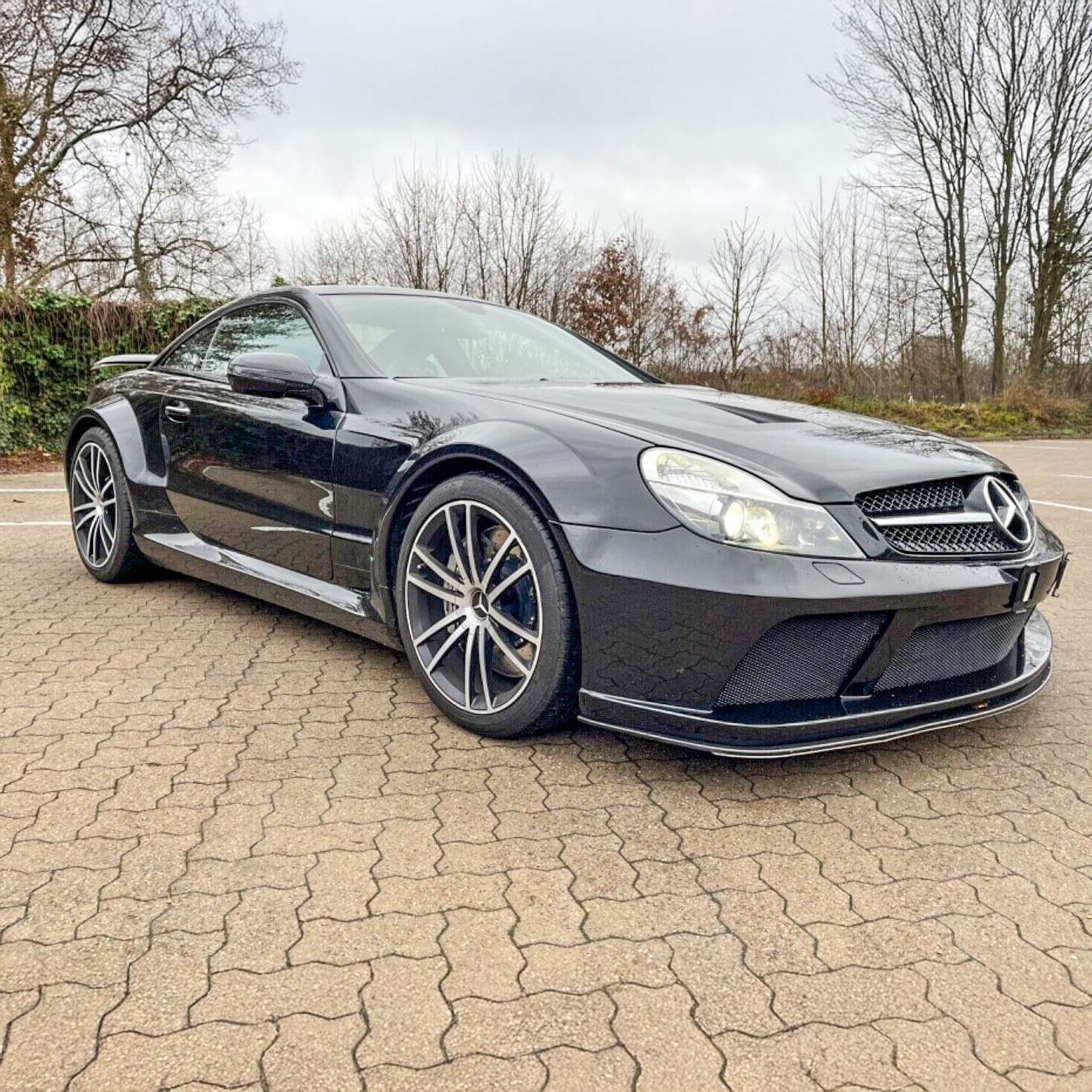
The car at the top of this page is the 2008 SL65 AMG Black Series, and it deserves a closer look. Under those extravagant front wings sat a twin-turbocharged V12. The regular SL was a grand tourer with a folding hardtop, the sort of car you could buy for the open-air journey to the south of France. The Black Series had a fixed roof. At a stroke AMG had removed one of the main reasons for buying an SL, and created one of the strongest reasons for remembering this particular one.
There is a nice way to read the Black Series family album. Start with the short, stubby SLK, turn the page to the wide-arched CLK, then look at that vast SL. Each started with a different job and a different set of proportions. Even the number of cylinders changed. By 2011 you could have the treatment on a C63 Coupé. Imagine explaining to the original C36 development team that one day the discreet little company car would have a relative with wheelarches like those.
The SLS AMG, unveiled in 2009, gave Affalterbach the freedom to design a complete sports car. Its long bonnet and gullwing doors recalled the 1950s 300 SL, while a rear-mounted gearbox helped balance the front-mounted V8. Yet one of the most extraordinary SLS derivatives barely made a sound. The SLS AMG Electric Drive used four electric motors, one for each wheel. AMG was already experimenting with how to distribute power through a corner while many of its customers were still choosing a sports exhaust.

How the AMG GT put the engine between the wheels
Viewed from the side, the first AMG GT looks as though the photographer has accidentally stretched the front half of the picture. The bonnet goes on for ages. The driver sits well back, the tail falls away almost immediately, and the front wheels look a long way from the door. Unveiled in 2014, it followed the SLS as a sports car AMG could design from scratch. The proportions tell you where the engineers spent that freedom. They set the V8 behind the front axle and the gearbox at the rear, sharing two substantial lumps of machinery between the ends of the car.
The engine itself was quite a departure. The SLS had made its name with a large, naturally aspirated V8. The GT went down to four litres and tucked two turbochargers into the space between the cylinder banks. Exhaust gases had a short trip from the heads to the turbines, and the complete assembly fitted under that low bonnet. Where the SLS announced itself with gullwing doors, the GT had conventional doors and a decidedly unconventional engine room. Five minutes looking round one with the bonnet up is time well spent.
Then came the 2020 GT Black Series, with a flat-plane crankshaft that changed the firing sequence and the sound of the V8. That detail goes some way towards explaining the fascination of the Black Series cars. You could recognise this one from the far side of a paddock by its rear wing. The part that gave it a different voice was buried so far inside the engine that most owners would never see it.
From a Formula One engine to the electric four-door
The Mercedes-AMG ONE pursued a different obsession. Could AMG make a road car around a Formula One-derived 1.6-litre turbocharged V6? Getting it to idle civilly and meet emissions requirements was rather a different assignment from getting it round Silverstone. In September 2024 Maro Engel drove the finished hybrid around the full Nürburgring Nordschleife in 6min 29.090sec. For an engine once asked to behave itself at traffic lights, it was quite an afternoon out.

The same argument about the sound of an AMG came home to roost with the C63 S E Performance. Revealed in 2022, it combined a turbocharged two-litre four-cylinder engine with a rear electric motor for a system output of 680 PS. Think back to the W204 estate. Half the charm of that car was hearing eight cylinders clear their throats on an entirely unremarkable journey. The hybrid offered a very different pleasure, with an electric motor able to contribute as soon as the driver asked for acceleration. You can admire the ingenuity of the newer car and still choose the older one for the drive home.
By November 2026 the badge has reached another crossroads. The electric Mercedes-AMG GT 4-Door Coupé, unveiled in May, uses three compact axial-flux motors and directly cooled battery cells. Cooling matters because a performance car should still deliver its punch after the first big acceleration. Meanwhile AMG has confirmed that a new GT Black Series is being developed alongside its next GT3 racing car. One engineering team has batteries to cool. Another has a road-going relative of a racing car to perfect.
Which leaves the Red Pig in rather good company. Park the 1971 saloon beside the electric GT and they would draw a crowd for entirely different reasons. Open the back doors, though, and there it is again, the peculiar pleasure AMG understood from the beginning. There’s room to bring people along who will scarcely believe what just happened.