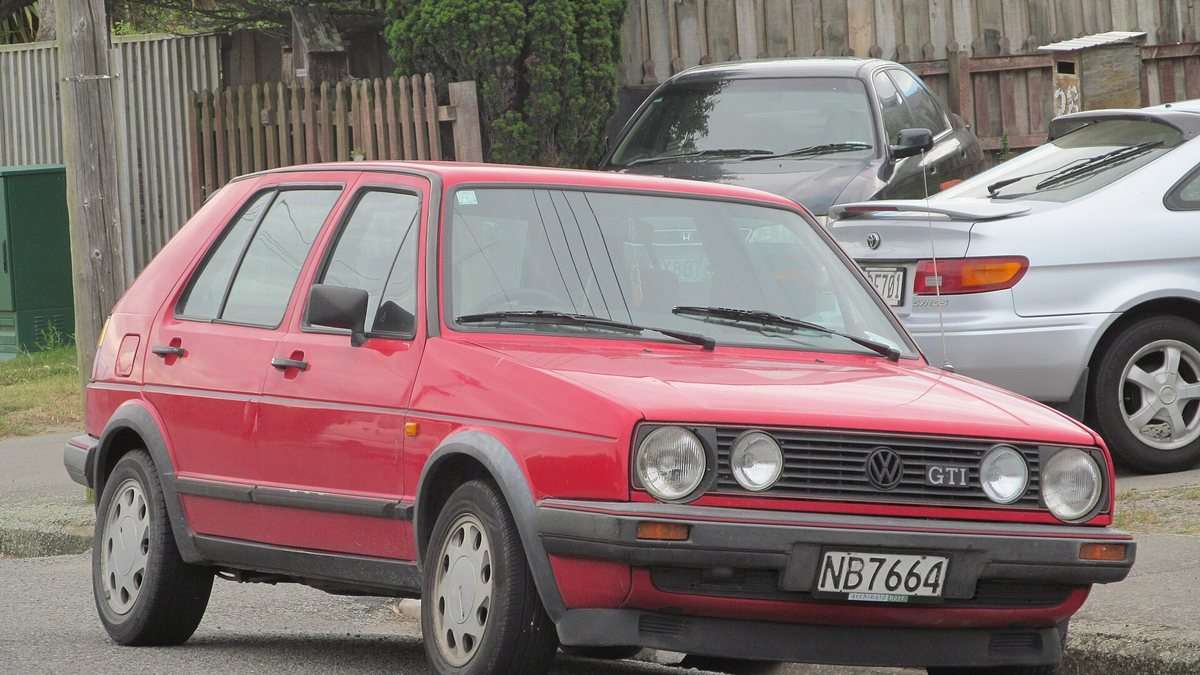

A larger Golf with the same brief
The second-generation Golf used a longer, wider and more aerodynamic body, giving passengers more space and the car greater high-speed stability. Volkswagen retained the GTI’s red grille detail, twin-headlamp identity and practical hatchback layout. Although heavier than the Mk1, the Mk2 felt more substantial and became one of the defining European performance hatchbacks of the 1980s.

The 8-valve GTI
Early cars continued with 112 PS, although catalytic-converter versions briefly fell to 107 PS. The 1.8-litre 8V is valued for accessible torque and uncomplicated road manners rather than headline speed. Later DigiFant-injected cars feel different from early K-Jetronic examples, so year, engine code and market specification should be identified rather than treating every 8V as identical.

Love cars you don’t see every day?
Get forgotten cars, surprising motoring stories and the most interesting finds from Unusual Cars by email.
Free to join. No spam. Unsubscribe whenever you like. See our privacy policy.
Why the 16V changed the argument
The twin-cam 16-valve engine arrived in 1986 with 139 PS without a catalyst, or 129 PS in catalysed form. Its appetite for revs and stronger top-end made the GTI competitive with a new generation of faster rivals. Red 16V badging, discreet styling changes and model-specific mechanical details distinguished it without turning the Golf into a body-kitted special.

G60 and specialist derivatives
Volkswagen’s spiral G-Lader supercharger lifted the Golf GTI G60 to 160 PS in 1990. It sat above the 16V but remained a relatively rare choice. The broader Mk2 family also produced the four-wheel-drive Rallye Golf and the 210 PS Golf Limited; those are distinct collector models, not ordinary GTIs with cosmetic changes.
Why the Mk2 remains important
The Mk2 demonstrated that a hot hatch could mature without losing its identity. It offered everyday space, mechanical variety and a huge motorsport and tuning culture. Originality now matters because engines, interiors, suspension and body panels were frequently mixed between cars during decades of affordable use.
Versions at a glance
| Version | Engine | Output | Defining trait |
|---|---|---|---|
| GTI 8V | 1.8-litre eight-valve | 107–112 PS | Flexible everyday character |
| GTI 16V | 1.8-litre sixteen-valve | 129–139 PS | Stronger high-rev performance |
| GTI G60 | 1.8-litre supercharged | 160 PS | Rare G-Lader flagship |
Frequently asked questions
Is the Golf GTI Mk2 8V or 16V better?
Neither is universally better. The 8V has accessible low-speed torque; the 16V rewards revs and is faster. Condition and originality matter more than the valve count.
What is a big-bumper Mk2 GTI?
Later Mk2s received deeper moulded bumpers. The term describes a production-era appearance, not a separate engine specification, and many earlier cars have been converted.
Did Britain receive the Golf GTI G60 officially?
The G60 was not a normal high-volume UK model. Many surviving right-hand-drive or UK-registered examples have import or conversion histories that should be documented.
Is the Rallye Golf the same as a GTI G60?
No. The Rallye has widened bodywork, rectangular headlamps and Syncro four-wheel drive. Both use G-Lader technology, but they are structurally and historically distinct.
Continue the Volkswagen story
Browse the Rare & Performance Volkswagens hub, compare it with the Mk1 Golf GTI, or explore the Rallye Golf G60.