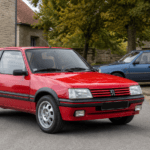
The Peugeot 205 CTI translated the GTI idea into a compact four-seat cabriolet. It retained recognisable sporting details while adding Pininfarina-designed open bodywork, creating a model with its own character and its own buying risks.
Peugeot 205 CTI history
Peugeot’s in-house team created the basic 205 hatchback, while Pininfarina was responsible for the cabriolet. The open model debuted in 1986 in CT and CTI forms, with the CTI borrowing sporting presentation and mechanical ideas from the GTI. Less performance-focused CJ versions and special editions broadened the cabriolet family later.
The removal of the fixed roof required a different structure, and Pininfarina assembled the cars in Italy. That gives the CTI more than novelty value: it represents a distinct Franco-Italian branch of the 205 story.
Engines and specification
| Launch | 1986 |
|---|---|
| Early CTI | 1.6-litre petrol, 115hp in Peugeot’s heritage account |
| Later CTI | 1.9-litre petrol, commonly quoted at 105hp in relevant markets |
| Body | Two-door, four-seat fabric-roof cabriolet designed and assembled by Pininfarina |
| Layout | Front engine, front-wheel drive |
UK specifications, emissions equipment and trim changed over time. Confirm the engine code and original market rather than assuming every 1.9 CTI shares the 130hp closed GTI specification.
CTI versus GTI
205 CTI
Open-air experience, Pininfarina bodywork and extra structural considerations. It has sporting character but a different balance of rigidity, weight and practicality.
205 GTI hatchback
Closed shell, sharper performance focus and the best-known 1.6 and 1.9 GTI specifications. It is the benchmark, not an identical car with a roof attached.
Roof, body and corrosion checks
- Raise and lower the roof, checking frame alignment, catches, fabric, rear window and seals.
- Look for water staining beneath carpets, behind trim and inside the boot.
- Inspect drainage routes and check for improvised sealants or trapped moisture.
- Examine sills, floors, inner wings, suspension mountings and the cabriolet’s structural reinforcements.
- Check door gaps with the roof both raised and lowered; unusual movement can indicate corrosion or poor repairs.
- Inspect the boot floor and rear quarters for previous accident damage.
Mechanical and interior checks
Ask for evidence of timing-belt and cooling-system maintenance, then check for overheating, leaks and unstable idle. On the test drive, listen for gearbox or driveshaft noise, assess steering and brakes, and look for rear-wheel lean that may indicate rear-beam wear.
Edition-specific seats, door cards, mouldings and hood components can be difficult to source. Verify electrical equipment, heater fan, instruments and window operation. A damp cabin can damage trim and electrics even when the roof appears presentable.
Originality and modifications
Many CTIs have accumulated GTI wheels, replacement roofs, lowered suspension or engine changes. Sensible improvements do not automatically make a poor car, but the work should be documented and correctly insured. A car advertised as original should have engine, trim, colours and equipment consistent with its year and market.
Frequently asked questions
Was the Peugeot 205 CTI built by Pininfarina?
Pininfarina designed the cabriolet and assembled it at its Italian facilities.
Does a 1.9 CTI have the same engine output as a 1.9 GTI?
Do not assume so. Peugeot heritage material describes the later CTI’s 1.9-litre engine at 105hp, while specifications can vary by market and emissions equipment.
Is the CTI a genuine GTI convertible?
It is Peugeot’s sporting 205 cabriolet and shares GTI-related engines and presentation, but its open body and structure make it a distinct model.
Research note: launch, design, assembly and engine chronology were checked against Peugeot and Stellantis heritage material. Specifications varied by model year and market; verify an individual vehicle from its VIN and original documentation.