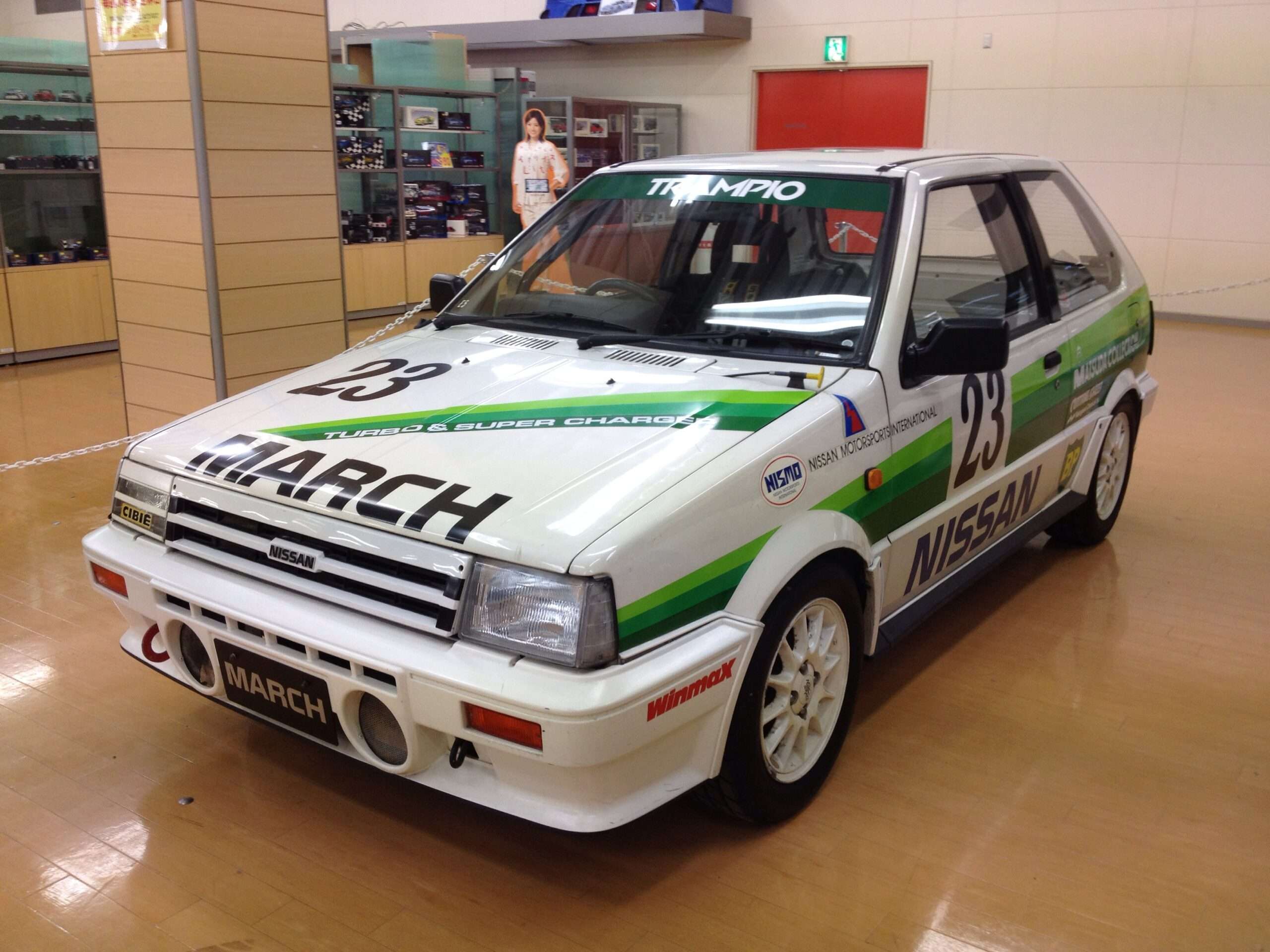
The Nissan March Super Turbo paired a supercharger and turbocharger with a 930cc K10 hatchback. It is one of Nissan’s most unusual road cars: small, light, Japanese-market only and built around a powertrain few manufacturers would have attempted.
March Super Turbo specifications
| Feature | Factory guide |
|---|---|
| Model | Nissan March Super Turbo (EK10) |
| Engine | MA09ERT, 930cc inline four, OHC |
| Induction | Supercharger and turbocharger |
| Quoted output | 110PS at 6,400rpm; 130Nm at 4,800rpm |
| Layout | Front engine, front-wheel drive |
| Context | Road-going relative of the competition-focused March R |
Why twin charging?
Nissan used the supercharger to strengthen response at lower engine speed and the turbocharger to sustain boost higher up the rev range. The result is a far broader, more energetic character than a 930cc capacity suggests. Nissan’s own Heritage Collection identifies both systems on the MA09ERT engine.
Love cars you don’t see every day?
Get forgotten cars, surprising motoring stories and the most interesting finds from Unusual Cars by email.
Free to join. No spam. Unsubscribe whenever you like. See our privacy policy.
From March R to Super Turbo
The March R was designed with motorsport classification in mind. Capacity was reduced from the ordinary MA engine’s 987cc to 930cc so that, with a forced-induction equivalency factor applied, the car fitted the relevant competition class. The Super Turbo followed as a road car, retaining the remarkable engine but adding the usability expected of a small hatchback.
Buying checks
Shell and corrosion
Inspect sills, jacking points, floors, inner wings, suspension mounts, rear arches, boot floor and windscreen surround. Japanese imports may have avoided UK winters when new, but age, storage and later repairs still matter.
Twin-charged engine
Start it cold and look for smoke, coolant loss, unstable idle, hose deterioration and improvised wiring. The supercharger, turbocharger, vacuum lines, cooling system and electronic controls must work as one system. Routine K10 parts may be available; Super Turbo-specific components require patience.
Road test and completeness
Check gearbox operation, clutch, driveshafts, brakes, wheel bearings and suspension bushes. Test every electrical function. Original instruments, seats, trim and exterior details are not cosmetic afterthoughts on a rare import: they are part of its identity and can be difficult to replace.
Ownership advice
Use a specialist comfortable with older Japanese forced-induction engines, keep documentation, and make preventative maintenance part of ownership. A well-sorted Super Turbo is a tiny, clever and genuinely unusual performance car; an undocumented one is not a bargain merely because it looks like a hot hatch.
Frequently asked questions
How much power did it make?
Nissan lists 110PS and 130Nm for the road-going Super Turbo.
Was it both supercharged and turbocharged?
Yes. Both systems were fitted to the factory MA09ERT engine.
Is it the same as the March R?
No. They are related, but the March R was the competition-focused model and the Super Turbo was the road car.
Technical details checked against Nissan’s Heritage Collection. Photograph: Iwao, CC BY-SA 2.0, via Wikimedia Commons.