The Morris J2 was one of Britain’s early forward-control, unitary-construction vans—and an important base for compact 1950s and 1960s camper conversions. Today its character, rarity and period interiors are highly appealing, but structural condition matters far more than nostalgic paintwork.
This guide covers J2 history, the closely related Austin 152, petrol and diesel engines, period camper builders, identification and the checks needed before buying or restoring one.
Morris J2 at a glance
| Produced | 1956–1967 |
|---|---|
| Layout | Forward control, rear-wheel drive |
| Construction | Unitary steel body; chassis-cab versions also supplied for specialist bodies |
| Morris designation | J2 |
| Austin equivalent | Austin 152 / Austin J2 |
| Early petrol engine | 1,489cc BMC B-Series |
| Later petrol engine | 1,622cc BMC B-Series |
| Diesel option | 1,489cc BMC diesel from the early 1960s |
| Transmission | Four-speed manual; automatic available on some later versions |
| Main buying concern | Corrosion in the unitary structure and quality of past camper alterations |


What is a Morris J2?
The J2 was a medium-sized BMC light commercial introduced in 1956. Its forward-control layout placed the driver and passenger ahead of the front axle with the engine housed between them. This maximised usable body length for a relatively compact overall footprint, making the van attractive to delivery fleets, minibus operators and motor-caravan converters.
Unlike the older separate-chassis Morris J-type and JB, the standard J2 used unitary construction. BMC also offered pickup, minibus and chassis-cab forms, allowing outside coachbuilders to create specialist bodies. Production continued until 1967, when the Austin/Morris 250JU replaced it.
Morris J2 or Austin 152?
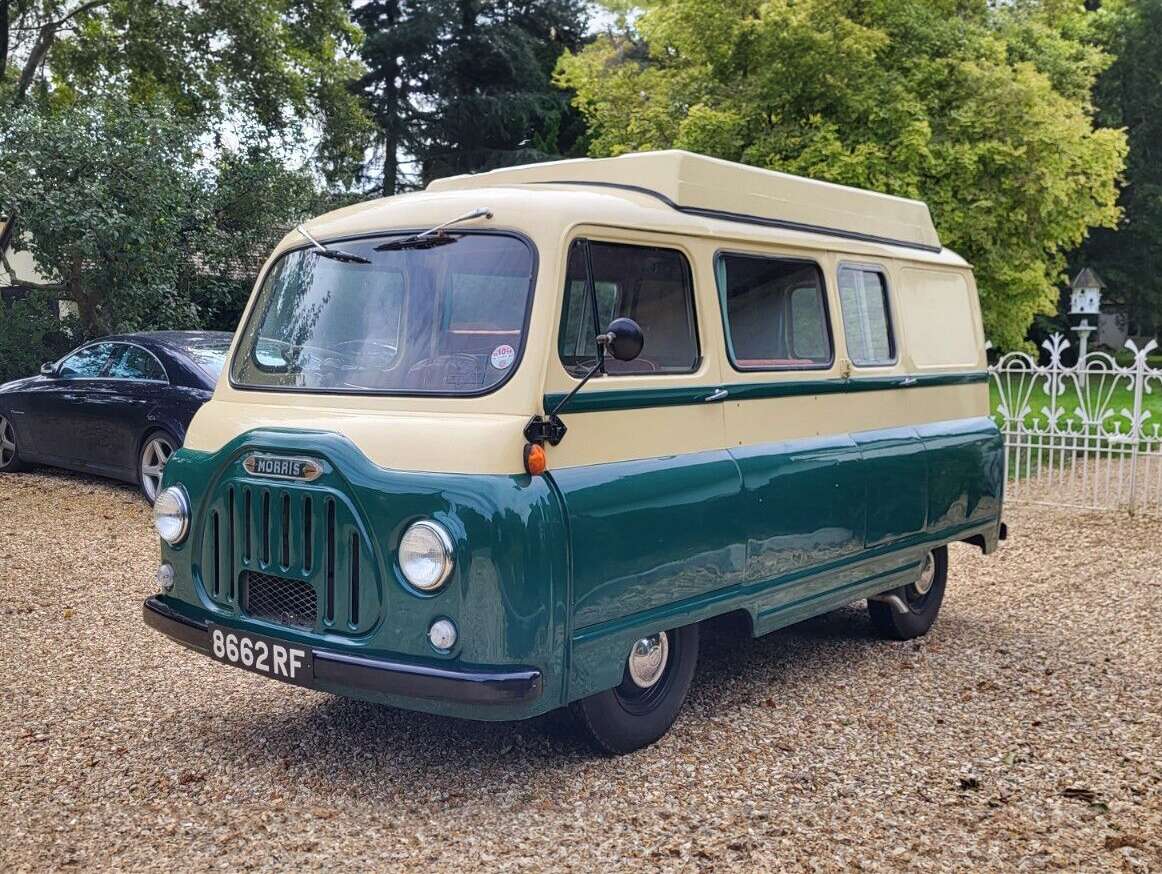
Under the badges, the Morris J2 and Austin 152 were essentially twins produced within the British Motor Corporation. The most obvious visual difference is at the front: the Morris has a lozenge-shaped grille with vertical bars, while the Austin uses a more rectangular grille with horizontal bars.
Grilles and badges can change during a vehicle’s long life. One preserved 1960 Calthorpe Home Cruiser, for example, wore an Austin grille after an accident before a Morris item was eventually sourced. Use identity numbers, documents and period photographs rather than the grille alone.
Why the J2 made a good camper
The engine-between-the-seats layout freed a useful rectangular space behind the cab. A relatively wide body and upright sides allowed converters to install beds, cupboards, a small galley and, in some cases, an elevating roof. It was modest by modern motorhome standards but offered genuine family holiday freedom in the late 1950s and 1960s.
Both van conversions and coachbuilt bodies existed. Known period names include Calthorpe Home Cruiser and Bluebird Highwayman, while Martin Walter’s Dormobile business was closely associated with elevating roofs and compact British campers. Specifications varied greatly because outside converters and later owners adapted vehicles to suit different needs.
Conversion warning: an old-looking interior is not necessarily the original camper fit-out. Establish who converted the vehicle, when the work was done and how much period material survives before paying a premium for provenance.
Morris J2 engines and driving experience
Early J2s use the 1,489cc BMC B-Series petrol engine, a familiar unit with strong parts knowledge across the classic-car world. From the early 1960s the petrol engine grew to 1,622cc, and a 1,489cc naturally aspirated diesel was offered. The vehicle pictured here was advertised as a 1960 1,489cc petrol model with a four-speed column-change gearbox.
A J2 is happiest at an unhurried pace. Steering, drum brakes, crosswinds and the weight of a camper conversion all demand anticipation. The engine cover also places heat and noise directly in the cab. That is part of the period experience, but excessive wandering, poor braking or overheating should never be dismissed as “old vehicle character”.
How to identify a period camper conversion
- Look for a converter’s plate, badge, handbook, invoice or sales leaflet.
- Compare roof shape, window layout, furniture and floor plan with documented examples.
- Check old registration documents and photographs for body-type or colour changes.
- Inspect whether window and roof apertures appear professionally reinforced.
- Record surviving fittings before restoration; rare original items are easy to discard and difficult to replace.
Morris J2 camper buying checklist
Unitary structure and body
- Inspect sills, floors, wheelarches, spring and suspension mounting areas and the lower body seams.
- Check cab steps, door apertures, front panel, windscreen surround and roof gutters.
- Examine rear floor and body edges beneath furniture and water containers.
- Look for distortion or cracking around side-window and elevating-roof cut-outs.
- Treat fresh underseal with caution unless photographic evidence shows sound metal beneath it.
- Confirm doors close consistently and the body sits level before judging cosmetic paintwork.
Engine and cooling
- Start from cold and check for smoke, oil-pressure concerns, coolant loss and persistent noise.
- Inspect radiator, hoses, water pump, fan belt and signs of previous overheating.
- Look for oil and fuel leaks around the engine enclosed inside the cab.
- Verify that insulation around the engine cover is secure, heat resistant and not contaminated with fuel or oil.
- Ask for recent servicing evidence and check modifications are documented.
Gearbox, steering and brakes
- Test the column gearchange carefully for excessive play or difficulty selecting gears.
- Check clutch operation, propshaft joints and rear axle for vibration or noise.
- Inspect steering joints, kingpins, wheel bearings, springs and dampers.
- Brake firmly in a safe place and ensure the van stops straight without excessive pedal travel.
- Check tyres for age, load rating and damage, not simply tread depth.
Camper equipment
- Inspect the elevating roof fabric, frame, catches and seals for damage and water ingress.
- Check furniture is securely fixed without concealing damp or structural corrosion.
- Have gas equipment and cylinders assessed by a suitably qualified professional before use.
- Inspect 12V and mains wiring, batteries, chargers and hook-up equipment for safe modern installation.
- Test water systems and look for leaks around pumps, sinks and tanks.
- Confirm the seating and sleeping layout suits your needs; early camper seats may not have modern restraints.
The 1960 camper pictured here
This green-and-cream J2 appeared in a 2023 online advertisement. Its seller described a restored 1,489cc petrol camper retaining its original front seats, dashboard and steering wheel, with a pop-top, gas stove, sink and water pump in the rear. The advert also mentioned overhauled brakes, ignition work and a stainless-steel exhaust.
Those details preserve the story of this particular vehicle but are not a substitute for an inspection or proof of who completed the conversion. The expired sales link has therefore been removed from this evergreen guide.
Frequently asked questions
Is an Austin 152 the same as a Morris J2?
Mechanically they are closely related BMC twins. Badges and grille design are the clearest original external differences.
Did every J2 leave the factory as a camper?
No. Many began as vans or chassis-cabs and were converted by specialist coachbuilders or later owners.
What is the biggest buying risk?
Corrosion in the unitary structure, especially where camper alterations or furniture conceal it. Obtain a thorough structural inspection.
Explore more unusual classics
Continue through our Rare & Forgotten Cars guides, read the Gilbern Invader guide, or use our classic-car rust inspection guide before assessing a historic van.