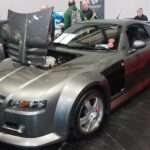
The MG XPower SV-R was one of the boldest road cars ever to wear an MG badge. A carbon-bodied, Ford V8-powered coupe with Italian roots and British finishing, it was MG Rover’s improbable attempt to build a genuine halo car: rare, dramatic and far more interesting than its short life suggests.
It was never meant to be sensible. The SV-R arrived in an era when Porsche and Aston Martin owned the well-established grand-tourer market, yet MG Rover chose to take them on with a hand-built machine born from a complicated Anglo-Italian story. Its commercial timing was cruel, its production run tiny and its design gloriously unapologetic. That is precisely why it deserves to be remembered.
For the shorter companion read, start with 10 Things You Probably Didn’t Know About the MG XPower SV-R. This is the fuller story of where the car came from, how it was made and why it remains such an extraordinary modern MG.
MG XPower SV-R at a glance
| Built | 2003–2005 |
|---|---|
| Layout | Front engine, rear-wheel drive |
| Structure | Steel box-frame chassis with carbon-fibre body panels |
| Origins | De Tomaso Biguà / Qvale Mangusta |
| Production styling | Peter Stevens |
| SV-R engine | 5.0-litre Ford Modular V8 |
| Output | About 385bhp and 510Nm |
| Gearbox | Five-speed manual |
| Production | Very limited; the overall SV-family total is commonly quoted at about 82, although sources differ |


A supercar with a life before MG
The XPower SV-R did not begin as a clean-sheet project at Longbridge. Its family tree goes back to the De Tomaso Biguà, a compact V8 sports car shown in 1996. When the original project changed hands it became the Qvale Mangusta, built in Modena under the leadership of American distributor Bruce Qvale. The Mangusta had already solved the expensive basics: a viable chassis, a Ford V8 installation and approval for key markets.
MG Rover bought the Qvale operation and its assets in 2001. It was a shrewd shortcut for a company without the budget or time to engineer an exotic car from nothing. The underlying structure was inherited, but MG’s intention was never simply to rebadge a Mangusta. The first clue was the MG X80 concept, followed by a production car that looked much sharper, lower and more confrontational.
Peter Stevens gave it its own identity
Peter Stevens, whose work includes the McLaren F1 and Lotus Esprit, led the transformation. The finished SV was recognisably related to the Qvale beneath its skin, but its proportions and detailing were unmistakably different. Vast air intakes, vented wings, deep skirts and a deliberately theatrical tail made it look more like a concept car that had slipped through the approval process than a conventional MG.
That extroversion is part of the car’s appeal. In a world of cautious premium coupes, the XPower had no interest in being anonymous. It was an automotive statement from a company better known at the time for warm hatchbacks and sports saloons. Whether one loves every angle or not, the SV-R has the rarer quality of being instantly recognisable.

Born in Modena, finished at Longbridge
The XPower SV-R was a genuinely international car. Its chassis was produced in Modena, its carbon-fibre bodywork was made in Italy from material supplied from Britain, and the cars were sent to Longbridge for final trimming, finishing and inspection. Ford supplied the core Modular V8 architecture from North America. It was a complex, low-volume chain, but it gave the car a character no ordinary production MG could have achieved.
Carbon fibre was central to the project. It allowed MG to make dramatic body panels without the massive tooling costs that stamped steel would demand, while providing a suitably exotic talking point for a flagship sold in serious-money territory. The SV-R was not a carbon-tub supercar, but its carbon body over a stiff steel frame gave it a distinctive mixture of hand-built engineering and visual drama.
Why the SV-R was the one to have
The standard XPower SV used a 4.6-litre, four-valve Ford V8 producing around 320bhp. The SV-R made the project’s case more convincingly, enlarging the engine to 5.0 litres and lifting output to approximately 385bhp, with about 510Nm of torque. It remained rear-wheel drive and manual-only in spirit, with the long-legged, muscular delivery one expects of a large-capacity American-derived V8 rather than a high-revving Italian unit.
Contemporary figures put the SV-R close to five seconds from 0–62mph and at roughly 175mph flat out. Those numbers still have weight, but they do not fully explain the car. The appeal is the combination: a raw five-litre soundtrack, carbon panels, a hand-built cabin and an exterior that makes a 911 of the same period appear almost discreet.
| Feature | XPower SV | XPower SV-R |
|---|---|---|
| Engine | 4.6-litre Ford V8 | 5.0-litre Ford V8 |
| Power | About 320bhp | About 385bhp |
| Torque | About 410Nm | About 510Nm |
| Purpose | Original production model | Higher-output flagship |
A tiny production run and an unfinished story
The first customer cars reached owners in 2004, but the project had almost no time to establish itself. At more than £80,000, the SV-R was competing for attention with far more familiar names, and MG Rover itself was approaching the end of its life. When the company collapsed in 2005, XPower production ended almost as soon as it had begun.
Exactly how many were made depends on the definition used. About 82 completed XPower SV-family cars is the total most often repeated, but published counts vary according to whether prototypes, unfinished chassis and cars completed from remaining parts after the collapse are included. The important point is simpler: this is one of the rarest production MGs ever built, and the SV-R is rarer still.
Production-number note: an exact figure is unusually difficult here because the project was interrupted by MG Rover’s collapse. Any total should state whether it includes development cars and post-collapse completions.

Why the MG XPower SV-R matters
It is easy to frame the SV-R as a brave failure. It was expensive, its build process was ambitious and the business behind it did not survive. Yet that view misses the achievement. Few manufacturers of MG Rover’s size would have attempted a carbon-bodied V8 flagship at all, let alone one assembled between Modena and Longbridge. The car was not a nostalgic MGB successor; it was an attempt to put MG back into conversations usually dominated by specialist British and European supercars.
Today, that ambition is what makes the XPower so compelling. It is a time capsule of early-2000s optimism, built with an eclectic mix of proven components and ambitious craftsmanship. It has the strange authenticity of a car that could only have existed once: part Italian exotic, part American-muscle GT and completely unlike any other modern MG.
The ultimate modern MG?
There are more polished British performance cars, and there are quicker cars for the money. But there are few with such a memorable backstory. The XPower SV-R was conceived from a De Tomaso idea, developed through Qvale, shaped by one of Britain’s great designers, made around Modena and finished at Longbridge in the last days of MG Rover. That tangled history is not a weakness; it is the very reason the car is so fascinating.
For a lighter look at the odd details behind this extraordinary car, read 10 Things You Probably Didn’t Know About the MG XPower SV-R. Then continue through our Rare & Forgotten Cars hub or revisit another iconic MG competition special, the MG Metro 6R4.
Love cars you don’t see every day?
Get forgotten cars, surprising motoring stories and the most interesting finds from Unusual Cars by email.
Free to join. No spam. Unsubscribe whenever you like. See our Privacy Policy.