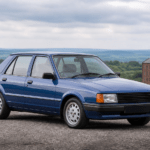
The Austin Montego was a spacious British family car built from 1984 until 1994. It ranged from ordinary 1.3-litre fleet saloons to seven-seat estates, luxurious Vanden Plas models, economical diesels and the rapid 150bhp MG Montego Turbo.
Once a common alternative to the Ford Sierra and Vauxhall Cavalier, the Montego is now an unusual sight. This guide explains its complicated development, model range, naming, strengths, common faults and the checks that matter when buying one today.
Austin Montego at a glance
| UK production | 1984–1994 |
|---|---|
| Manufacturer | BL / Austin Rover / Rover Group |
| Factory | Cowley, Oxford |
| Body styles | Four-door saloon and five-door estate |
| Petrol engines | 1.3 A-Plus, 1.6 S-Series and 2.0 O-Series |
| Diesel | 2.0 MDi / Perkins Prima |
| Performance model | MG Montego EFi and 150bhp Turbo |
| Total production | 571,457 according to the British Motor Museum |
| Final car | 2.0DLX diesel saloon, December 1994 |
Was it an Austin or a Rover Montego?
The car launched as the Austin Montego in April 1984, with separate MG versions carrying the octagonal badge. The Austin name was quietly phased out later in the decade. Revised cars were generally marketed in Britain simply as Montego rather than formally rebadged Rover Montego.
“Rover Montego” remains a familiar description because Rover Group manufactured the later cars and the dealer network increasingly used Rover branding. For historical accuracy, Austin Montego is the right name for early mainstream cars; Montego is safest for later marque-less examples.
Development: from Maestro to Montego
The Montego grew from the same programme that produced the Maestro hatchback. Both shared their central body structure, front-wheel-drive layout and much of their engineering, but the saloon needed a distinct nose and rear body to compete convincingly in the fleet-heavy family-car market.
Development stretched through major upheaval at British Leyland. The car arrived later than intended and faced rivals that had already changed expectations: Ford’s Sierra looked radical, while the front-wheel-drive Vauxhall Cavalier had built a strong reputation. The Montego answered with a conventional three-box shape, excellent interior room and a broad range.
Montego saloon and estate
The four-door saloon launched first in spring 1984. The estate followed later that year and became one of the Montego’s most convincing forms. Its large glass area, low load floor and generous capacity made it a genuine working family estate rather than an afterthought.
Some estates included two rear-facing occasional seats, giving space for seven occupants. The arrangement is part of the model’s appeal, but those seats, belts, catches and the surrounding floor must be inspected carefully. They should be regarded as period occasional seating rather than compared directly with a modern seven-seat car.
Engines and important versions
1.3 and 1.6 Montego
The entry-level 1.3 used the familiar A-Plus engine, while the 1.6 S-Series served the heart of the range. These were the ordinary family and fleet models that made the Montego a familiar road sight. Basic specifications are now particularly rare because they were usually used hard and discarded when values fell.
2.0-litre and Vanden Plas
The 2.0-litre O-Series offered more relaxed performance and powered higher-specification versions. Vanden Plas models added the equipment expected of an Austin Rover flagship, including plusher upholstery and numerous electrical conveniences. Completeness matters because correct trim is now much harder to find than routine mechanical service parts.
MG Montego EFi and Turbo
The MG Montego EFi combined fuel injection with sporting trim. The Turbo, introduced in 1985, raised output to approximately 150bhp. Period figures of around 7.2 seconds to 60mph and a 125mph top speed made it a genuinely fast saloon. Early cars became known for strong torque steer, although development changes improved later examples.
Perkins Prima diesel
The 2.0-litre direct-injection diesel arrived in 1988. Closely associated with Perkins and commonly called the Prima, it gave the Montego excellent real-world economy and a reputation for durability, albeit with period diesel noise and vibration. Diesel saloons and estates found loyal fleet, taxi and high-mileage private buyers.
Which Montego is most collectable? MG Turbos attract obvious interest, but an unmodified early car, Vanden Plas, seven-seat estate or exceptionally original diesel can be just as difficult to replace. Condition and completeness are more important than choosing the rarest badge.
The 1988–89 revisions
Late-1980s revisions improved the Montego’s presentation and addressed some early weaknesses. Exterior and cabin details changed, build quality improved and the range became easier to understand. The diesel also gave the ageing design a valuable new role just as economical company cars were gaining importance.
The Montego never completely escaped the reputation created by early quality problems, yet good later examples could be spacious, comfortable and economical. Its chassis layout was conventional but effective, offering a useful blend of ride, handling and load-carrying ability.
Why did production last until 1994?
Newer Rover 200, 400 and 600 models progressively replaced the Montego’s role, but the estate and diesel still answered practical needs at a competitive cost. Production continued in small numbers at Cowley after the main line was wound down.
The British Motor Museum records that the final Montego was a 2.0DLX diesel saloon built in December 1994. Signed by the 962 workers involved in production, it is preserved in the museum’s collection. The museum gives total production as 571,457 cars.
Austin Montego buying checklist
Bodywork and corrosion
- Inspect sills, jacking points, floor edges and every suspension mounting area.
- Check front and rear wheelarches, inner wings, door bottoms and the fuel-filler area.
- Examine the bonded windscreen surround for bubbling, poor repairs and water leaks.
- Look around the sunroof aperture and confirm its drains are clear.
- Check saloon boot and estate load floors for damp, corrosion and detached drain tubes.
- Inspect areas hidden by bumpers and plastic trim; some concealed metal received inadequate protection.
- Value sound structure above cosmetics because replacement panels are scarce.
Engine and cooling system
- Start from cold and watch for smoke, difficult starting, oil leaks and excessive valve noise.
- Confirm cambelt history on the 1.6 S-Series; age matters as much as mileage.
- Check 2.0-litre O-Series engines for oil leakage and signs of head-gasket trouble.
- Make sure the cooling fan operates and the coolant is clean, correctly filled and free from oil.
- On carburettor cars, test hot and cold running carefully; electronically controlled carburettors can be troublesome.
- On EFi cars, investigate uneven running rather than assuming a simple tune-up will cure it.
- For diesels, check starting, smoke under load, turbo condition and evidence of fuel-system maintenance.
Transmission, suspension and brakes
- Listen for gearbox bearing noise and test every synchromesh from cold and hot.
- A vague gear change may indicate worn linkage components.
- Check clutch engagement for slip, judder or excessive cable effort.
- Inspect front struts, rear trailing arms, bushes, wheel bearings and steering joints.
- Test for seized brakes, corroded pipes and pulling under firm braking.
- Automatic cars need smooth engagement and clean fluid; repair costs can exceed the value of a poor car.
Interior, trim and electrics
- Test every instrument, warning lamp, electric window, lock, mirror and sunroof.
- Look for a sagging headlining and water staining around screens and sunroofs.
- Check dashboards and switchgear for cracks or missing pieces.
- Confirm MG, Vanden Plas and estate-specific trim is present and recoverable.
- On seven-seat estates, inspect the folding seats, belts, mountings and catches.
Frequently asked questions
How many Austin Montegos were built?
The British Motor Museum records a total of 571,457 Montegos.
Was the Montego Estate a seven-seater?
Some estates were equipped with two rear-facing occasional seats, creating a seven-seat layout.
What was the fastest Montego?
The production performance flagship was the 150bhp MG Montego Turbo, capable of approximately 125mph.
Explore more forgotten British cars
Browse the Rare & Forgotten Cars guides, discover the one-off Rover Metro Scout prototype, or take our classic-car rust inspection guide when viewing a survivor.