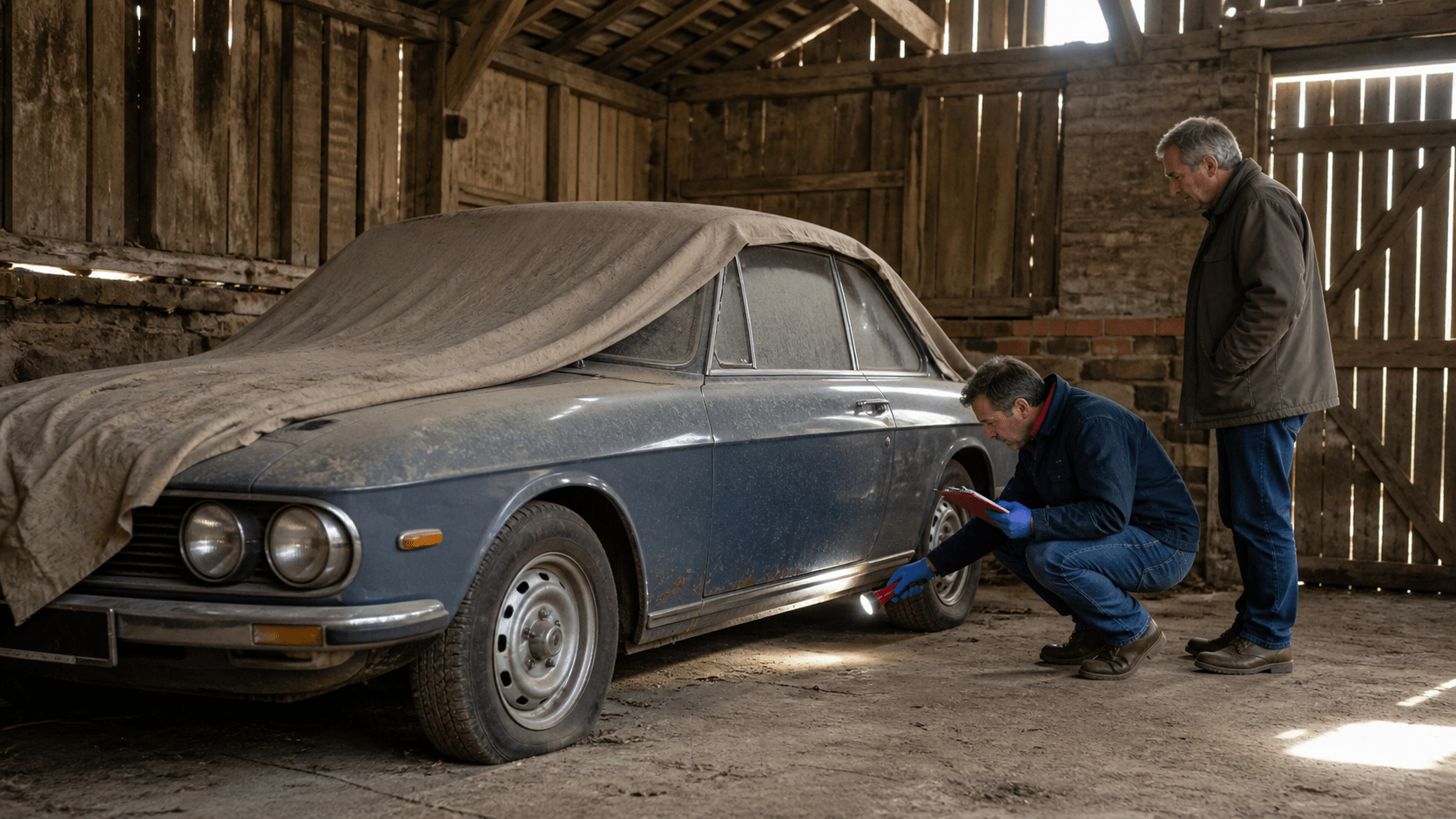
A barn-find car should be inspected as a dormant machine, a restoration project and a piece of evidence. Dust and a compelling discovery story can hide corrosion, missing components, confused ownership and years of mechanical deterioration. This UK-focused checklist helps you establish what the vehicle is, what storage has done to it and whether the complete project suits your budget and abilities.
Before the viewing: ask for evidence
Request the registration number, make, model, VIN or chassis number, MOT history, V5C status and clear photographs of the whole car. Ask when it last ran and drove, why it was parked, whether it has moved since, who owns it and exactly what is included in the sale.
Use the registration to check the DVLA record, MOT history and recalls. GOV.UK’s official used-vehicle buying checks advise comparing seller information with DVLA records, reviewing MOT status and history, seeing the V5C and matching its details to the VIN and engine number.
Old MOT failures and advisories can reveal structural corrosion, brake imbalance and recurring faults from before the vehicle disappeared into storage. A long gap in the record does not prove anything improper, but it helps establish a timeline and the minimum work already known.
Take the right inspection kit
See and record
Bright torch, phone or camera, mirror, notebook, gloves and suitable clothing. Photograph identity marks, components and the storage space before moving anything.
Check condition
Magnet wrapped in cloth, tyre-pressure gauge and basic hand tools used only with permission. A moisture meter can help assess damp interiors.
Stay safe
Eye protection, dust mask and solid footwear. Do not crawl beneath an unsupported vehicle, disturb unstable buildings or handle unknown fluids and droppings carelessly.
Read the building before the car
The storage environment explains many defects. Look at the roof, floor, ventilation and direction of water entry. A car on damp soil or grass may corrode severely underneath while appearing presentable above. A waterproof cover can trap condensation against paint and seams. Sunlight through a window can damage one side of the interior and rubber.
Note whether tyres have sunk into the surface, vegetation has grown around the shell or animals have nested nearby. Check for flood marks, silt, mould and tidelines inside the car and building. Ask whether agricultural chemicals, salt, fertiliser or battery acid have been stored close to it.
Document the vehicle before it is moved
Photograph all four sides, the roof, underside where safely visible, interior, engine bay, boot, wheels and surrounding loose parts. Record the position of keys, documents, badges, tools and boxes. If the car is genuinely original, its untouched details may matter to future research and conservation.
Do not clean VIN plates, scrape finishes or dismantle rare features merely to satisfy curiosity. Use gentle inspection and obtain specialist advice where authenticity or historical significance could affect the correct approach.
Confirm identity and the right to sell
See the original V5C where available and compare its registration, make, model, VIN or chassis number and engine information with the vehicle. Check multiple factory identity locations and look for disturbed rivets, grinding, overstamping, fresh welding or inconsistent plates.
The V5C identifies the registered keeper but is not proof of ownership. Ask how the seller acquired the car and whether an estate, company, landlord or third party has an interest in it. Obtain a written receipt recording seller and buyer details, price, registration, VIN and the main components included.
Check whether the barn find is complete
Completeness can matter more than superficial appearance. Check glass, lamps, handles, locks, trim, instruments, seats, bumpers, hubcaps, badges, carburettors or injection parts, air cleaner, manifolds, gearbox, starter, alternator and model-specific brackets. Ask whether anything was removed for repair or stored elsewhere.
Open every labelled box with permission and confirm that parts belong to this model and year. Photograph rare items and search their availability before valuing them. A common service item can be bought later; missing one-year-only glass, brightwork or interior fittings can stop a restoration.
Inspect the structure before the paint
Dust, poor light and storage clutter make rust hard to see. Inspect sills, floors, chassis rails, jacking points, bulkheads, suspension mounts, wheel tubs, pillars and areas beneath seals and trim. Look for swelling seams, perforation, previous plates, filler and distorted mounting points.
Use the detailed classic-car rust inspection guide and arrange a professional structural assessment when access is limited or repairs will determine the project’s viability. Never rely solely on visible outer panels.
Assume every mechanical system needs assessment
- Engine: check oil and coolant levels, contamination, missing parts, open ports, rodent damage and whether the unit is known to turn. Do not force it.
- Fuel system: old fuel, corrosion and deposits can affect the tank, lines, pump, carburettors and injectors.
- Cooling: hoses, radiator, core plugs, pump seals and antifreeze protection may have failed during storage.
- Brakes: seized cylinders, corroded pipes, stuck handbrakes and contaminated friction material are common after long inactivity.
- Transmission: inspect fluid, linkage, clutch hydraulics, driveshafts and evidence of why the car may originally have been parked.
- Tyres and suspension: old tyres can be unsafe despite good tread; springs, bushes, bearings and dampers deteriorate or seize.
- Electrical system: check battery leakage, brittle wiring, rodent damage, damp fuse boxes, keys and missing control components.
Do not make “will it start?” the first test
A hurried first start can circulate contaminated oil, draw stale fuel through the system, damage dry cylinders or create a fire risk from leaking hoses and wiring. It also tells you little about brakes, tyres and structural safety.
Follow the staged Unusual Cars recommissioning guide. Before turning the engine, establish why the vehicle stopped, inspect fluids and wiring, assess whether the engine rotates safely and prepare the fuel, lubrication and cooling systems appropriately.
Value originality separately from usability
Original paint, trim, tools, books and matching components can make a discovery historically interesting. Patina should not automatically be polished away or covered in fresh paint. At the same time, originality does not make unsafe tyres, degraded brakes or a corroded structure usable.
Decide whether the right outcome is conservation, sympathetic recommissioning, restoration or use as a donor. That decision affects what previous wear should remain, what must be renewed and which specialist skills are needed.
Build the full purchase budget
Add purchase price, recovery, loading equipment, storage, cleaning, specialist inspection, missing parts, structural work, mechanical recommissioning, tyres, brakes, interior treatment, MOT preparation, tax, insurance and contingency. Assume that the first repaired fault may reveal the next one.
Use the project-car restoration cost guide to divide the project into workstreams. Compare the completed total with usable examples, while recognising that a rare or historically important vehicle may justify a conservation decision that is not purely financial.
Plan recovery before agreeing the deal
Confirm whether the wheels turn, steering operates, brakes are seized, tyres hold air and access suits a transporter. Measure gates, doorways and vehicle dimensions. Tell the recovery operator about soft ground, slopes, locked wheels, low clearance and loose parts.
GOV.UK states that a SORN vehicle may only be driven on the road to or from a pre-booked MOT or other test appointment. Even in a permitted situation, the vehicle must remain roadworthy. A long-stored car of unknown condition should normally be transported, not driven home.
Questions to ask the seller
- Who owns the vehicle, and how did it come to be stored here?
- When did it last run, drive and pass an MOT?
- Why was it taken off the road?
- Has it flooded, been accident damaged or recorded as an insurance write-off?
- Are the V5C, VIN, engine and registration details consistent?
- Which parts, keys and documents are stored elsewhere?
- Has anyone attempted to start, repair or move it recently?
- Will the wheels roll and steer for loading, and what access does recovery have?
Printable barn-find car inspection checklist
Before travelling
- Registration and vehicle details obtained
- DVLA, MOT, recall and history checks completed
- Ownership and V5C status discussed
- Storage and last-use history requested
- Recovery access and location checked
Identity and evidence
- Vehicle photographed as found
- V5C details matched to the car
- VIN and engine numbers checked
- Seller’s authority to sell established
- Keys, books, invoices and old photographs recorded
- Written receipt prepared
Condition and completeness
- Storage environment assessed
- Structure and corrosion inspected
- Engine, fuel and cooling assessed
- Brakes, steering, tyres and suspension assessed
- Wiring, damp and animal damage checked
- Glass, trim and model-specific parts inventoried
- Missing and unusable parts priced
Decision and collection
- Conservation or restoration route chosen
- Recovery quote obtained
- Workstreams and specialist labour priced
- Storage cost included
- Contingency added
- Total compared with a usable example
- Safe loading plan agreed
Confirm the documents and ownership, plan professional recovery and calculate the complete restoration commitment before paying.
Documents & ownershipTransport & recoveryBarn-find costsBarn Finds hub