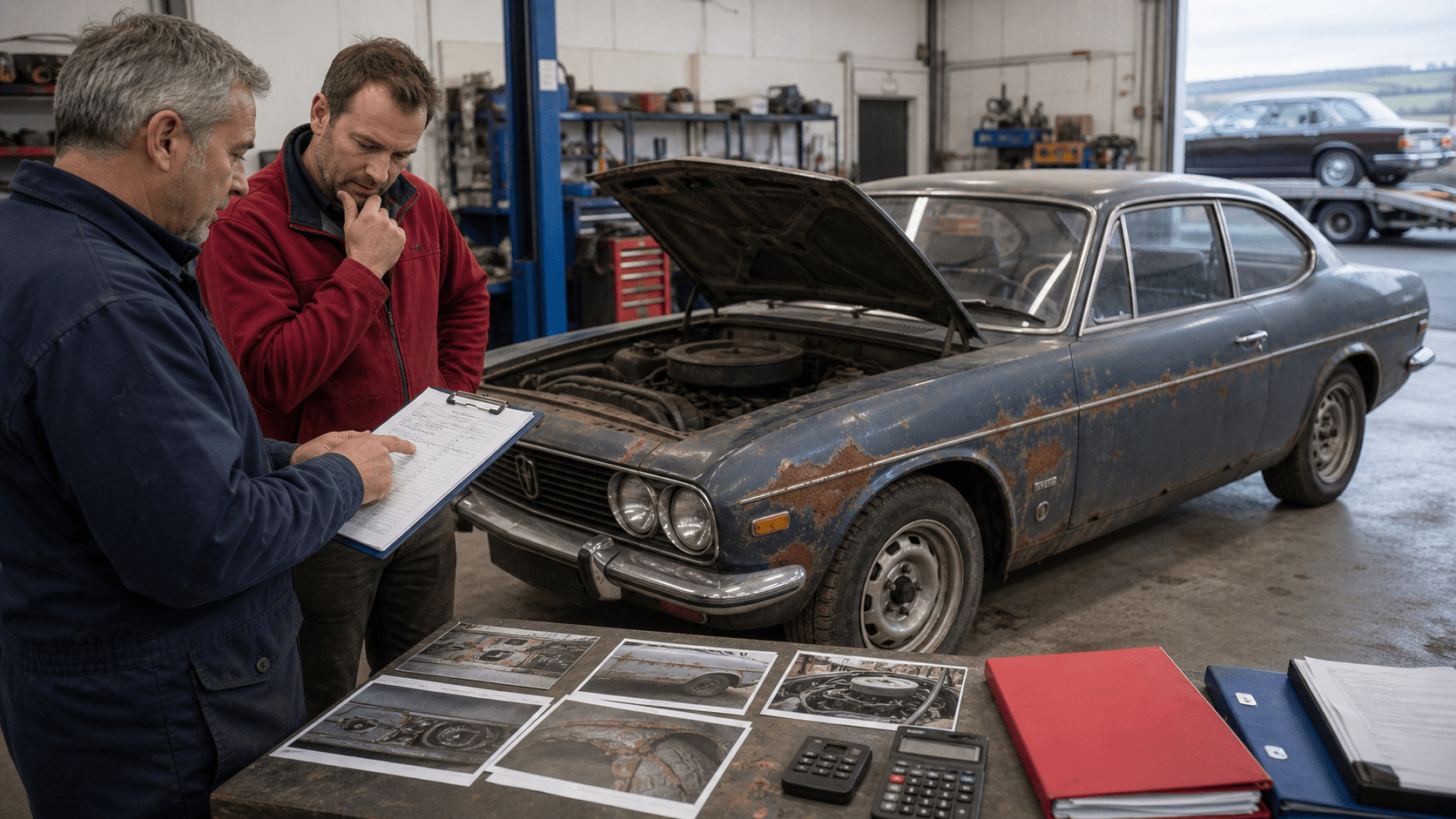
The purchase price is usually the smallest certain number in a barn-find restoration. A long-stored car can require specialist recovery, careful cleaning, missing parts, a complete brake and fuel-system overhaul and major corrosion repair before ordinary restoration even begins. The right budget therefore starts with evidence, staged inspection and several possible outcomes—not one optimistic total.
Why barn finds are harder to price
A running project can be road-tested and assessed system by system. A dormant vehicle may conceal a seized engine, blocked fuel system, corroded brake hydraulics, damaged wiring and previous accident repairs. Its underside may be inaccessible and its loose parts scattered across the storage building.
Many workshops cannot give a reliable fixed total before cleaning, strip-down and measurement. Current UK restoration-cost guidance also emphasises that corrosion discovered after stripping is the central unknown and that preparation—not simply spraying paint—consumes much of the labour in body restoration.
Three useful 2026 planning bands
Recommission and preserve
Rough planning band: £2,000–£8,000+
For a complete, structurally sound car needing recovery, fluids, fuel, brakes, tyres, battery, servicing and limited repairs while retaining its appearance.
Targeted restoration
Rough planning band: £8,000–£30,000+
For localised welding, mechanical rebuilding, selected paint and trim work, missing parts and professional assembly without a total bare-shell rebuild.
Full professional restoration
Rough planning band: £30,000–£100,000+
For extensive strip-down, fabrication, body and paint, drivetrain, suspension, brakes, wiring, interior, brightwork and detailed reassembly.
These deliberately wide bands are budgeting prompts for ordinary classic cars—not promises, valuations or marque-specific quotes. Rare parts, coachbuilt bodies, major structural reconstruction and very high finish standards can exceed them substantially. Owner labour can reduce invoices but does not remove parts, materials, tooling, storage or rework.
Start with the all-in equation
− value of genuinely usable included parts = realistic project commitment
Do not subtract the hoped-for finished value as though it were guaranteed profit. Market conditions change, personal specifications may reduce appeal and a restored car can still require sorting after completion.
Recovery and extraction
A vehicle transporter normally quotes for the job according to distance, vehicle condition, access, waiting time and equipment. A non-runner with seized wheels on soft ground costs more to extract than a rolling car beside a road. Enclosed transport may be appropriate for a valuable or fragile discovery.
Obtain a written quote after providing honest details: dimensions, tyre condition, steering, brakes, locked wheels, ground surface, doorway width and loose parts. Include winching, skates, additional labour and a second trip for components where required.
Initial assessment and stabilisation
Budget for cleaning only enough to inspect the vehicle, photographing and cataloguing, checking identity, draining contaminated fluids and making storage safe. A specialist may need to assess structure, engine condition, originality or historic significance before any restoration plan is chosen.
Stabilisation can include drying the interior, treating active corrosion, supporting fragile trim, protecting bare metal and moving the vehicle into controlled storage. These costs create no dramatic visual transformation, but prevent further loss while decisions are made.
Mechanical recommissioning costs
- Fuel system: tank removal or replacement, lines, pump, carburettor or injection cleaning, filters and contaminated-fuel disposal.
- Engine: inspection, lubrication, belts, hoses, seals, cooling, compression work and potentially a complete rebuild if seized or damaged.
- Brakes: master and wheel cylinders, calipers, pipes, hoses, discs or drums, friction materials and handbrake components.
- Transmission: clutch hydraulics, friction components, gearbox or differential seals, bearings and internal rebuilding.
- Suspension and steering: bushes, joints, bearings, springs, dampers, steering box or rack and wheel alignment.
- Electrical: battery, charging and starting, lamps, switches, damaged loom sections, rodent damage and obsolete components.
- Tyres and wheels: replacement tyres regardless of tread where age or damage makes them unsafe, plus wheel repair and balancing.
The first controlled start is a milestone, not completion. Once the engine runs, oil pressure, cooling, charging, clutch, transmission and leaks may reveal additional work. Keep a second-stage contingency for faults that cannot be tested while the car is dormant.
Bodywork and paint dominate many budgets
Visible rust is rarely the full repair. Corrosion spreads between overlapping panels, inside sills, around suspension mounts and beneath filler and old repairs. Labour accumulates through dismantling, media or manual stripping, fabrication, welding, trial fitting, sealing, preparation, priming, blocking and reassembly.
A low quote described simply as a “respray” may include very different preparation from a complete restoration finish. Ask what will be removed, which areas are painted, how corrosion is exposed, whether glass and trim come out, what metal repair is included and how additional discoveries are authorised.
Missing parts can stop the project
Create an inventory before purchase. Price glass, lights, handles, trim, instruments, seats, bumpers, brightwork, engine ancillaries and model-specific brackets. Some small pieces require long searches, expensive restoration of poor used examples or one-off manufacture.
Do not value boxes of untested parts at retail replacement cost. Identify correct, usable components and budget cleaning, rebuilding, plating and fitting. Duplicates and unrelated pieces may add no practical value.
Interior, chrome and specialist work
Damp and rodents damage seat padding, stitching, carpets, headlining, wood, instruments and wiring. A sympathetic interior conservation may cost less than complete retrimming but can require more specialist judgement. Full replacement using correct patterns and materials becomes a separate workstream.
Chrome plating, instrument repair, carburettors, radiators, woodwork and rare electrical units are commonly subcontracted. Include packing, transport, minimum charges and long lead times. A car occupying paid storage while one missing component is away still costs money.
Storage, tools and project overhead
A multi-year restoration needs secure, dry space. Include monthly storage, insurance, electricity, shelving, containers and transport between specialists. DIY work also requires tools, safety equipment, consumables and sometimes learning materials or wasted parts.
Track every purchase from the start. Small orders for fasteners, clips, paint, abrasives, fluids, sealants and delivery charges become a significant total because they occur repeatedly.
Choose the finish standard before requesting quotes
| Target | What it means | Budget effect |
|---|---|---|
| Safe survivor | Original appearance retained; structure and mechanical systems made safe and reliable. | Avoids unnecessary cosmetic work but may require skilled conservation and extensive hidden mechanical work. |
| Usable classic | Sound body, presentable finish and dependable systems for regular leisure use. | Balances visible finish with function; often the most rational target for an ordinary car. |
| High-quality restoration | Thorough strip-down, detailed preparation, correct finishes and careful reassembly. | Labour rises sharply because areas unseen in normal use receive equal attention. |
| Concours or reference standard | Research-led correctness, exceptional cosmetics and extensive detail. | Specialist hours, rare finishes and repeated refinement can make cost disproportionate to market value. |
How to obtain useful workshop estimates
Give each specialist the same written brief, photographs, parts inventory and intended finish. Ask for labour rate, estimated hours or phase price, materials treatment, subcontracted work, VAT position, storage charges and how variations are approved.
Request staged work: assessment, dismantling, structure, mechanical systems, body and paint, trim, assembly and commissioning. Agree photographs and written updates at each stage. A transparent estimate with clear exclusions is more useful than a low headline total.
Set contingency according to uncertainty
A complete running car with accessible structure may justify a smaller reserve. A non-runner buried in a damp building, missing documents and partly dismantled needs a much larger one. As a planning approach, consider at least 15–20% for a well-inspected project and 25–40% or more where strip-down has not exposed the structure and drivetrain.
Contingency is not money available for optional upgrades. Keep it for discoveries necessary to reach the agreed outcome. When it is consumed, stop and recalculate rather than continuing automatically.
When the restoration does not make financial sense
Add the purchase and complete restoration budget, then compare it with genuinely comparable finished cars. Include the value of your time, the delay before use and the possibility that the finished specification will not suit the next buyer.
A project can still be worthwhile for rarity, family history, education or enjoyment. Make that an explicit personal decision rather than presenting an uneconomic restoration as an investment. Sometimes preservation, targeted recommissioning, sale to a better-equipped owner or use as a legitimate donor is the more responsible route.
Printable barn-find restoration budget
Acquisition and recovery
- Purchase price
- History and inspection checks
- Extraction and transporter
- Loose-parts transport
- Initial secure storage
Assessment and structure
- Cleaning, inventory and photography
- Specialist condition assessment
- Dismantling and stripping
- Fabrication and welding
- Panel repair and fit
- Paint preparation and materials
Mechanical and electrical
- Engine and cooling
- Fuel system
- Clutch, gearbox and driveline
- Brakes, steering and suspension
- Tyres and wheels
- Wiring, instruments and lighting
Finish and overhead
- Interior and weather seals
- Glass, trim and brightwork
- Missing and rebuilt parts
- Tools, consumables and delivery
- Ongoing storage and insurance
- MOT, registration and commissioning
- Contingency
Inspect the car, choose the right treatment route and include recovery before finalising the budget.
Inspection checklistPreserve or restore?Transport & recoveryBarn Finds hub