A Peugeot 405 can still be dependable, but no surviving example is simply an old version of the car it was when new. Age, storage, previous repairs and parts availability now matter as much as the original design. This guide explains the symptoms worth investigating and the maintenance that prevents small faults becoming expensive failures.
Is the Peugeot 405 reliable?
The underlying mechanical package earned a strong reputation. Period AA reporting praised the 405’s chassis and noted that later production cars improved in build and driveability. Many diesels covered substantial mileages. However, reliability in a car now several decades old is individual rather than guaranteed: a carefully serviced 180,000-mile car may be safer than a low-mileage example that has sat unused with old belts, tyres and coolant.
Separate three kinds of fault. Design characteristics include heavy unassisted steering. Known weak points include carburettor driveability, ageing trim and rear-suspension wear. Neglect-related failures include overheating after coolant loss or engine damage after an undocumented timing belt. Treating every fault as “a common 405 problem” leads to poor diagnosis.
Peugeot 405 symptoms and possible causes
| Symptom | Possible areas to investigate | Immediate response |
|---|---|---|
| Temperature rises in traffic | Cooling fan, switch or relay; radiator blockage; low coolant; airlock; thermostat | Stop before overheating and pressure-test the system when cold |
| Erratic cold idle or stalling | Carburettor choke or fuelling; vacuum leak; ignition service items; injection sensors | Identify the exact engine and diagnose rather than adjusting at random |
| Heavy clutch pedal | Dry or failing cable, pedal mechanism or worn clutch assembly | Inspect the cable and act before it strands the car |
| Rear wheel leans inward | Rear trailing-arm bearing or axle wear | Avoid continued use and obtain an axle specialist’s assessment |
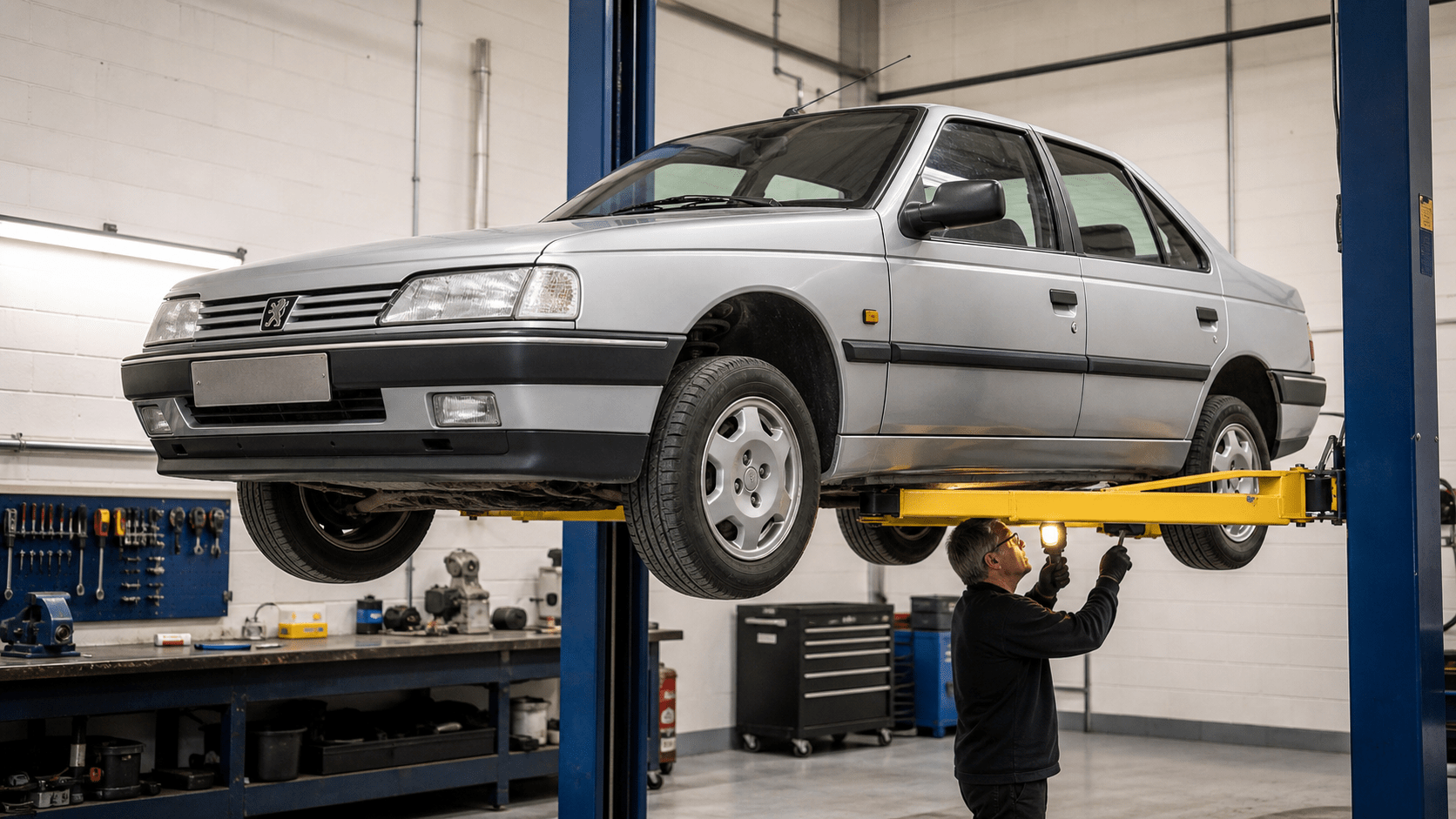
| Knock over bumps | Drop links, bushes, ball joints, strut top, rear suspension or loose exhaust | Inspect on a lift; do not replace parts solely from the sound |
| Oil around the engine | Breather restriction, camshaft or crank seals, rocker cover, sump or previous spillage | Clean, locate the source and check oil level frequently |
| Battery repeatedly goes flat | Old battery, charging fault, poor earth, lamp or accessory drain, altered alarm wiring | Test battery and charging voltage before fitting parts |
| Water in the boot | Rear-light, boot-lid, aerial or body-seam sealing; blocked drains | Dry the area, trace entry with water testing and treat corrosion |
Cooling-system and overheating problems
Cooling condition is fundamental on petrol and diesel models. Inspect the radiator, expansion tank, cap, hoses, clips, thermostat housing and water-pump area. Confirm that the heater becomes hot and that the electric fan cuts in without the gauge entering the danger zone. Brown coolant, repeated topping-up or a fan wired to a manual dashboard switch may indicate an unresolved problem.
Persistent bubbling, unexplained pressure, coolant in the oil, white exhaust vapour after warm-up or repeated hose failure can indicate combustion leakage, but test before condemning a head gasket. A failed cap, external leak, airlock or restricted radiator can imitate more serious trouble.
Timing belts, oil and engine maintenance
The 405 used several engine families and there is no responsible universal belt interval for every version. Follow the correct schedule for the engine code and shorten it where age, storage or incomplete history justifies caution. If there is no dated invoice, treat belt, tensioners and associated work as due. On engines where the water pump is driven or made accessible during the job, ask a specialist what preventive replacement is sensible.
Regular oil and filter changes help the XU petrol and XUD diesel engines enormously. A blocked or neglected breather can contribute to seepage. Establish whether a leak is fresh and active; old engines often have light staining, but oil reaching a timing belt, clutch or hot exhaust demands prompt repair.
Petrol-engine starting, idling and fuelling
Period AA used-car reporting identified erratic cold starting, idling and hesitation on carburetted cars, while later fuel injection improved matters. Today, aged vacuum hoses, contaminated fuel, weak ignition components, poor earths and previous adjustments complicate diagnosis. Observe the engine from completely cold through warm-up, then test hot restarting.
Do not automatically replace a carburettor or injection unit. Verify ignition timing and service condition, search for air leaks, check fuel delivery and identify the exact system first. Random adjustment may disguise one fault while creating another.
XUD diesel and turbo-diesel issues
The XUD’s durability is deserved, but cooling and belt history remain critical. Cold starting should be prompt after the glow-plug cycle. Check for a weak battery, failed glow plugs, air entering fuel lines and tired injectors before assuming low compression. Some smoke on an old diesel can have several causes; persistent blue smoke, heavy crankcase breathing or dense smoke under modest load warrants investigation.
On turbo-diesels, allow the car to warm fully and listen for abnormal turbo noise. Check intake and boost hoses, oil feed and return areas, and look for evidence of careless boost modifications. A healthy standard car is preferable to an undocumented “turned-up” one.
Clutch, gearbox and driveshafts
A heavy pedal may be a binding cable or a worn clutch. Gear selection should be checked when cold and hot, under acceleration and on overrun. Sloppy selection can involve external linkage wear; crunching may indicate clutch drag or internal wear. Inspect driveshaft boots, listen for clicking on full lock and look for leakage at gearbox output seals.
Use the correct lubricant specification. Do not assume any modern generic gear oil is suitable: inappropriate oil can spoil shift quality or affect synchronisers.
Rear suspension and axle wear
The conventional 405 rear assembly can develop trailing-arm bearing wear. Warning signs include negative camber, a tyre close to the inner arch, creaking, instability and uneven tyre wear. Estate cars deserve particular attention because many worked hard. Proper repair may require an exchange or rebuilt axle rather than a superficial bearing change after shafts or housings have been damaged.
The Mi16x4 and T16 use much more specialised four-wheel-drive and self-levelling hardware. Their hydraulic, transfer and differential systems should not be treated as ordinary 405 components. Use the dedicated Mi16x4 and T16 guides.
Front suspension, steering and brakes
Ageing bushes, ball joints, struts, top mounts, anti-roll-bar links and wheel bearings can produce knocks or vague handling. Uneven tyres may reveal alignment or component wear. Power steering should be consistent and quiet, with no significant leakage from pump, hoses or rack; manual steering is naturally heavy at low speed.
Check rigid brake pipes, flexible hoses, calipers, rear wheel cylinders where fitted and the operation of the handbrake. A car returning from storage may have seized components or internally degraded hoses despite clean-looking paintwork. ABS-equipped versions need correct warning-lamp operation and system-specific diagnosis.
Electrical and interior faults
Test the battery and charging system before blaming electronics. Clean major earth points and inspect additions such as alarms, stereos, immobilisers and tow-bar wiring. Period AA reporting noted door-release and central-locking faults, failed heated-window elements, a fluttering speedometer and deteriorating interior trim. Heater controls, fan speeds, windows, mirrors, sunroof, gauges and every warning lamp should be exercised.
Later air conditioning may need more than a recharge, and obsolete trim can be harder to find than mechanical service parts. A complete interior is therefore a reliability advantage as well as a cosmetic one.
Rust, water leaks and structure
The 405 resisted corrosion well by contemporary standards, but survivors now require full inspection. Examine sills, jacking points, floor seams, suspension and subframe mountings, wheel arches, door bottoms, brake pipes, boot floor and spare-wheel area. Estates also need scrutiny around the tailgate and rear load structure.
Water in the boot or cabin must be dried and traced. Long-term damp damages connectors, trim and seams. Fresh underseal is not proof of solidity; ask what preparation and repairs were completed beneath it.
Preventative-maintenance plan
- Identify the exact engine, gearbox and market specification.
- Establish dated proof for timing-belt work; renew it if uncertain.
- Baseline all fluids and filters with the correct specifications.
- Pressure-test the cooling system and verify fan operation.
- Inspect brake pipes, hoses, tyres, suspension joints and wheel bearings.
- Check rear-wheel alignment and axle condition.
- Clean and protect important earth connections.
- Remove unsafe accessory wiring rather than joining more repairs onto it.
- Treat water leaks and emerging corrosion early.
- Keep a dated maintenance file to help future diagnosis and resale.
Use the official GOV.UK MOT history service to find recurring advisories and mileage patterns, but remember DVSA’s warning: an MOT records testable items at that moment and is not evidence of the vehicle’s overall mechanical condition.
Frequently asked questions
What is the Peugeot 405’s biggest reliability risk?
There is no single failure across every version. For an ordinary car, neglected cooling and timing-belt history, structural corrosion and rear-axle wear are the most important areas to eliminate early.
Are Peugeot 405 diesels reliable?
XUD diesels can cover very high mileages with correct servicing, but they still depend on sound cooling, clean oil, good fuel supply and timely belt maintenance.
Why is my Peugeot 405 clutch heavy?
A dry or failing cable is possible, but the clutch itself or pedal mechanism may be worn. Inspect rather than assuming the least expensive cause.
Why are the rear wheels leaning inward?
Visible negative camber commonly points to wear in the rear trailing-arm bearings or axle assembly and needs prompt specialist assessment.
Is an MOT pass proof that a 405 is mechanically good?
No. The MOT is a minimum roadworthiness inspection of specified items at the test time; it does not assess the entire mechanical condition or predict future reliability.
Research note: fault patterns were cross-checked against the AA’s period Peugeot 405 used-car reporting, official DVSA guidance and established 405 technical knowledge. Symptoms have deliberately been presented as investigation routes rather than remote diagnoses. Engine specifications and service requirements vary; use the correct workshop information for the individual car.