
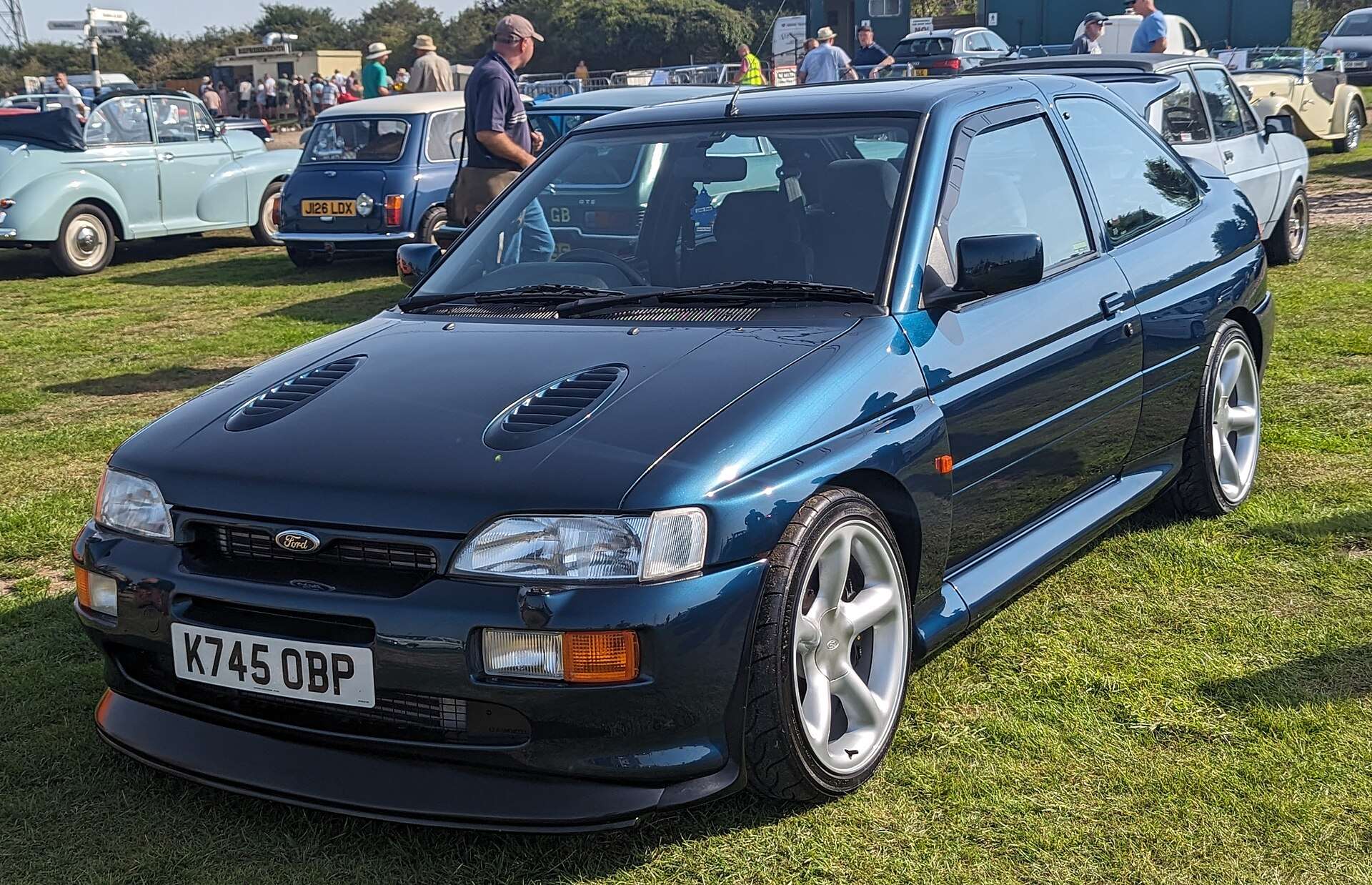
The Escort RS Cosworth looked like a wild version of Ford’s family hatchback, but beneath the skin it was a very different four-wheel-drive homologation special.
For the complete story: read our full Ford Escort RS Cosworth history, engineering and rally guide.

1. It was closer to a Sierra underneath
Ford shortened the Sierra RS Cosworth 4×4 platform and clothed it in Escort-shaped bodywork. The longitudinal engine, transmission and much of the floor architecture were therefore unlike an ordinary front-wheel-drive Escort.
2. The rear wing was functional
The celebrated double rear spoiler was developed to manage lift and stability at rally speeds. An even more elaborate triple-deck arrangement was investigated but never approved for production.
3. Early cars used a large turbo
The first homologation cars used a Garrett T3/T04B turbo and YBT engine. They delivered strong high-rpm performance but also the pronounced lag enthusiasts associate with early examples.
4. Later cars became easier to drive
From 1994 the smaller Garrett T25 turbo produced earlier boost and better everyday response. These later small-turbo cars were aimed more squarely at road buyers.
Love cars you don’t see every day?
Get forgotten cars, surprising motoring stories and the most interesting finds from Unusual Cars by email.
Free to join. No spam. Unsubscribe whenever you like. See our Privacy Policy.
5. Production exceeded the original requirement
Ford needed 2,500 examples for rally homologation but ultimately built more than 7,000 between 1992 and 1996.
6. Karmann assembled it in Germany
The specialist Karmann factory at Rheine handled production, reflecting how different the car was from a standard mass-produced Escort.

7. It had permanent four-wheel drive
A Ferguson viscous coupling split torque between the axles, with a rearward bias that helped preserve the character of earlier Cosworths.
8. It won at World Championship level
Escort Cosworths won eight WRC rounds, beginning with Monte Carlo in 1993, despite arriving during an intensely competitive era.
9. The whale tail was briefly optional
Late production cars could be ordered without the enormous upper spoiler, although most buyers chose the defining visual feature.

10. Originality is unusually valuable
Many cars were tuned, stolen, crashed or converted into replicas. Correct wheels, wings, trim, engine specification and documented identity now matter enormously.
Love cars you don’t see every day?
Get forgotten cars, surprising motoring stories and the most interesting finds from Unusual Cars by email.
Free to join. No spam. Unsubscribe whenever you like. See our Privacy Policy.