
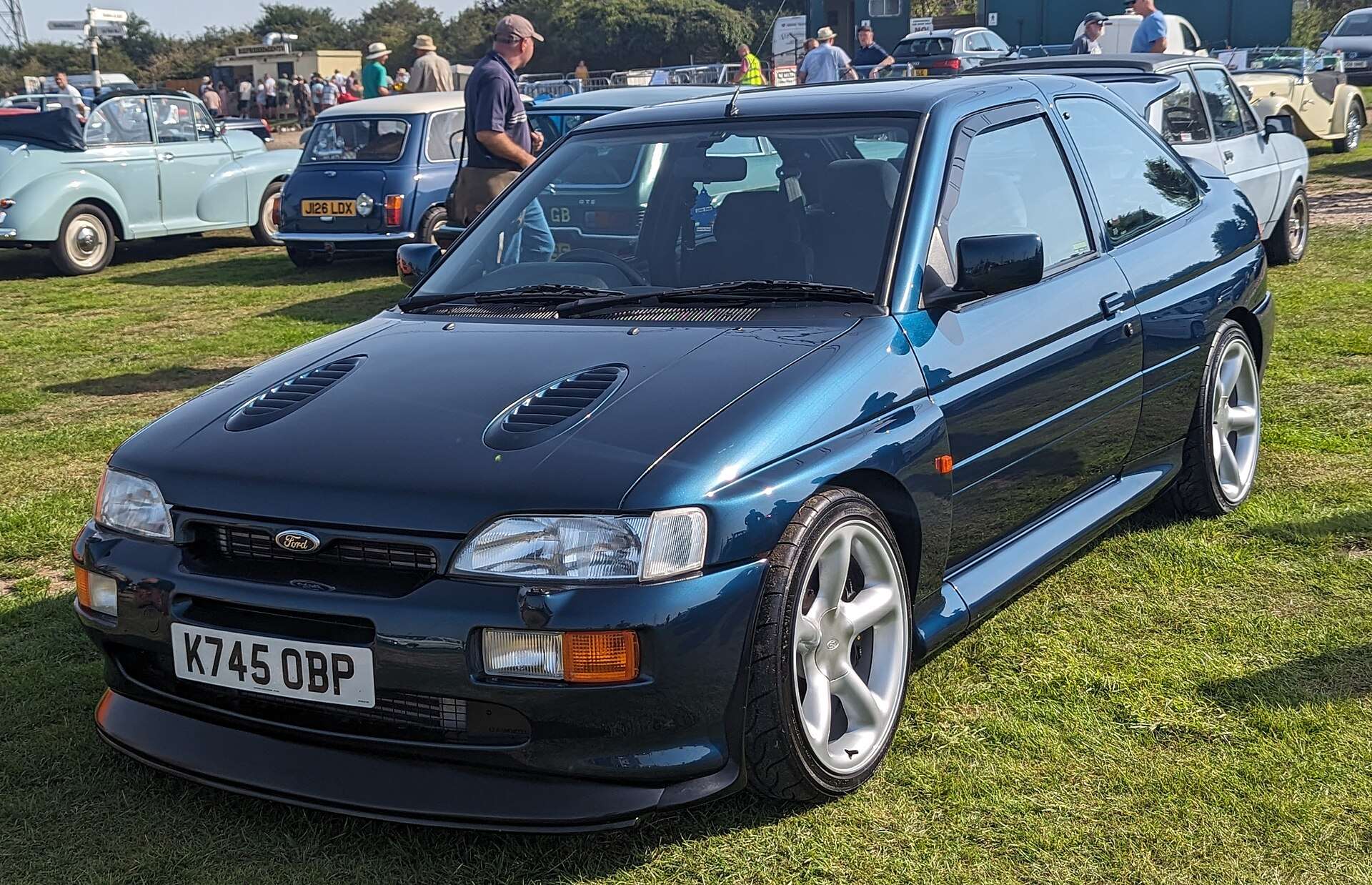
The Ford Escort RS Cosworth was not simply a faster version of an ordinary Escort. It was a compact, four-wheel-drive homologation special built around Sierra Cosworth engineering, shaped by rallying and produced with help from Karmann. Its huge rear wing made it famous, but the machinery beneath it is what made the car genuinely exceptional.

Why the Escort RS Cosworth existed
By the end of the 1980s, Ford had already proved the potential of the Cosworth YB engine in the Sierra RS Cosworth and RS500. Those cars became touring-car legends, while the four-wheel-drive Sierra Cosworth supplied useful rally engineering. The problem was size: for the tight, rapidly changing conditions of international rallying, Ford wanted a shorter and more agile competition platform.
The answer was a car that looked like an extreme Escort but was mechanically much closer to a shortened Sierra RS Cosworth 4×4. Ford’s own historical account describes the Escort Cosworth as using the Sierra floorpan and a longitudinal engine. This distinction matters. An ordinary contemporary Escort was a transverse-engined, front-wheel-drive family car; the Cosworth had an entirely different structural and mechanical purpose.
The road car was therefore created around motorsport requirements rather than by progressively tuning an existing hot hatch. Its wide arches, aggressive bumpers, bonnet vents and rear aerodynamics were consequences of that mission, not a styling package applied to a standard Escort.
Sierra engineering beneath an Escort-shaped body
Ford and Karmann adapted the Sierra 4×4 platform to the more compact proportions required for the Escort project. The wheelbase was shortened, while the body was developed to resemble the Mk5 Escort without sharing its ordinary front-wheel-drive architecture.
That explains the Cosworth’s distinctive proportions. The longitudinal engine and four-wheel-drive transmission demanded a substantial centre tunnel and different floor construction. The swollen arches covered a much wider track, while the nose had to feed air to a turbocharged engine, intercooler and cooling system intended for sustained competition use.
Karmann assembled the production cars at Rheine in Germany. Specialist assembly was appropriate for a machine whose structure, drivetrain and bodywork differed so fundamentally from Ford’s mass-produced Escort range.
The Cosworth YB engine
At the heart of the car was a turbocharged 1,993cc Cosworth YB four-cylinder engine with a twin-cam, 16-valve cylinder head. Ford’s contemporary heritage material quotes 220 PS for the road car, although market literature and later references may express output slightly differently depending on the unit used.
The engine was mounted longitudinally, driving all four wheels through a five-speed manual gearbox and a permanent four-wheel-drive system. The road car retained the purposeful character of Ford’s competition programme: strong mid-range acceleration, considerable tuning potential and a power delivery shaped by turbocharger choice.
Big-turbo homologation cars
The first production phase used the large Garrett T3/T04B turbocharger and Weber-Marelli engine management. These early cars are often described simply as “big-turbo” Escort Cosworths. They are the specification most closely associated with the original homologation programme.
The large turbo could support serious competition power, but on the road it produced pronounced lag. Below the engine’s effective boost range the car could feel restrained; once the turbo was working, acceleration arrived with far greater intensity. That contrast is a defining part of the early car’s personality.
Small-turbo road cars
After the initial homologation requirement had been met, Ford developed a more road-focused version. From 1994, the smaller Garrett T25 turbocharger and revised Ford EEC-IV management improved response at lower engine speeds. The later car was easier to drive progressively and better suited to everyday use.
“Small turbo” does not mean an inferior Escort Cosworth. It describes a different balance of priorities. Early cars have the stronger homologation connection and more dramatic boost delivery; later cars respond sooner and can feel more coherent on an ordinary road.
Love cars you don’t see every day?
Get forgotten cars, surprising motoring stories and the most interesting finds from Unusual Cars by email.
Free to join. No spam. Unsubscribe whenever you like. See our privacy policy.
Escort RS Cosworth specifications
| Feature | Road-car specification | Why it matters |
|---|---|---|
| Engine | 1,993cc Cosworth YB, turbocharged, 16 valves | A proven competition-derived engine with substantial development potential. |
| Layout | Longitudinal front engine | Fundamentally different from a normal transverse-engined Escort. |
| Power | Approximately 220 PS in Ford’s period description | Road output was only the starting point for rally development. |
| Transmission | Five-speed manual, permanent four-wheel drive | Provided traction and preserved the Sierra Cosworth 4×4 engineering concept. |
| Production | 1992–1996; just over 7,000 commonly recorded | The first 2,500 cars formed the core homologation run. |
| Assembly | Karmann, Rheine, Germany | Reflects the specialist construction and unique body-platform combination. |
These figures describe production road cars. Rally cars changed continually through homologated evolutions, event preparation and team development, so competition outputs should always be tied to a particular season and specification.
Why the rear wing was so important
The rear wing became the car’s visual signature, but it was developed for aerodynamic control. The combination of the upper “whale tail”, lower spoiler, deep front bumper and other body details helped manage lift and stability at rally speeds.
Designer Frank Stephenson has discussed the more elaborate multi-plane concepts explored during development. The production arrangement remained dramatic, yet it was still a practical compromise between aerodynamic ambition, manufacturing and road legality.
Later buyers could obtain some cars without the large upper wing. Those examples are unusual, but the winged car remains the form most closely connected with the Escort Cosworth’s rallying identity.

Homologation and the rally programme
The FIA Historic Database records Escort RS Cosworth homologation number A-5466 from 2 January 1993. The production programme supplied the required road-going foundation while allowing Ford and its teams to develop the car for Group A rallying.
The Escort immediately looked at home on a rally stage. Its compact body, four-wheel-drive traction and turbocharged Cosworth engine addressed the shortcomings of the larger Sierra. François Delecour and Daniel Grataloup became closely associated with the car, and Ford’s archive highlights their victory on the 1994 Monte Carlo Rally.
Other leading drivers included Miki Biasion, Malcolm Wilson, Tommi Mäkinen and Carlos Sainz. The model won World Rally Championship rounds and remained competitive through an era dominated by rapidly developing four-wheel-drive machinery.
The production-based Group A Escort eventually provided the basis for the Escort WRC introduced for 1997. That later car represented a new regulatory chapter, but its identity and much of its story grew directly from the RS Cosworth programme.

Road car versus rally car
The road car was not a detuned works rally car in every detail, nor should every competition specification be projected back onto the production model. It was the homologated foundation from which rally versions could be developed within the regulations.
Competition cars received roll cages, specialised suspension, stronger brakes, different gearing, safety equipment and continuously evolving engine management. Depending on the team, year and event, the engine, turbocharger and drivetrain specification could vary substantially.
For that reason, claims about rally power should be treated carefully. A figure may describe an early Group A car, a later works development, a privateer machine or a modern historic build. The production car’s importance lies not in sharing every rally component but in making the competition programme possible.
What made it different from the Sierra Cosworth?
The Escort Cosworth inherited the Sierra’s essential engine and four-wheel-drive thinking, but placed them in a shorter, more focused package. Its body was designed around rallying from the outset, and its aerodynamics were far more conspicuous.
The Sierra RS Cosworth remains one of the definitive touring cars of its generation. The Escort RS Cosworth pursued a different target: creating a more compact and effective international rally platform while preserving Ford’s proven Cosworth powertrain.
Why the Escort Cosworth still matters
Many performance cars become famous because they are fast. The Escort RS Cosworth became important because its appearance, construction and competition purpose told the same story. Nothing about it was accidental: not the swollen body, the longitudinal engine, the four-wheel-drive system or the towering rear wing.
It also marked the end of a particular kind of Ford. Although later Focus RS models carried the badge with great success, the Escort Cosworth belonged to the homologation-special tradition in which a manufacturer built a conspicuously specialised road car to support a top-level motorsport campaign.
That combination explains its continuing appeal. It is recognisable to people who followed rallying, touring cars, performance magazines or the modified-car culture of the 1990s. Yet beneath the cultural image is a sophisticated piece of engineering with a documented competition purpose.
Frequently asked questions
Is the Escort RS Cosworth really based on a Sierra?
Its platform and longitudinal four-wheel-drive engineering were derived from the Sierra Cosworth 4×4, shortened and adapted beneath an Escort-inspired body. It is not mechanically equivalent to an ordinary Mk5 Escort.
What is the difference between big-turbo and small-turbo cars?
Early homologation cars used a larger Garrett T3/T04B turbo and have more noticeable lag. Later cars used a smaller Garrett T25 with revised management for earlier response and improved road drivability.
How many Escort RS Cosworths were made?
Just over 7,000 is the widely recorded total, with 7,145 frequently quoted. The first 2,500 cars were central to satisfying the original Group A homologation requirement.
Was the rear wing functional?
Yes. It formed part of a broader aerodynamic package intended to control lift and improve high-speed stability, although it also became the car’s defining visual feature.
Did it win the Monte Carlo Rally?
Yes. François Delecour and Daniel Grataloup won the 1994 Monte Carlo Rally in an Escort RS Cosworth.
Research sources
- Ford Media: 50 years of Ford RS models
- Ford Media: 50 years of the Escort
- FIA Historic Database: Escort RS Cosworth
- FIA homologation form A-5466
Continue the Ford story
Browse the Rare & Performance Fords hub, trace the road to the Cosworth through the Sierra XR4i, or continue with the Focus RS Mk1.