
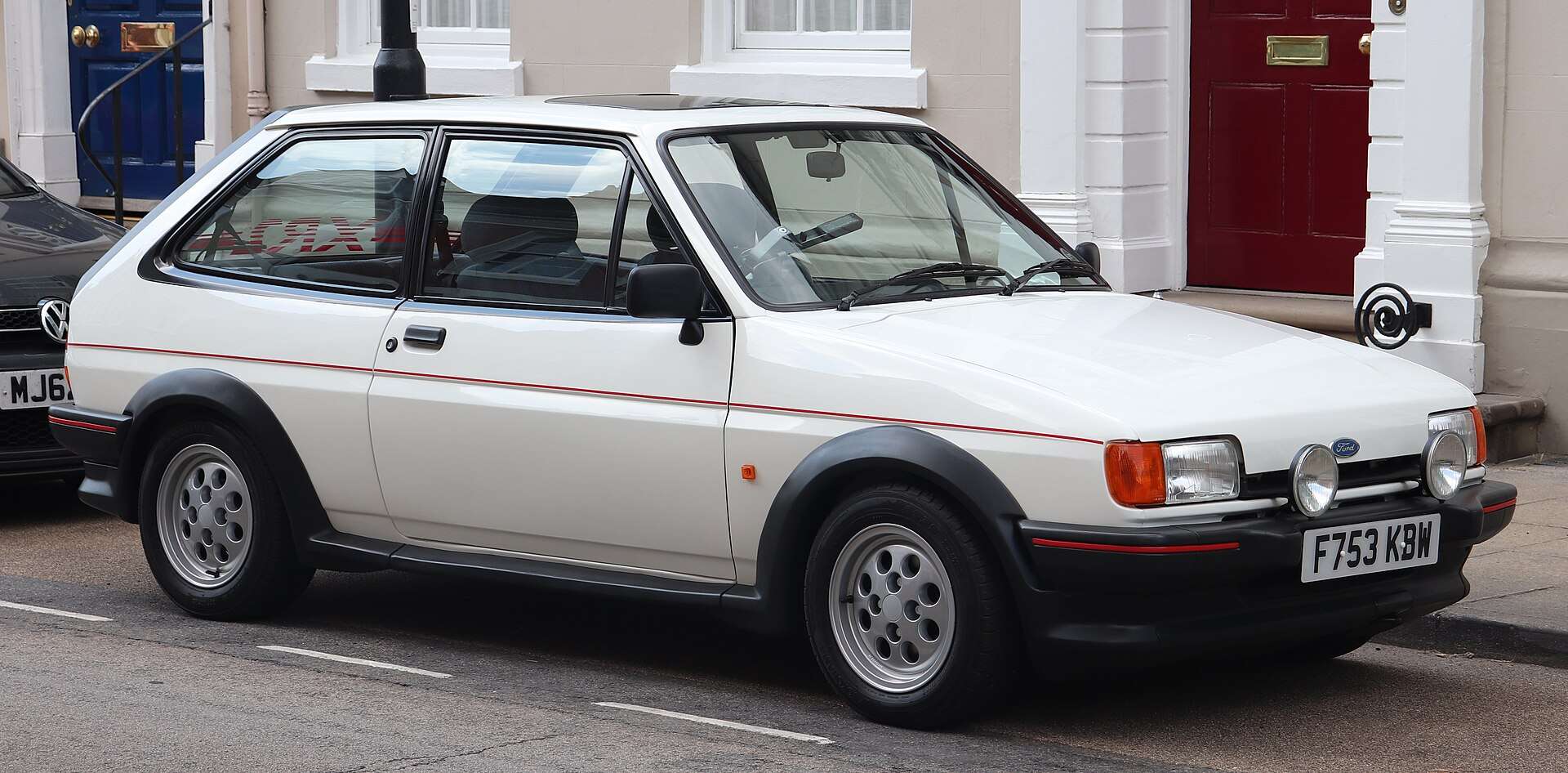
The Ford Fiesta XR2 and XR2i turned Britain’s everyday supermini into one of the defining affordable performance cars of the 1980s and early 1990s. Across three distinct generations, Ford changed the recipe from a light, carburettor-fed pocket rocket into a larger, fuel-injected hot hatch—but the appeal remained rooted in accessible speed, simple engineering and unmistakable road presence.
How the Fiesta became an XR
The ordinary Fiesta was conceived as Ford’s compact, economical European car, but competition was never far from the programme. A sporting Fiesta appeared in the 1979 Monte Carlo Rally, and Ford soon converted that energy into a road model. The XR badge—already familiar from other sporting Fords—gave the small hatchback a clear performance identity without pushing it into the more specialised RS world.
Ford’s own Fiesta timeline records the first XR2’s 1981 launch with a 1.6-litre engine, stiffer suspension, unique perforated alloy wheels and distinctive styling. Crucially, it was the first production Fiesta capable of 100mph. That figure now looks modest, but in a light early-1980s supermini it made the XR2 feel genuinely serious.

Mk1 Fiesta XR2: the original 100mph pocket rocket
The Mk1 XR2 is the purest version of the idea. Its 1,597cc Kent-family engine used a Weber carburettor and drove the front wheels through a four-speed manual gearbox. Period output figures vary slightly by market and source, but roughly 84bhp was enough because the car weighed well under a tonne.
Visual changes mattered as much as the numbers. Round headlamps, auxiliary lamps, black wheelarch extensions, spoilers and distinctive alloy wheels transformed the upright little Fiesta. The cabin remained recognisably related to the standard car, which was part of its charm: this was an attainable Ford rather than an exotic machine.
On the road, the appeal came from response rather than refinement. Unassisted steering, compact dimensions and modest tyre widths allowed the driver to feel speed at ordinary road pace. The four-speed gearbox and carburettor require more involvement than later hot hatches, and that mechanical directness is why good Mk1 cars now feel so special.
Mk2 Fiesta XR2: more usable, still full of character
The second-generation Fiesta arrived in 1983 and the XR2 followed in 1984. Ford retained a 1.6-litre single-overhead-cam engine but introduced a five-speed gearbox, improved brakes and suspension, and lower-profile tyres. Ford’s heritage material quotes 96PS for the Mk2.

The Mk2’s rounded nose, deeply integrated bumpers and pepper-pot-style wheels made it immediately recognisable. It was faster and more mature than the Mk1, with better motorway manners and a broader spread of performance. Yet it remained small and light enough to preserve the eager, slightly unruly quality enthusiasts expect from an XR2.
| Model | Introduced | Engine | Key change |
|---|---|---|---|
| Fiesta XR2 Mk1 | 1981 | 1.6-litre carburettor | First 100mph Fiesta |
| Fiesta XR2 Mk2 | 1984 | 1.6-litre SOHC carburettor | Five-speed gearbox and greater refinement |
| Fiesta XR2i Mk3 | 1989 | 1.6-litre fuel injection | Larger body and electronic injection |
Love cars you don’t see every day?
Get forgotten cars, surprising motoring stories and the most interesting finds from Unusual Cars by email.
Free to join. No spam. Unsubscribe whenever you like. See our privacy policy.
Mk3 Fiesta XR2i: the injected generation
When the wider and longer Mk3 Fiesta appeared in 1989, Ford replaced the XR2 badge with XR2i. The “i” advertised electronic fuel injection, an important selling point as emissions, cold-start behaviour and everyday driveability became more significant. Ford’s contemporary histories describe a 1.6-litre injected engine and five-speed gearbox.

The XR2i was roomier, more aerodynamic and easier to live with, but also heavier. Early 8-valve cars offered a different character from the later 16-valve XR2i, which adopted Ford’s newer Zetec engine. The Mk3 therefore bridges two eras: the old CVH-powered Ford hot hatch and the multi-valve performance cars of the 1990s.
It also provided the foundation for the more aggressive Fiesta RS Turbo. The two share their basic Mk3 shape and much of their visual language, but the RS added an intercooled Garrett turbocharger and a sharper performance identity.
Which version has the strongest identity?
The Mk1 is the most historically significant and visually distinctive. The Mk2 is often the sweet spot for driving: still compact and analogue, but more usable thanks to its five-speed transmission and improved chassis. The Mk3 XR2i is less delicate, yet its injected engine, broader cabin and unmistakable 1990s styling make it an important part of the story rather than a footnote.
Condition matters more than a theoretical hierarchy. Surviving cars have often endured corrosion, theft damage, poor repairs and decades of modification. A structurally sound, accurately presented example of any generation is now far more interesting than a nominally more desirable car assembled from compromised parts.
Why so few survive
These were affordable performance cars, bought to be used. Many accumulated hard miles; others were modified, crashed or consumed by corrosion around sills, floors, suspension mounting areas, inner wings and wheelarches. Period alarm installations and audio wiring can create further electrical problems, while missing trim and model-specific details can be surprisingly difficult to replace.
The same history that reduced survival rates also explains the cars’ cultural importance. XR2s were visible, attainable and embedded in everyday British motoring. They appeared in college car parks, outside nightclubs and on club stands—not hidden away as investment objects.
Why the XR2 and XR2i still matter
Ford did not invent the hot hatch, but it understood how to make one feel like part of popular culture. The XR2 placed real performance within reach of ordinary buyers and gave the Fiesta an enthusiast identity that later RS and ST models could inherit.
Read alongside the Fiesta RS Turbo guide and the wider Rare & Performance Fords hub, the three XR generations show how quickly the idea of a fast small Ford evolved.
Frequently asked questions
When was the first Fiesta XR2 launched?
Ford introduced the Mk1 XR2 in 1981. It was the first production Fiesta capable of 100mph.
What is the difference between an XR2 and XR2i?
The XR2 name was used for carburettor-fed Mk1 and Mk2 performance Fiestas. The Mk3 XR2i introduced electronic fuel injection and a larger, more modern body.
Did the XR2i become the RS Turbo?
The Fiesta RS Turbo was developed from the Mk3 performance-Ford formula and used an intercooled turbocharged version of the 1.6-litre engine, but it was a separate RS model.
Research sources
- Ford Media: 40 years of Fiesta production
- Ford Media: Fiesta historical timeline
- Wikimedia Commons image records and licence pages linked beneath each photograph.
Specifications can differ by year and market. Always identify an individual car from its chassis, engine, documentation and original equipment.
Continue the Ford story
Browse the Rare & Performance Fords hub, continue with the Fiesta RS Turbo, or discover the Racing Puma.
For more about this car, read 10 Things You Probably Didn’t Know About the Ford Fiesta XR2 Mk1 and Mk2.