UNUSUAL CARS MOTORSPORT GUIDE
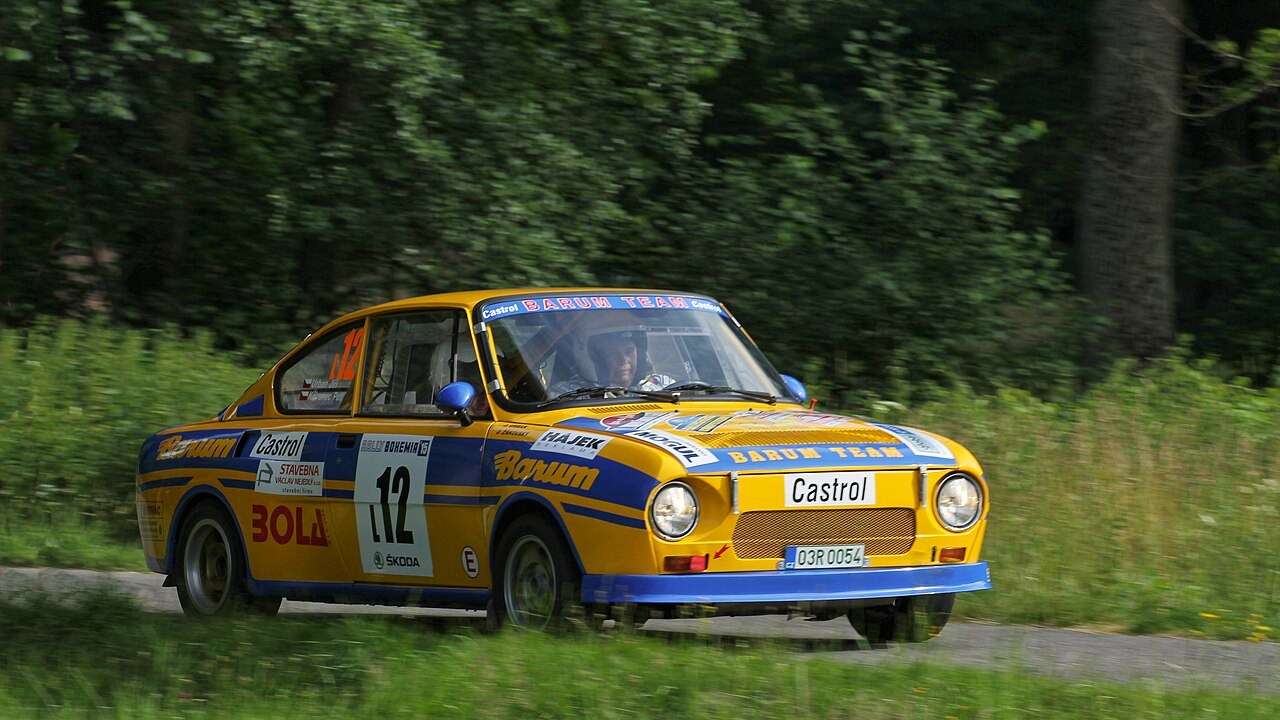
The Škoda 130 RS was a purpose-built competition coupé that won on rally stages and racing circuits despite using a 1.3-litre pushrod engine. Introduced in 1975, it scored a class one-two on the 1977 Monte Carlo Rally and helped Škoda win the 1981 European Touring Car Championship manufacturers’ title.
Featured image: Škoda 130 RS competition coupé. Photograph by Jiří Sedláček, CC BY-SA 4.0, via Wikimedia Commons; locally hosted.
How the 130 RS was created
Škoda’s 180 RS and 200 RS prototypes demonstrated the potential of the rear-engined coupé, but changing competition rules favoured a smaller-capacity car. Engineers developed the 130 RS from the 110 R shape and the 130-series mechanical family, concentrating on low weight, strength and reliability.
Aluminium roof and door skins and glass-fibre outer panels reduced mass. Wider tracks, pronounced wheelarch extensions and competition suspension transformed the stance, while a protective cage and discipline-specific equipment made it a racing machine rather than a modified road coupé.

Engine, transmission and construction
The 1,289cc OHV four-cylinder retained an aluminium block but gained intensive development. Works specifications changed over time: rally cars prioritised tractability and durability, while circuit engines eventually produced around 140 PS at high engine speeds. Power still went through a rear transaxle.
Low mass made the power meaningful. Published works figures vary by year and discipline, so any specification claim must be tied to a particular car and event rather than treated as universal.


Rally success
The 1977 Monte Carlo Rally supplied the defining result: Václav Blahna and Lubislav Hlávka led a 130 RS class one-two in the category for cars up to 1,300cc. The model continued to take class results on demanding international rallies, proving that careful engineering could overcome a modest engine capacity.
Love cars you don’t see every day?
Get forgotten cars, surprising motoring stories and the most interesting finds from Unusual Cars by email.
Free to join. No spam. Unsubscribe whenever you like. See our privacy policy.
Circuit racing and the 1981 European title
The 130 RS was equally credible on circuits. Škoda’s official history highlights the 1981 European Touring Car Championship, where consistent results delivered the manufacturers’ title. Period photographs show cars racing door-to-door with larger and more powerful machinery.

Originals, replicas and historic competition cars
Almost 200 cars were produced in original factory specification, according to Škoda. Since then, many road-car shells have been converted and numerous accurate replicas have been built for demonstration or historic competition. A replica can be an excellent event car, but it must not be represented as a factory original without documentary proof.
For a high-value car, commission marque and motorsport-history specialists to examine shell construction, identification numbers, period photographs, homologation details and the provenance of major components.
Škoda 130 RS inspection guide
Identity and provenance
Start with continuous documented history. Cross-check chassis details, logbooks, factory records, period entry lists and photographs. Be wary of histories that depend on verbal claims or recently attached identification plates.
Shell and safety equipment
Inspect the underlying structure for fatigue, corrosion and crash repairs. Competition shells may have been repaired repeatedly. Current belts, seats, fire systems, cage compliance and fuel equipment matter if the car will be used, even when period authenticity is important.
Engine and transaxle
A genuine specification engine is specialised and expensive. Record compression, leak-down results, oil pressure, cooling behaviour and rebuild documentation. Confirm gear ratios, casing identity and differential setup, then budget for inspection by a specialist familiar with historic Škoda competition cars.
Eligibility
Historic rally and race organisers apply their own regulations. Before buying, confirm that the shell, engine, brakes, suspension, wheels and safety equipment fit the intended championship or demonstration category.
Sources and further reading
Continue the Škoda story
The 130 RS turned modest mechanical ingredients into world-class results. Explore the complete Škoda hub, then read about its 110 R ancestor, then follow the RS badge into the modern Octavia vRS.
Frequently asked questions
Is the Škoda 130 RS a road car?
No. It was a factory competition car developed for rallying and circuit racing, although modern replicas and recreations are common.
What engine did the Škoda 130 RS use?
It used a rear-mounted 1,289cc OHV four-cylinder. Works output varied by discipline and development, reaching roughly 140 PS in later circuit form.
What did the Škoda 130 RS win?
Major achievements included a class one-two on the 1977 Monte Carlo Rally and the manufacturers’ title in the 1981 European Touring Car Championship.
How many original 130 RS cars were built?
Škoda states that almost 200 were produced in original factory specification.
How can you identify a genuine 130 RS?
Identity requires factory history, period documents and expert inspection of the shell, construction details and components; appearance alone is insufficient.