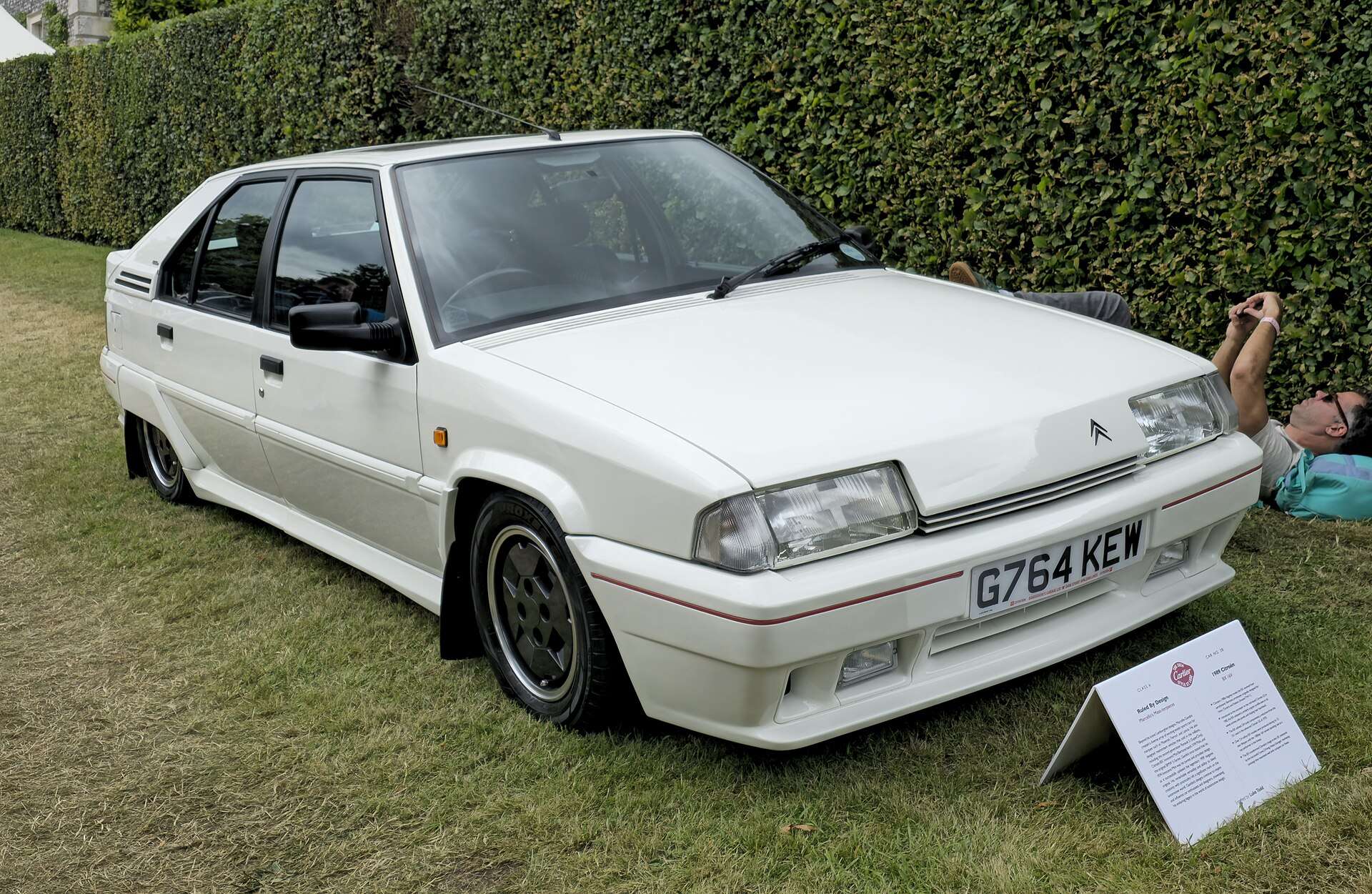
The Citroën BX GTI 16V hid one of the most advanced naturally aspirated engines of its era beneath sharp-edged family-hatch bodywork. It was fast, light, comfortable and unmistakably Citroën.
Thinking of buying one? Read our Citroën BX GTI & 16V buying guide for practical checks before buying and ownership advice.

1. Marcello Gandini shaped it for Bertone
The BX was designed at Bertone under Marcello Gandini, whose résumé included the Lamborghini Miura and Countach. Its folded-paper lines echoed earlier Bertone concepts while still looking distinctly French.
2. The 16V arrived after the ordinary GTI
Citroën launched the BX in 1982 and added the eight-valve GTI in 1986. The sixteen-valve flagship followed in 1987 for the 1988 model year, giving the angular hatchback true sports-saloon performance.
3. Its engine was Peugeot-Citroën’s new XU9J4
The all-alloy 1,905cc four-cylinder used twin overhead camshafts, sixteen valves and Bosch fuel injection. In early non-catalyst form it produced 160 PS, exceptionally strong output for a naturally aspirated two-litre family car.
4. It was genuinely fast
Citroën quoted 0–100 km/h in 7.9 seconds and a top speed of 218 km/h—about 135 mph. Low weight made the car feel even more urgent than its figures suggest.
Love cars you don’t see every day?
Get forgotten cars, surprising motoring stories and the most interesting finds from Unusual Cars by email.
Free to join. No spam. Unsubscribe whenever you like. See our Privacy Policy.
5. It pioneered French multivalve production
Citroën described it as France’s first mass-produced car with a multi-valve engine. The head was developed with lessons from Peugeot Talbot Sport and became a celebrated power unit in several PSA performance models.

6. Hydropneumatic suspension remained central
Despite the performance upgrade, the 16V retained Citroën’s self-levelling hydropneumatic system. It kept ride height constant under load and delivered a blend of control and suppleness rivals struggled to match.
7. Anti-lock brakes were standard
ABS was included as standard equipment on the 16V, an important safety feature that was still far from universal in late-1980s family cars.
8. Composite panels helped keep weight down
The BX used lightweight materials including a composite bonnet, tailgate and bumpers. Depending on specification, the 16V weighed only a little over a tonne, giving it an excellent power-to-weight ratio.
9. Later versions lost a little power
When catalyst-equipped cars appeared for markets with tightening emissions rules, quoted output fell from around 160 PS to roughly 148 PS. Styling also evolved, with later cars receiving smoother bumpers and revised trim.
10. It was a sleeper before the word became fashionable
A red pinstripe, discreet 16 Valve badges and modest spoilers were the main clues. To most people it looked like an eccentric family hatch, which made its effortless motorway pace and high-revving engine all the more surprising.
Keep exploring
Read our full Citroën BX GTI 16 Valve guide, or browse the 10 Things hub.
Love cars you don’t see every day?
Get forgotten cars, surprising motoring stories and the most interesting finds from Unusual Cars by email.
Free to join. No spam. Unsubscribe whenever you like. See our Privacy Policy.
Sources and further reading
- Citroën Origins heritage archive
- Citroën BX 16 Valve sales literature
- PSA technical specifications