Before the Cosworth became the poster car, Ford used the Sierra XR4i to prove that its controversial “jelly mould” family hatch could be a serious performance machine. Its specification and short life make it far stranger than memory suggests.
1. It arrived while the Sierra’s shape was still controversial
The Sierra had replaced the square-edged Cortina only months earlier, and its aerodynamic styling shocked conservative buyers. Launched in 1983, the XR4i deliberately exaggerated that shape with spoilers, cladding and an unusual side-window treatment.
2. The engine came from Ford’s Cologne V6 family
Under the bonnet sat the fuel-injected 2.8-litre Cologne V6, producing about 150 bhp. It was related to engines used in the Granada and Capri, but in the lighter, slipperier Sierra it delivered 0–60 mph in roughly eight seconds and a top speed near 130 mph.

3. It stayed rear-wheel drive
The XR4i sent its power through a five-speed manual gearbox to the rear wheels, with independent rear suspension rather than the Cortina’s live axle. That layout gave it a very different character from the front-wheel-drive hot hatches that were becoming fashionable.
4. The bi-plane rear spoiler was more than decoration
Its two-level rear wing became the XR4i’s visual signature. Ford’s aerodynamic work was intended to manage airflow and high-speed stability, while the lower hatch spoiler and upper wing turned the otherwise smooth Sierra into one of the decade’s most recognisable silhouettes.
Love cars you don’t see every day?
Get forgotten cars, surprising motoring stories and the most interesting finds from Unusual Cars by email.
Free to join. No spam. Unsubscribe whenever you like. See our Privacy Policy.
5. The “three-door” body looked as though it had six side windows
The XR4i used a distinctive bodyshell with a divided rear side-glass arrangement. The extra pillar and separate pane made it look different from ordinary three-door Sierras and is one reason converting a standard shell into a convincing XR4i is not straightforward.
6. Its original career was remarkably short
The XR4i was sold in Europe from 1983 to 1985. Ford then shifted emphasis to the XR4x4, which paired the V6 with four-wheel drive and a more conventional body. That brief production window helps explain why genuine, unmodified XR4is are scarce today.
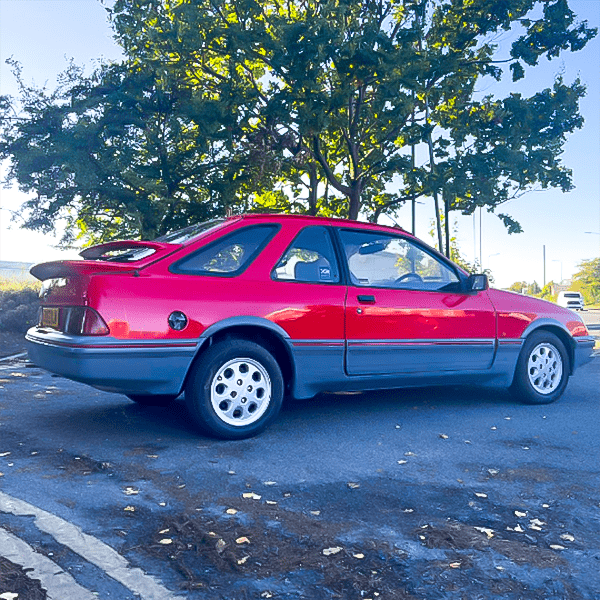
7. America’s Merkur XR4Ti was not the same car
Ford sold a related Sierra-bodied model in North America under the Merkur brand. The XR4Ti looked familiar but used a turbocharged 2.3-litre four-cylinder engine, different bumpers and market-specific equipment. It should not be described simply as an American XR4i.
8. The XR4x4 was a successor, not merely an option
From 1985 the XR4x4 offered the V6 with Ferguson-style four-wheel drive, initially as a five-door hatch. It was a more discreet and all-weather interpretation of the sporting Sierra, and its arrival effectively closed the XR4i’s first chapter.
9. The Cosworth quickly stole its limelight
The turbocharged Sierra RS Cosworth appeared soon afterwards with homologation purpose, 204 bhp and an enormous rear wing. Its racing success and tuning potential eclipsed the XR4i, even though the earlier V6 car had prepared buyers for the idea of a dramatic high-performance Sierra.

10. Survival is about originality as much as numbers
Low used values once made XR4is tempting donors, modifiers and track cars, while corrosion attacked sills, arches, floors and suspension mounting areas. A correct shell, injection system, interior trim, spoiler set and metric-era details can therefore matter more than an eye-catching repaint.
Read more: See our full Ford Sierra XR4i guide, or explore every article in the 10 Things hub.
Love cars you don’t see every day?
Get forgotten cars, surprising motoring stories and the most interesting finds from Unusual Cars by email.
Free to join. No spam. Unsubscribe whenever you like. See our Privacy Policy.