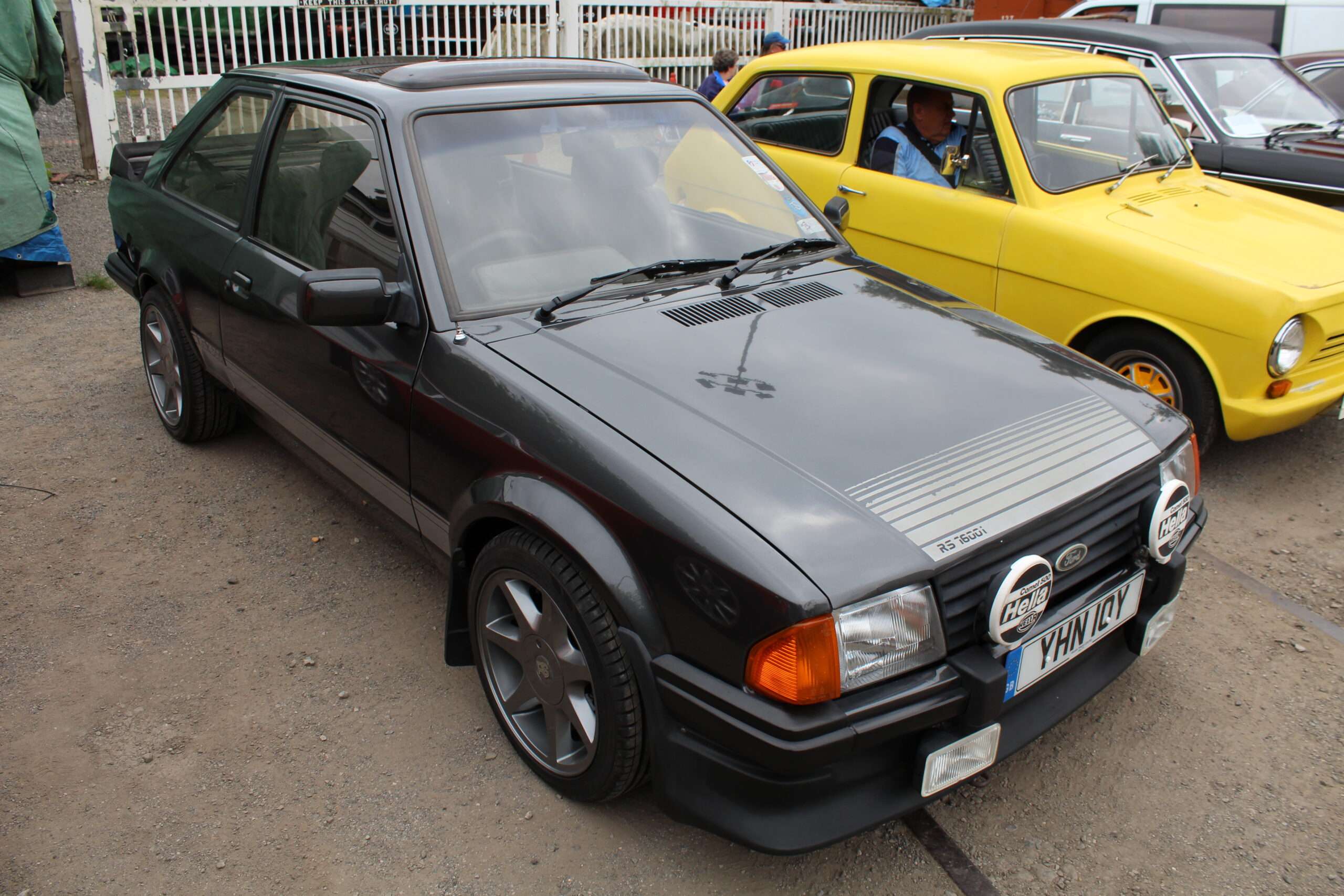
The Ford Escort RS1600i occupies a fascinating position between the carburettor-fed XR3 and the later RS Turbo. It looked familiar, but beneath the stripes was a homologation-focused Escort developed by Ford Motorsport in Germany.

1. It was developed in Germany—not Britain
The RS1600i was created by Ford Motorsport at Merkenich and assembled at Saarlouis. Although Britain became one of its most enthusiastic markets, this front-drive RS was fundamentally a German-led homologation project.
2. Its name recalled a very different Escort
The badge deliberately echoed the rear-wheel-drive Mk1 Escort RS1600, but the Mk3 used a transverse CVH engine and front-wheel drive. The shared name connected two technically unrelated generations through Ford’s competition heritage.
3. The engine was not simply an XR3i unit
Both cars used a 1.6-litre injected CVH, but the RS received a different cylinder head, camshaft, pistons and Bosch fuel-injection calibration. Output rose to about 115PS, compared with roughly 105PS for the contemporary XR3i.
4. It had twin ignition coils
One of the clearest engine-bay clues is the unusual dual-coil arrangement. The ignition system alternated between the coils, an exotic detail for an early-1980s Escort and one of several parts that make correct restoration challenging.
Love cars you don’t see every day?
Join the Unusual Cars Club for new “10 Things” articles, forgotten cars and surprising motoring stories by email.
Free to join. No spam. Unsubscribe whenever you like. See our Privacy Policy.
5. Motorsport rules shaped the road car
The RS1600i was homologated in Group A as FIA number 5097. Close-ratio gearing, engine changes and chassis revisions were not simply showroom decoration—they provided Ford with the required production foundation for competition.
6. Its suspension geometry differed from the XR3i
Ford Motorsport specified its own springs, dampers, anti-roll bars and alignment. Contemporary testing found the RS more demanding and uncompromising than an XR3i, which was exactly what its specialist brief suggested.
7. The stripes were more than an aftermarket flourish
The bonnet and body graphics, deep front spoiler, rear wing and seven-spoke alloy wheels created the RS identity. Correct stripes and trim now matter because so many cars were modified, repainted or converted when values were low.
8. Britain received a special right-hand-drive run
The model proved popular enough for Ford to offer right-hand-drive cars, despite its European homologation origins. British-market examples helped turn the RS1600i into a cult Fast Ford rather than an obscure continental special.
9. Production was substantial for a homologation model
Approximately 8,659 examples are widely recorded. That was far more than the minimum needed for competition, yet corrosion, theft and modification have made sound, credible survivors much scarcer today.
10. It bridged two eras of Fast Ford
The RS1600i combined the naturally aspirated immediacy of the XR3 generation with the competition focus that would soon produce the Escort RS Turbo. It is the missing link between the early front-drive hot hatch and Ford’s turbocharged future.
For more period performance Fords, explore our forgotten 1980s performance-car guides and the complete 10 Things collection.
Research note: key homologation and specification details were checked against FIA records, Ford’s RS chronology and contemporary road tests.
Love cars you don’t see every day?
Join the Unusual Cars Club for new “10 Things” articles, forgotten cars and surprising motoring stories by email.
Free to join. No spam. Unsubscribe whenever you like. See our Privacy Policy.