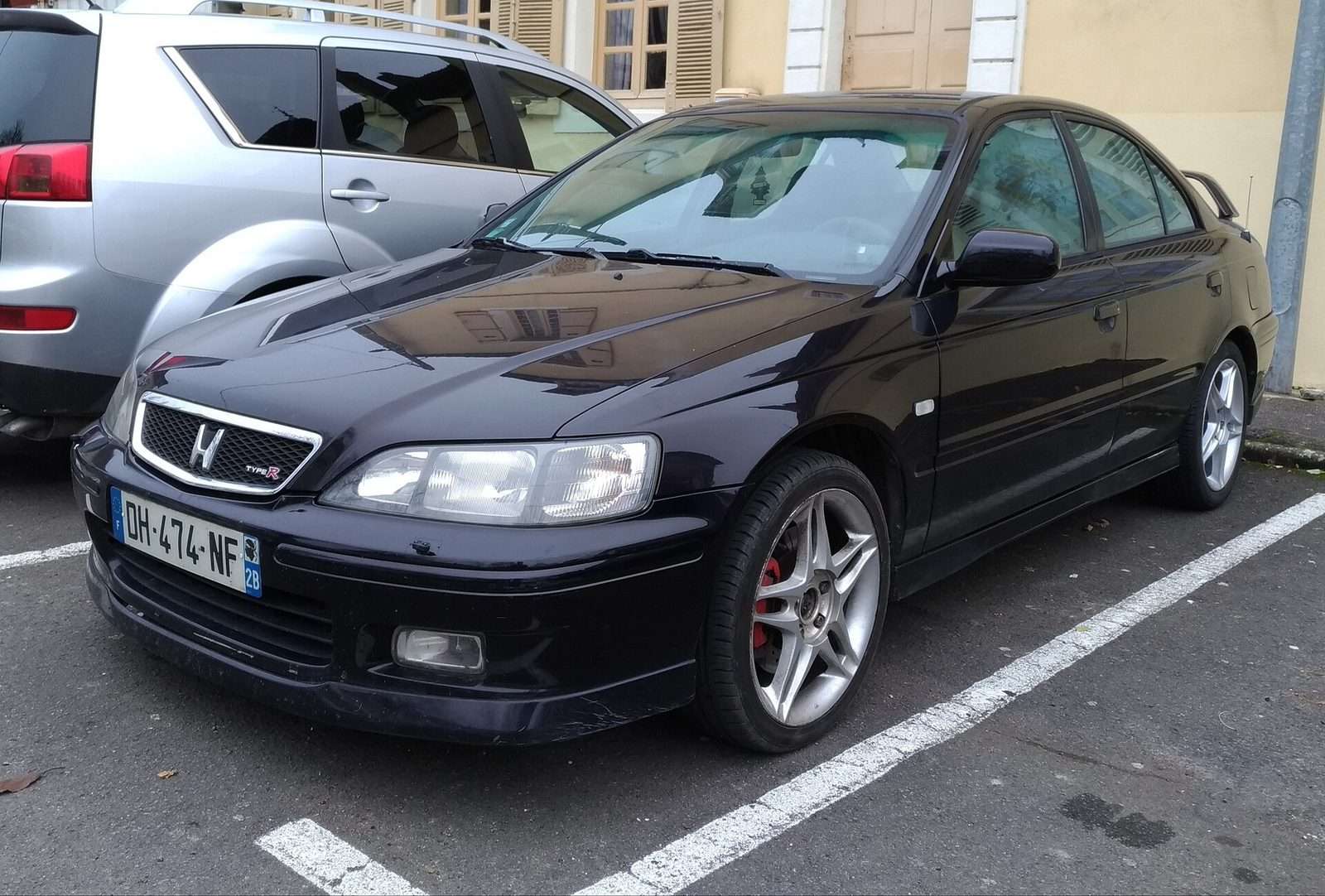
The Honda Accord Type R is often overshadowed by smaller Civic and Integra Type Rs, yet the CH1 was one of Honda’s most complete performance cars: a hand-finished-feeling sports saloon with a high-revving engine, a limited-slip differential and genuine long-distance ability.
Thinking of buying one? Read our Honda Accord Type R buying guide for practical checks before buying and ownership advice.

1. It was developed specifically for Europe
The CH1 Accord Type R was based on the European sixth-generation Accord rather than the visually different Japanese and American saloons. Built at Honda’s Swindon plant, it was tailored to European roads and tastes.
2. Its 2.2-litre engine was related to the Prelude’s—but not identical
The H22A7 shared its basic architecture with the Prelude VTi’s H22, but received Type R-specific pistons, camshafts, intake and exhaust work. It produced about 212 PS and delivered its best work close to the red line.
3. Each engine received unusually careful assembly
Honda applied the Type R philosophy beyond badges. Ports were hand-finished, reciprocating components were selected for close tolerances and the engine was balanced more carefully than an ordinary production unit.
4. A helical limited-slip differential was standard
The close-ratio five-speed gearbox fed the front wheels through a torque-sensing helical LSD. It helped the Accord deploy power cleanly out of bends and was a major part of the car’s character.
Love cars you don’t see every day?
Join the Unusual Cars Club for new “10 Things” articles, forgotten cars and surprising motoring stories by email.
Free to join. No spam. Unsubscribe whenever you like. See our Privacy Policy.
5. The shell was significantly stiffened
Extra bracing and reinforcements increased rigidity, allowing firmer suspension calibration to work accurately. The trade-off was weight: unlike the tiny Integra, this was still a substantial four-door saloon.
6. It had more serious brakes and suspension
Honda fitted larger brakes, firmer springs and dampers, revised geometry and a quicker-feeling set-up. Owners remember steering precision and body control more than outright straight-line speed.
7. The cabin used genuine Recaro seats
Supportive Recaros, a Momo steering wheel, alloy gearknob and red detailing provided the Type R atmosphere. The rear seat and useful boot remained, giving it practicality few homologation-flavoured cars could match.

8. It was deliberately restrained to look at
A deeper bumper, discreet rear spoiler, 17-inch wheels and red badges were the main clues. That understatement made the Accord a convincing Q-car and is part of its appeal today.
9. The exhaust note was engineered into the experience
A freer-flowing twin-exit exhaust and aggressive VTEC changeover gave the large saloon a hard-edged voice above roughly 5,700rpm. Below that point it remained tractable and civilised.
10. Survival—not original production—is what makes it feel rare
Several thousand were built, but rust, hard use and the cost of model-specific parts have thinned the population. Standard, structurally sound examples are now far harder to find than the production total suggests.
Continue the story: read our complete Honda Accord Type R CH1 guide, explore the Honda hub, or browse every 10 Things article.
Join the Unusual Cars Club
Get the next forgotten performance car story by email.
Free to join. No spam. Unsubscribe whenever you like.
Research basis: official Honda Type R historical material, period specifications and the Unusual Cars CH1 model guide.