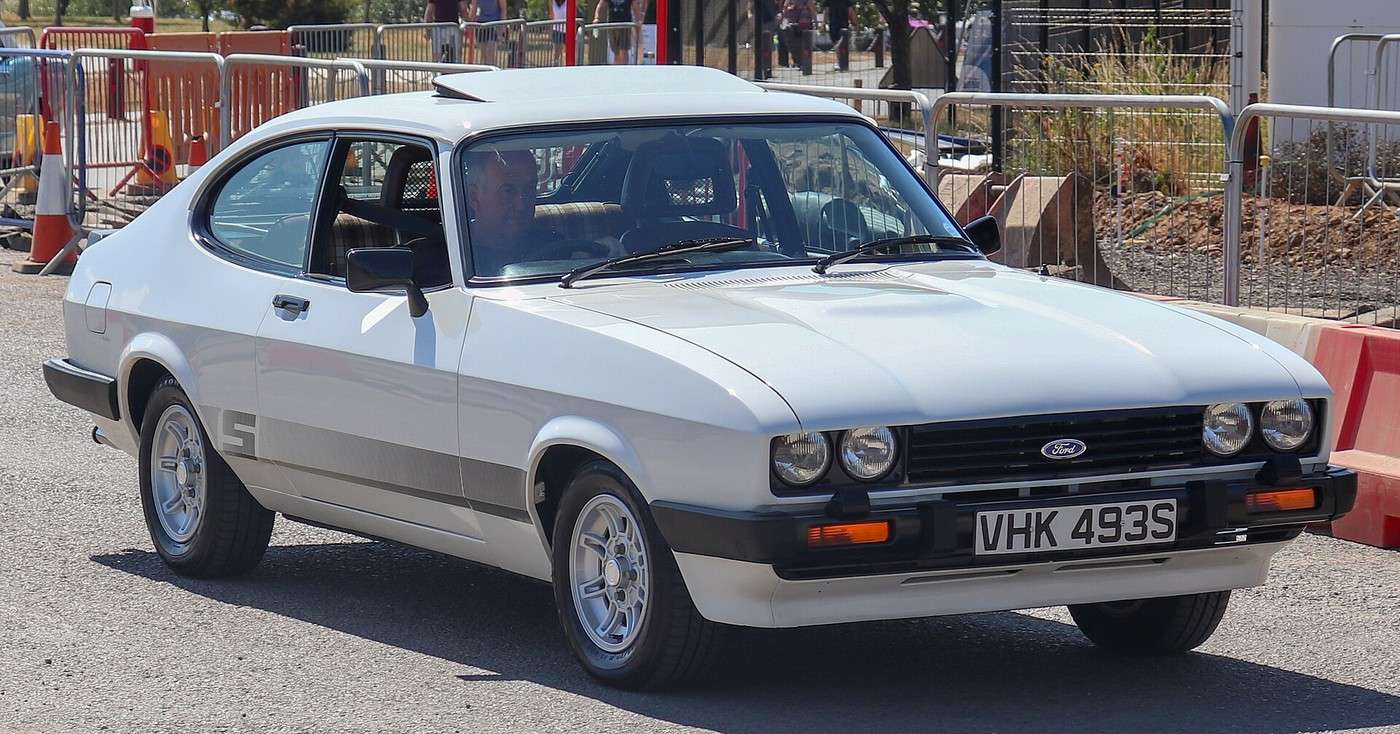
The Ford Capri 3.0S was the purposeful, sporting face of the late-1970s Capri range. With its Essex V6, four-speed gearbox and restrained black detailing, it delivered accessible grand-touring performance before the fuel-injected 2.8i took over.
1. The Mk3 was officially an evolution of the Mk2
Ford’s 1978 facelift brought quad headlamps, a new bonnet, deeper spoilers and cleaner aerodynamics, but the basic Capri II structure remained. Enthusiasts nevertheless adopted the Mk3 name because the visual change was so effective.
2. Its V6 displaced 2,994cc
The British-built Essex engine used a carburettor, overhead valves and a deliberately unstressed design. In 3.0S form it produced about 138bhp and 174lb ft, with torque arriving low enough to make relaxed progress easy.

3. It still used a four-speed manual gearbox
The later 2.8 Injection popularised a five-speed, but the 3.0S paired its V6 with a four-speed transmission. The relatively direct gearing contributed to its muscular, old-school character.
4. Ford quoted 0–100km/h in 8.6 seconds
A 1978 brochure gave the 3.0S acceleration that was genuinely quick for an affordable coupé of the period. Top speed sat around 125mph, placing it well above ordinary family saloons.
Love cars you don’t see every day?
Get forgotten cars, surprising motoring stories and the most interesting finds from Unusual Cars by email.
Free to join. No spam. Unsubscribe whenever you like. See our Privacy Policy.
5. The S was sportier than the luxury Ghia
While the 3.0 Ghia emphasised equipment and bright trim, the S used firmer suspension, sports seats, black exterior details and a more purposeful cabin. It was aimed at drivers rather than luxury-car buyers.
6. The Essex V6 gave it a distinctive soundtrack
A deep induction and exhaust note was central to the experience. The engine was less sophisticated than later fuel-injected units, but its broad torque and mechanical simplicity suited the Capri perfectly.
7. Television made it a cultural icon
A silver Capri 3.0S became closely associated with Bodie in The Professionals. Fast driving and action sequences fixed the model in the memory of viewers who might never have studied a Ford brochure.
8. Motorsport was part of the Capri’s wider identity
Earlier three-litre Capris achieved major touring-car success, and that competition image carried into the road-going 3.0S. The Mk3 itself also became a popular basis for club racing and rallying.
9. The 2.8 Injection ended its reign
Ford replaced the carburetted 3.0-litre flagship with the 2.8 Injection in 1981. The newer car was faster and more economical, but it also closed the chapter on the British Essex-powered performance Capri.
10. A sound shell is worth paying for
Strut tops, inner wings, sills, floor, rear spring hangers, arches and the scuttle can all corrode. Engines are rebuildable, but a badly rusted or poorly repaired body can consume a restoration budget.
Why it matters
The Capri 3.0S matters because it is the clearest expression of Ford’s European ‘car you always promised yourself’ idea: dramatic looks, usable rear seats, a big-engine soundtrack and performance within reach of ordinary enthusiasts.
Join the Unusual Cars Club
Get more forgotten performance cars, surprising motoring stories and new 10 Things articles by email.
Free to join. No spam. Unsubscribe whenever you like. See our Privacy Policy.