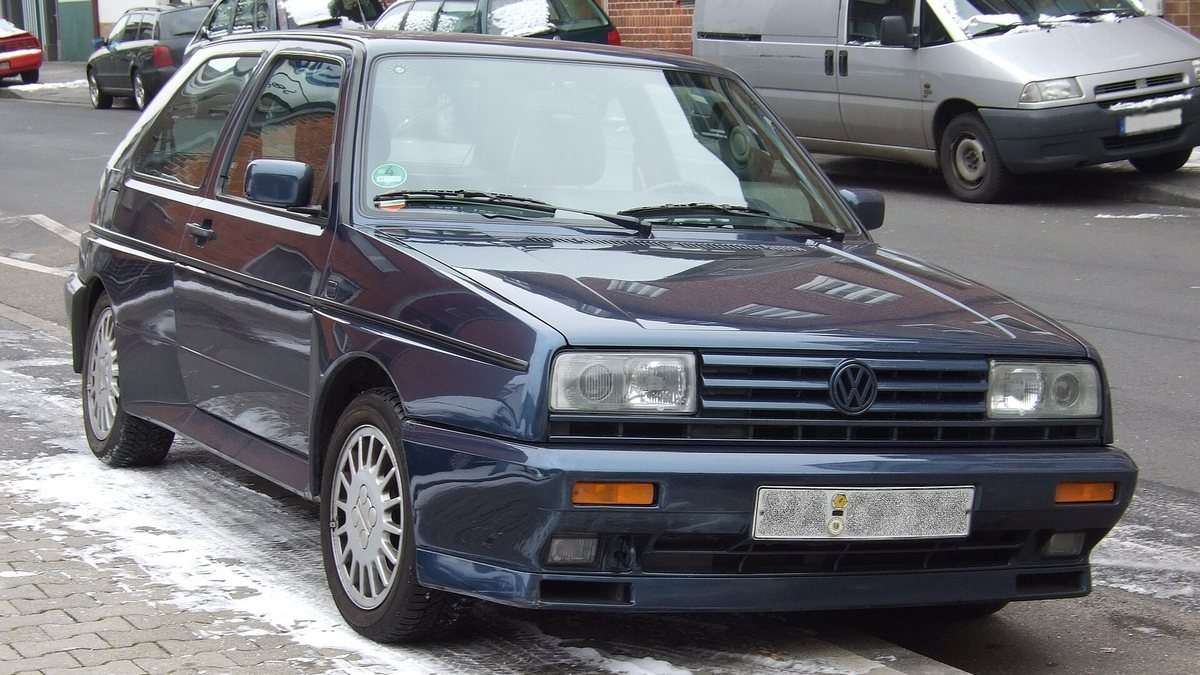
The Volkswagen Golf Rallye G60 looks like a Mk2 Golf inflated around its wheels, but almost every unusual detail has a technical reason. Built as a homologation special, it combined a supercharged engine, Syncro four-wheel drive and bespoke steel bodywork in a package far more exotic than its familiar badge suggested.
1. It was built for rally homologation
Volkswagen created the Rallye Golf so it could compete in international Group A rallying. The regulations demanded a production run of road cars, so this was not simply a styling exercise: its unusual engine capacity, four-wheel-drive system and wider body all served a competition programme.
2. The engine was deliberately smaller than a normal 1.8
Its four-cylinder engine displaced 1,763cc rather than the familiar 1,781cc used elsewhere in the Golf range. That reduction was calculated around the FIA multiplication factor applied to forced-induction engines, keeping the competition car inside the intended capacity class.

3. G60 refers to the supercharger, not the engine size
The G-Lader supercharger used a spiral displacer rather than conventional turbocharger turbines. The “60” referred to the approximate 60mm width of the internal spiral. In road trim the eight-valve engine produced about 160PS, with instant response and a distinctive mechanical character.
4. It sent power to all four wheels
Volkswagen’s Syncro system used a viscous coupling to transfer drive rearwards when the front wheels began to slip. It was less sophisticated than later electronically controlled systems, but in 1989 a supercharged, four-wheel-drive hatchback was remarkably exotic.
Love cars you don’t see every day?
Get forgotten cars, surprising motoring stories and the most interesting finds from Unusual Cars by email.
Free to join. No spam. Unsubscribe whenever you like. See our Privacy Policy.
5. The body was genuinely different
The box arches were pressed into widened steel panels rather than added as simple plastic extensions. Rectangular headlamps, a deeper front bumper, different sills and a uniquely broad stance meant a Rallye shell was expensive to manufacture and difficult to imitate properly.
6. Most were assembled in Brussels
The Rallye Golf was produced at Volkswagen’s Belgian plant in Forest, Brussels, rather than simply rolling down the main Wolfsburg line like an ordinary GTI. Its specialist construction and low volume helped explain its very high showroom price.
7. It was sold only in left-hand drive
Volkswagen never developed a factory right-hand-drive version. That kept it out of ordinary UK showrooms, although private imports later made the car familiar to British enthusiasts. Every genuine Rallye therefore has its steering wheel on the left.

8. It cost dramatically more than a GTI
The Rallye’s list price was close to twice that of a regular Golf GTI in some markets. Buyers were paying for bespoke bodywork, Syncro transmission and the G-Lader drivetrain—not necessarily crushing performance, since 0–62mph took roughly eight and a half seconds.
9. The rally car never became the giant-killer Volkswagen hoped for
By the time Volkswagen’s works Group A Rallye Golf appeared, rivals had more power, stronger competition budgets and increasingly specialised hardware. It scored useful results but never achieved the championship-defining success its road-car rarity now suggests.
10. A 16-valve version became even rarer
Volkswagen Motorsport created a tiny number of Rallye Golfs with a 16-valve G60 engine producing well over 200PS. They were never a normal catalogue model, making the few surviving examples among the most coveted factory-built Mk2 Golfs.
Why it matters
The Rallye G60 matters because it connected Volkswagen’s practical hatchback tradition with the all-weather performance formula later perfected by the Golf R. It was expensive, imperfect and only modestly successful in competition—but those qualities, combined with its rarity and unmistakable shape, make it one of the most fascinating Golfs ever built.
Join the Unusual Cars Club
Get more forgotten performance cars, surprising motoring stories and new 10 Things articles by email.
Free to join. No spam. Unsubscribe whenever you like. See our Privacy Policy.