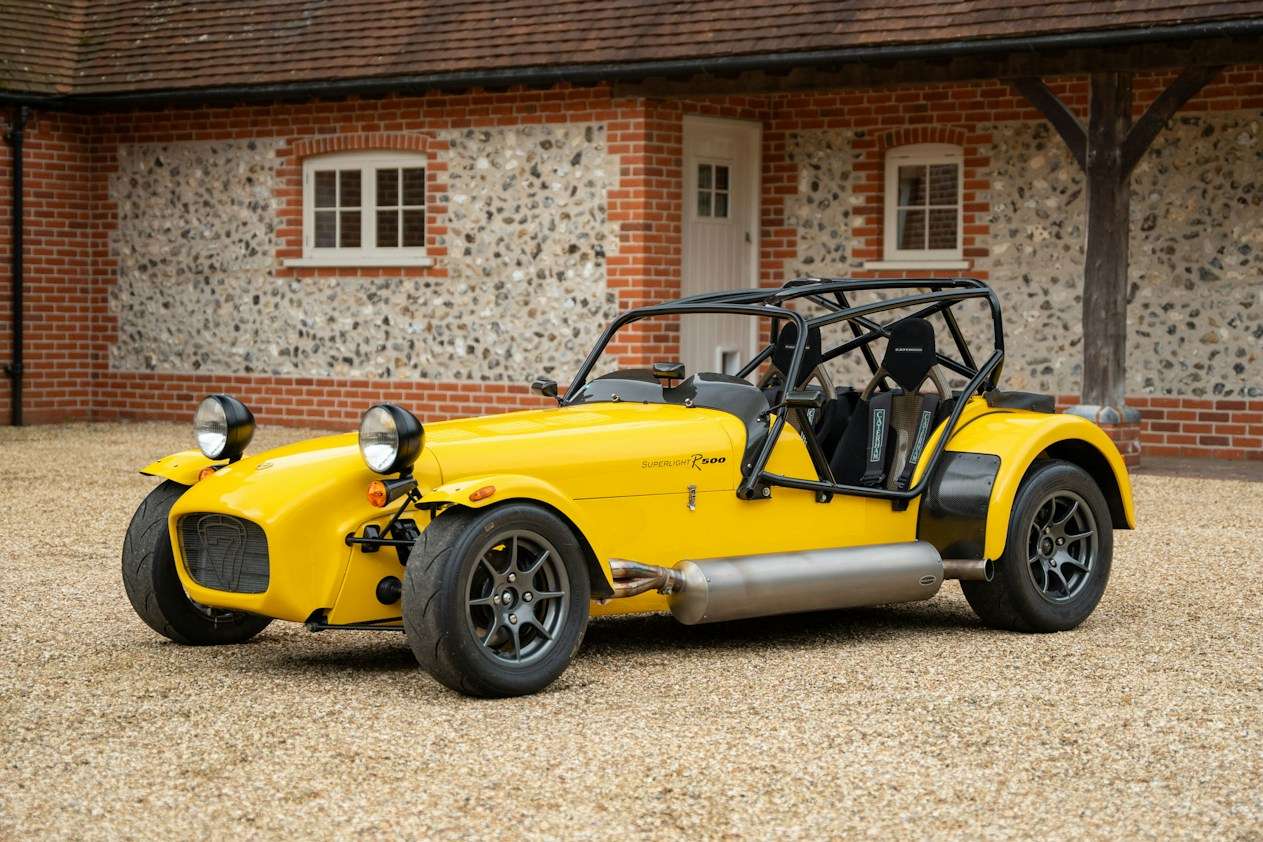
The Caterham Superlight R500 distilled the Seven idea to a wonderfully unreasonable number: roughly 500 brake horsepower per tonne. It was not a single frozen specification, but a name applied to two especially important generations of Caterham’s lightweight flagship—first with Rover K-series power and later with Ford Duratec power.

From Superlight to R500
Caterham introduced the Superlight R500 in 1999, building on the stripped-back philosophy of the earlier Superlight. Comfort was deliberately secondary. The important ingredients were low mass, immediate steering, strong brakes and a powertrain that made the car feel alive at any speed.
The original R500 used a highly developed 1.8-litre Rover K-series engine producing about 230bhp. With a quoted weight of roughly 460kg, its performance-to-weight ratio justified the badge. Dry-sump lubrication, lightweight body panels and carefully chosen components helped it survive fast road and track use without blunting the Seven’s delicacy.
The K-series character
The early car is remembered for more than its numbers. Its naturally aspirated engine needed revs and rewarded accurate gear changes, while the light chassis made every input count. There was little isolation between driver and road: the steering wriggled in the hands, the exhaust dominated the soundtrack and the car changed direction with very little inertia.
Period figures put the K-series R500 at around 3.6 seconds from 0–60mph, but the more telling measure was how quickly it gathered speed between corners. Magnesium wheels, carbon-fibre details and minimal equipment all served the same purpose rather than acting as decoration.

The Duratec R500
Caterham revived the name for a new R500 in 2008. This version used a 2.0-litre Ford Duratec engine producing 263bhp and weighed about 506kg. Contemporary testing recorded 0–60mph in 2.88 seconds, putting the open two-seater into supercar territory despite its modest engine capacity.
Buyers could choose a conventional six-speed manual or a sequential transmission, depending on specification and intended use. The later car was more developed than the K-series model, yet it remained unmistakably a Seven: narrow, loud and intensely responsive. Evo reported that 174 Duratec R500s were produced between 2008 and 2014.
Specifications at a glance
| Version | Original R500 | Duratec R500 |
|---|---|---|
| Engine | 1.8-litre Rover K-series | 2.0-litre Ford Duratec |
| Power | About 230bhp | 263bhp |
| Quoted weight | About 460kg | About 506kg |
| 0–60mph | About 3.6sec | 2.88–2.9sec |
| Production era | From 1999 | 2008–2014 |
Why the R500 matters
The R500 showed that Caterham could keep developing a design rooted in the 1950s without losing its essential honesty. It became a benchmark for power-to-weight performance and a reference point in road tests of far more expensive machinery. It also helped establish the modern hierarchy of extreme Sevens that later led to the 620R.
Today the two generations appeal for slightly different reasons. The K-series car is a fascinating piece of turn-of-the-century British lightweight engineering; the Duratec model is faster, more robustly developed and still startlingly modern in performance. Both make the same argument: speed can come from removing mass as effectively as adding power.
Enjoy unusual British performance cars?
Join the Unusual Cars newsletter for new model histories, forgotten-car features and specialist guides.
Frequently asked questions
What does R500 mean?
It refers to the car’s approximate power-to-weight target of 500bhp per tonne.
How many Duratec R500s were built?
Contemporary reporting records 174 examples built between 2008 and 2014.
Was the R500 sold in the UK?
Yes. It was a UK-market Caterham model offered in road and track-focused specifications.
Research sources include Caterham’s 50-at-50 archive, contemporary Caterham brochures, Car Enthusiast and Evo.