IN-DEPTH BUYING GUIDE · LOTUS CORTINA Mk1
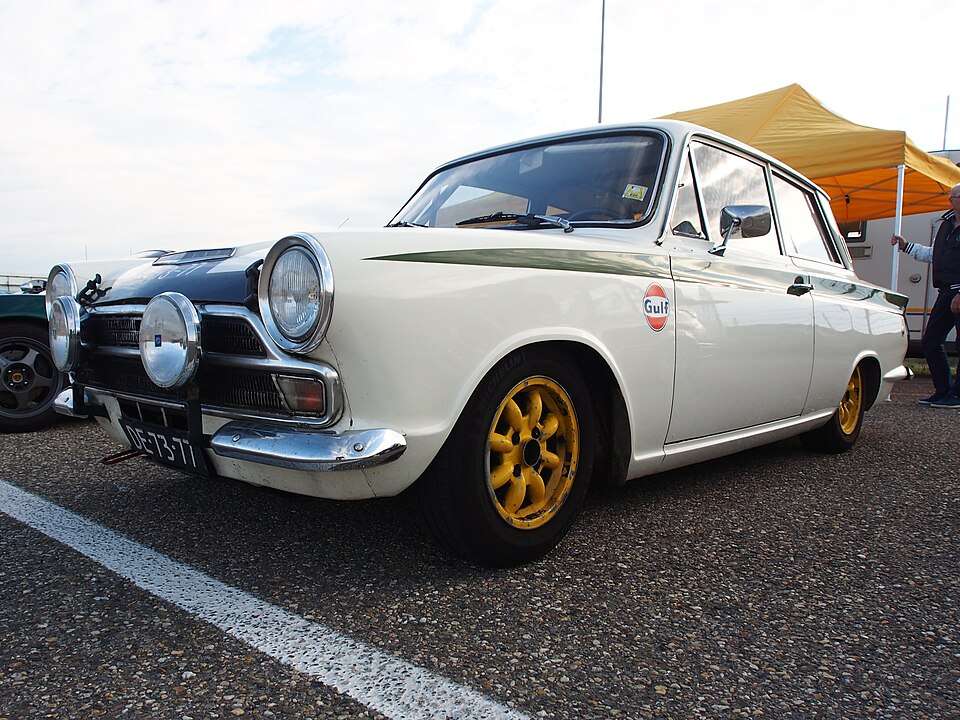
A Lotus Cortina Mk1 is much more than a white two-door Ford with a green stripe. It combines a Lotus-Ford Twin Cam engine with a specification that changed substantially during production, and an ownership history that may include competition, major restoration or a replacement shell. The right car can be an absorbing classic to drive and preserve. The wrong description can be more expensive than the obvious mechanical work.
The buying verdict
Prioritise provenance, a properly assessed shell and a specification that makes sense for the car’s build and subsequent history. Establish early versus later body details and A-frame versus leaf-spring rear suspension before comparing cars. A genuine car need not be completely untouched, but restoration, conversions and replacement assemblies must be documented and described accurately.
Which Mk1 Lotus Cortina should you buy?
This is a buying guide to the Mk1, built in the 1963–1966 period. The later Mk2 is a different buying brief, not simply the same car wearing another grille. Our Lotus Cortina history explains the wider story. Here, the priority is identifying the particular Mk1 and deciding whether its condition and specification suit your use.
The specialist Lotus Cortina Information library separates four broad variants: pre-Aeroflow A-frame, Aeroflow A-frame, and Aeroflow leaf-spring cars in right- and left-hand-drive form. Detail changes overlap, and many early cars were subsequently converted. Use a model-aware inspection and the documented build history instead of assuming that registration year alone defines everything.
| Candidate | Why it appeals | What must be established |
|---|---|---|
| Early pre-Aeroflow car | The earliest expression of the Lotus/Ford project | Original build details, later changes, panel materials, gearbox and rear-suspension history |
| Aeroflow with A-frame | Later body presentation with the early suspension concept | Correct change-point specification and the condition of installation, mountings and axle |
| Later leaf-spring road car | A different factory configuration that may suit touring priorities | Build evidence, actual suspension, gearbox and completeness |
| Restored, converted or competition car | Potentially usable and interesting when honestly documented | Identity, structural work, modifications, intended use and price category |
Do not automatically pay more for the earliest specification if you intend frequent touring and would prefer a later configuration. Equally, a car retaining rare original features may matter greatly to a collector. Decide whether you want originality, a documented driver or competition use before considering cosmetic preferences. Those objectives lead to different inspection questions and budgets.
An A-frame car converted in period is not the same proposition as a later factory leaf-spring example. A rebuilt engine can be original to the car, a period replacement or a later assembly. An original-specification part need not be the original physical part. Ask the seller to separate these ideas rather than using “original” as a catch-all assurance.

UK asking prices and how to compare them
Collect current advertisements for the same variant, steering configuration, provenance category and standard of restoration. Record price, seller terms, build and registration dates, mileage evidence, engine and shell history, completeness and maintenance due. A highly original early car, a later restored road car and a competition build are not interchangeable comparables.
A Car & Classic Lotus Cortina search included a Wingham dealer’s 1966 Mk1 described as authenticated, at £56,995. It also returned a 1967 car described as GT/Lotus at £24,950 and other sporting Cortinas or modified Fords. Those advertisements illustrate why a search result count is not a count of genuine comparable Lotus cars. Seller descriptions and asking prices still require independent checking.
Keep dealer asks, auction estimates and verified results separate. Read any result’s fees and date before comparing it with today’s retail offering. An exceptional competition history needs documentation; a car wearing competition equipment does not inherit that history. A high restoration bill may support the work carried out without establishing the market value of the completed car.
Once the inspection is complete, compare price plus work that actually differs between candidates. If both need the same routine service, remove that shared cost from the comparison. If one needs structural investigation, rare trim or a pump repair requiring substantial access, use a written scope and availability check. An unknown identity cannot be made certain by subtracting a notional repair allowance.
Provenance and authenticity come before the test drive
Request the registration, VIN and identification photographs, V5C details, service file, ownership chronology and restoration album. Check continuity between the car, older photographs and dated paperwork. Ask who knew it before restoration and whether an appropriate club or model specialist has examined it. A story about a previous owner’s collection is not a substitute for documents relating to this particular vehicle.
Lotus Cortina Information makes a useful distinction between checking specification and establishing provenance. A correctly assembled car can still have a complicated identity. Its general ownership discussion also records the importance of replacement shells and extensive repairs in the surviving population. Treat a register entry or correct-looking identification as one piece of evidence, not a complete verdict on condition or history.
Ask an experienced inspector to relate identification, construction details and change-point features to the documented build. Avoid relying on a single plate, engine number or boot detail as a complete authentication test. Transferable or reproducible components are clues within a larger assessment. If important markings or structural areas have been repaired, ask for the pre-repair record and an explanation.
For a claimed replacement shell, establish the starting vehicle, work carried out, records retained and how the completed car is described. Check the implications with your insurer and any relevant registration authority before paying. The seller should distinguish a restored original car, a documented re-shell, a replica and a competition reconstruction. If the description shifts when questions become specific, pause the transaction.
Verify special claims individually: original engine, period competition history, factory specification, original panels and recent restoration are different assertions. An engine number does not authenticate the body, and a photograph of a similar race car does not document this one. Make the sales description sufficiently precise that you and the seller are agreeing on the same proposition.
Useful documents to request
- Old registration and ownership records and a dated history narrative.
- Photographs before stripping, during structural work and before paint.
- Invoices identifying panels, engine assemblies, gearbox, axle and suspension changes.
- Any specialist or club correspondence, with the date and scope clearly understood.
- Evidence supporting competition provenance rather than merely competition equipment.
- A list of original or spare parts included, checked for condition and relevance.
Body inspection: get behind the finish
Arrange a lift inspection before agreeing the final price. Inspect front strut towers and adjacent reinforcement, inner wings, bulkhead, front rails, crossmember areas, sills, jacking points and floors. Ask the body specialist to distinguish replacement outer metal from repairs affecting load paths and suspension geometry. A neat paint finish can conceal both excellent restoration and poorly investigated corrosion.
Look inside accessible cavities and on the reverse of repairs, with permission. Ask where corrosion ended, what metal was removed and how hidden areas were protected. Overlapping patches, heavy coatings and recently replaced carpets need an explanation rather than an immediate diagnosis from appearance. The useful question is what the inspector can establish and what remains hidden.
At the rear, inspect wheel tubs, floor and axle/suspension mounting areas, boot structure and the metal around the fitted suspension arrangement. Compare both sides and look for cracks, distortion or repeated repairs. Ask whether earlier competition use or a suspension conversion altered the shell. Mounting integrity matters whether the car is intended for shows or regular road use.
Check screen surrounds, scuttle, gutters, door bottoms, arches and boot seams for corrosion or water paths. Operate doors, bonnet and boot and assess fit, latches and consistency of panel gaps. Investigate poor fit with a body specialist: replacing seals is not an adequate response if the underlying issue is alignment or structural repair.
Aluminium panels and changed specification
The earliest cars’ lightweight equipment should not be treated as universal across Mk1 production. The specialist variant guide documents changes in panels, gearboxes and suspension, including later options and conversions. Have the inspector identify what is fitted and whether it matches the documented car. A later steel panel may be part of a transparent repair history rather than evidence that the whole car is a replica.
Ask what the purchase objective requires. A driver may tolerate a documented replacement that a concours buyer would need to correct. Before pricing a return to original specification, establish whether the relevant panel, mounting hardware and trim can actually be obtained and whether fitting it involves further work. Original-looking components can themselves need expensive restoration.
Judge a restoration as a sequence
Read the album from the beginning. Look for investigation, stripping, metal replacement, trial assembly, preparation, paint, internal protection and reassembly. Match photographs to invoices and to the car. A folder containing only finished exterior shots provides little evidence about sill structure, rail repairs or hidden mounting areas.
For an unfinished project, request a staged quotation with agreed limits for the first investigation. Include glass and trim removal, storage, disposal, welding, protection and refitting as applicable. The workshop may not know the complete metalwork scope until stripping is underway. Honest uncertainty should be priced as uncertainty, not hidden inside an appealing fixed headline.

Lotus-Ford Twin Cam: inspect the installed engine
The 1,558cc Lotus Twin Cam is central to the car’s character, but many surviving engines have been rebuilt or changed. Ask for the engine identity, block and head specification, rebuild scope, builder, date and subsequent service. An engine retaining the correct appearance can contain a different specification; a replacement unit can be a good driver when documented honestly.
Read the invoice for machining, head work, valve gear, timing components and cooling work, not just the total spent. Ask who checked the finished assembly and what running-in or follow-up service was required. A recent rebuild with no subsequent use still needs assessment. “Rebuilt” is not a warranty unless a written agreement says what is covered and for whom.
Arrange a cold start. Observe how the owner uses the carburettor starting procedure, how the engine settles, warning or gauge behaviour, smoke, leaks and persistent mechanical noise. Let the specialist interpret any symptoms alongside oil, cooling and rebuild history. Do not assign every rattle to the timing chain or every coolant loss to a head gasket from a brief viewing.
Have the workshop assess oil leaks and signs of previous sealant or repairs around the front-cover area. Request a diagnosis that identifies the source and the access required. A low-priced gasket or pump repair kit does not establish the cost of dismantling, rebuilding and correctly resealing the assembly.
On a suitable drive, assess progressive response, temperature stability and hot restarting. Follow the applicable handbook and engine builder’s warm-up guidance. Avoid high-load demonstrations on a cold engine. If an overheating indication or significant leak appears, stop and arrange diagnosis instead of repeatedly adding fluid and continuing the test.
Timing chain, valve clearances and carburettor setup
The Lotus Twin Cam uses a chain-driven timing arrangement; do not populate its maintenance basket with a generic Pinto cambelt kit. Ask for records of timing-component and valve-clearance work and have a knowledgeable mechanic interpret noise and condition. A service plan should relate to the actual engine and use, especially on modified or competition builds.
Identify the carburettors, inlet and air-cleaner arrangement and any changes to ignition. Check starting, idle, normal acceleration and hot restart rather than only listening to an impressive blip of the throttle. A tune-up cannot repair low compression, fuel leakage or a cooling defect. If setup work is needed, agree what underlying checks are included first.
Ask the builder about appropriate fuel, ignition settings and maintenance requirements for the fitted engine. A historic power claim or a modern rolling-road sheet does not establish that the car is comfortable and reliable for your intended journeys. Keep the specification and settings with the history file so future maintenance does not start from guesswork.

Love cars you don’t see every day?
Get forgotten cars, surprising motoring stories and the most interesting finds from Unusual Cars by email.
Free to join. No spam. Unsubscribe whenever you like. See our privacy policy.
Water pump, front cover and cooling system
The pump and front-cover arrangement deserves its own discussion before buying. Identify whether original-type or later modular components are fitted and ask for invoices for previous pump work. Burton’s pump-kit listing specifically distinguishes an additional spacer requirement for some earlier modular covers. That is a reminder to identify the assembly, not a reason to assume every advertised kit can be fitted immediately.
Inspect visible pump and cover areas, radiator, hoses, thermostat housing and fan installation for leakage, damage or improvised repairs. Have the workshop trace any coolant loss and assess what access is required. Establish whether a quotation includes seals, coolant, associated parts, reassembly and checks after the engine is fully warm.
A larger radiator or electric fan is a modification to assess as part of the complete system. Look at mounting, wiring, control and clearance, and ask what problem the change was intended to solve. An upgrade invoice can document useful work without proving that an earlier overheating cause was resolved.
A-frame and leaf-spring rear suspension
First establish which arrangement the car was built with and which remains fitted. The variant library identifies different reinforcement and boot-area details around the earlier arrangement and the later leaf-spring configuration. Ask the inspector to assess the actual shell, mountings and conversion history together. A single visible brace does not prove the car’s original build.
On an A-frame installation, inspect joints, brackets, axle location and surrounding metal for wear, cracking, distortion and repairs. Ask for records of axle and differential work and any changes made to improve usability. Listen for noise and clunks during normal driving and have the specialist identify the source; do not dismiss poor behaviour as an unavoidable part of the design.
On a leaf-spring car, inspect spring and radius-arm mountings, bushes, axle condition and the quality of any altered attachment points. If an early car was converted, ask who did it and whether the work is documented. The conversion’s age does not itself establish the engineering standard or how it should affect the car’s value.
Check differential and propeller-shaft condition, leaks and vibration as part of the same assessment. Ask for the actual ratios and component specification if the owner advertises non-standard parts. The road experience and maintenance requirements of a modified axle or gearbox may differ materially from what an original brochure describes.
Gearbox, clutch, steering and brakes
Identify the gearbox and evidence behind claims about ratios or original castings. Early and later road-car specifications differ, and many cars have received replacement units. Ask what is fitted, why and whether the original assembly remains. A desirable historic specification still needs to suit your intended use and pass a condition assessment.
Try clutch take-up and every gear from cold and warm. Note baulking, jumping out, bearing noise, drag or slip under an appropriate legal load. Ask the mechanic to separate adjustment, release mechanism, mounts and internal wear. Do not force shifts in an attempt to demonstrate a fault or assume a clutch kit will cure all difficult selection.
The steering-box installation should be examined for wear, adjustment issues, mounting condition and joints. Assess free play and response with the inspector rather than treating every vague sensation as a need for a modern conversion. Tyres, alignment, suspension and shell condition can all affect the way the car steers.
Identify front and rear brake hardware and any servo or conversion arrangement before ordering parts. Check pipes, hoses, cylinders or calipers, fluid history and handbrake. Confirm what is needed to complete an axle repair safely. A catalogue search returning a Cortina component is not proof that it matches the Lotus-specific installation or later modifications.
Check tyre age, condition, dimensions, wheel integrity and correct fixings. Period appearance and deep tread do not establish tyre suitability. If suspension work is due, obtain the complete repair, alignment and tyre proposition rather than making separate assumptions about each visible part.
Interior, trim and electrical checks
Use the correct variant as the reference for instruments, seats, trim, air vents, switches and controls. An early dashboard photograph is useful context, but should not become a universal pattern for every Mk1. Record what is missing and what has been retrimmed or replaced. Original-looking parts can be incorrect for the car or in need of expensive refurbishment.
Test lights, wipers, washers, horn, heater, instruments, locks and both ordinary starting and charging behaviour. Identify whether the charging system retains its period arrangement or has been converted. Ask a competent auto-electrician to assess added equipment, protection and wiring rather than ordering an alternator solely because a warning lamp is on.
Check carpets, boot and accessible cavities for moisture. Ask about recent drying or trim replacement and trace the cause before ordering new seals. A properly fitted seal still cannot correct a distorted aperture or concealed corrosion. Price access, drying, metalwork and refitting separately where required.
UK parts, labour and fitted-cost evidence
Specialist engine parts can be available at modest supply prices while access and correct assembly make the complete job much larger. The checked examples below describe the advertised components. They are not restoration estimates, and a replacement part should only be ordered once the installed specification has been identified.
| Job or component | Checked reference | What a complete quotation needs |
|---|---|---|
| QED Twin Cam water-pump kit, SKU 109055 | £44 advertised per kit; confirm tax and delivery | Exact cover compatibility, dismantling, any additional seals, coolant, assembly and checks |
| Burton FL304K pump repair kit | £50.95 displayed with £42.46 excluding VAT; stock shown overdue | Confirm availability and any spacer or adaptor requirement for the actual cover |
| Timing-chain work | Individual parts and fitted quote required | Diagnosed chain, tensioner, guides/sprockets as necessary, access and correct setup |
| Classic-car labour reference | Village Classic Cars: £75 plus VAT, £90 including VAT per hour | A general rate, not a Lotus Cortina job time or an authentication inspection |
| Specialist servicing, engine overhaul and restoration | Hilton & Moss advertises Cortina support without a public model tariff | A written vehicle-specific scope, tax, access, parts, protection and reassembly |
References: QED pump kit, Burton kit and compatibility notes, Village labour tariff and Hilton & Moss Cortina service scope. Compare Twin Cam water-pump parts on eBay.
Why a £44 kit does not price a water-pump job
The quotation should explain what has failed, which cover and pump arrangement is fitted, what needs to be removed and what will be renewed while access is available. Compare the parts list with the kit contents and ask whether any machining, adaptor, seals or additional repair is provisional. The workshop should identify the point at which further work needs approval.
Use the same discipline for clutch, gearbox, head or structural work. A generic hourly rate is a useful context, but multiplying it by a guessed number of hours is not a sourced fitted estimate. Ask for the actual workshop total and exclusions. If the extent cannot be established without dismantling, authorise and budget a limited investigative stage first.
For a car returning from storage, add recovery and a roadworthiness assessment before cosmetic spending. Obtain a service plan for the installed engine and use. Keep photographs, measurements where relevant and itemised invoices so later work does not rely on the memory of whoever assembled the car.
Lotus Cortina Mk1 eBay service-parts table
Affiliate disclosure: we may earn a commission from qualifying purchases at no additional cost to you. Check actual specification, part numbers, seller, quantities and returns. Searches can include unrelated Cortina or Lotus parts; a search result is not a fitment guarantee or a fitted-work quotation.
| Service item | Fitment and buying check | eBay parts comparison |
|---|---|---|
| Oil filter and service parts | Identify filter housing/conversions and appropriate oil specification with the engine builder. | Compare oil filter and service parts |
| Spark plugs and ignition | Match engine tune, distributor and any electronic conversion; compare complete quantities. | Compare spark plugs and ignition |
| Timing-chain components | Confirm head, covers and complete diagnosed scope; not a Pinto timing-belt kit. | Compare timing-chain components |
| Water-pump repair kit | Identify original/modular cover, seals and any spacer requirement; access and fitting are additional. | Compare water-pump repair kit |
| Cooling hoses and thermostat | Match radiator, housing, pump arrangement and modifications. | Compare cooling hoses and thermostat |
| Gaskets and seals | Identify actual leak, early/late engine features and correct gasket scope before ordering. | Compare gaskets and seals |
| Charging-system parts | Identify original charging equipment or conversion; check regulator, polarity and wiring requirements with a specialist. | Compare charging-system parts |
| Clutch components | Confirm gearbox, flywheel and release arrangement, particularly after conversions. | Compare clutch components |
| Brake service parts | Match installed front/rear assemblies, servo and conversion details. | Compare brake service parts |
| A-frame bushes and joints | Only for the actual fitted arrangement; inspect mountings and axle location first. | Compare a-frame bushes and joints |
| Leaf-spring suspension parts | Identify factory/later conversion and exact mounting hardware. | Compare leaf-spring suspension parts |
| Glass and door seals | Match body, quarter-light and seal profiles; inspect metal and leak damage as well. | Compare glass and door seals |
Hidden ownership costs and the project decision
Rare specification details: missing air-cleaner equipment, correct trim, original-type wheels or specialised suspension pieces can turn a superficially complete car into a lengthy sourcing exercise. Before paying a premium for originality, list the details you would need to correct and establish whether suitable parts exist in usable condition.
Restoration access: panel prices omit much of the work. Glass, wiring, interior, pipework and fittings may need removal and refitting. Ask whether the quote includes corrosion protection inside repaired sections and what happens if adjoining metal is worse than expected. Keep investigation, repair and final finishing as distinct decisions.
Workshop and storage time: check booking dates, transport and storage costs before buying an immobile car. A long restoration can tie up both the car and the budget. Parts included with a project must be inspected for completeness and suitability; a box labelled “Lotus” is not evidence that it contains everything needed.
Preservation versus use: a highly original early car may require different compromises from a touring driver. Consider garage access, secure dry storage, appropriate maintenance and how readily you could replace damaged rare components. Decide those priorities before you pay for a specification you will then feel unable to use.
Three realistic purchase decisions
A documented later road car with due maintenance
If identity and structure are clear, due servicing can be a definable buying condition. Obtain a fitted quote and compare it with an equivalent car that has completed the same work. Keep cosmetic preferences separate. A service bill is manageable when the underlying proposition is understood and the right workshop can support it.
An early car with a suspension conversion
Establish original build, conversion date, engineering and later repair history. Have the shell and installed arrangement inspected, and agree how the car will be described for sale and insurance. It can be an attractive driver, but should not be valued automatically as an untouched early configuration. Do not plan a reversal until parts, access and the actual work have been priced.
A freshly painted project with little history
Pause before treating the finish as evidence of a completed restoration. Request the earlier album, identify inaccessible structural areas and seek model-specific provenance advice. If the seller cannot supply evidence, you cannot count the car as authenticated simply because it has the expected engine and stripe. The uncertainty is more fundamental than a routine repair allowance.
Lotus Cortina Mk1 viewing checklist
- Identity: compare documents and the actual vehicle, establish the claimed variant and check any special provenance.
- History: request pre-restoration photographs, invoices, ownership continuity and specialist or club correspondence.
- Structure: inspect towers, rails, bulkhead, sills, floors, rear mounting areas and the reverse of accessible repairs.
- Specification: identify A-frame or leaf springs, panel materials, gearbox, engine, charging equipment and modifications.
- Cold engine: observe starting, gauges, persistent noise, smoke and leaks with a knowledgeable mechanic.
- Cooling: identify the pump/cover arrangement, inspect leakage evidence and assess stability warm.
- Drivetrain: try clutch and each gear cold and hot, note axle noise or vibration, and inspect mountings.
- Chassis equipment: assess steering box, joints, brakes, wheels and tyre condition before a road test.
- Cabin: test every control and inspect trim completeness and moisture.
- Decision: separate confirmed faults from unknowns, get fitted quotations and keep unresolved identity or structural issues conditional.
Frequently asked Lotus Cortina buying questions
Did every Mk1 have A-frame rear suspension?
No. Establish the variant and later changes. Later Mk1 leaf-spring cars and converted earlier examples need different interpretation; the fitted arrangement alone does not establish original build.
Does the green stripe prove it is genuine?
No. Appearance and correct-looking components are only part of an assessment. Provenance, identification, construction details and restoration evidence need to agree.
Should every Mk1 have aluminium panels?
No. Panel specification changed, and replacements and options further complicate the picture. Match the actual car to its documented history with a model specialist.
Is the engine serviced like an ordinary Pinto?
No. This is the Lotus Twin Cam, with its own timing-chain, head and cooling arrangements. Use the correct engine-specific parts and workshop knowledge.
Can a replacement-shell car be worth buying?
It can be a clearly documented proposition, but identity, description, engineering and insurance need checking. Do not value a known re-shell automatically as an untouched car.
Is the water-pump kit the main cost of a pump repair?
The fitted cost depends on the actual arrangement, access and associated work. A supply price alone is not a complete estimate.
Which should I buy: early or late?
Choose the verified specification that suits your use and preservation priorities. A better documented, sound later car can be a clearer purchase than an early one with unresolved history or repairs.

Lotus Cortina Mk1 cars for sale
Compare current advertisements for complete cars on eBay UK. Asking prices are not completed sale results. Check identity, condition and history before contacting a seller.
Affiliate disclosure: we may earn a commission from qualifying purchases.

Love cars you don’t see every day?
Get forgotten cars, surprising motoring stories and the most interesting finds from Unusual Cars by email.
Free to join. No spam. Unsubscribe whenever you like. See our privacy policy.