The Škoda Rapid 136 looked like a conventional 1980s coupé until you went looking for the engine. That is where this late Czechoslovak Škoda gets interesting.
1. The engine sat behind the rear axle
Lift the rear lid and there is the engine, mounted longitudinally behind the axle. The gearbox drove the rear wheels. For British buyers used to front-engined hatchbacks and coupés, the Rapid was a very different proposition.
2. The luggage went under the front lid
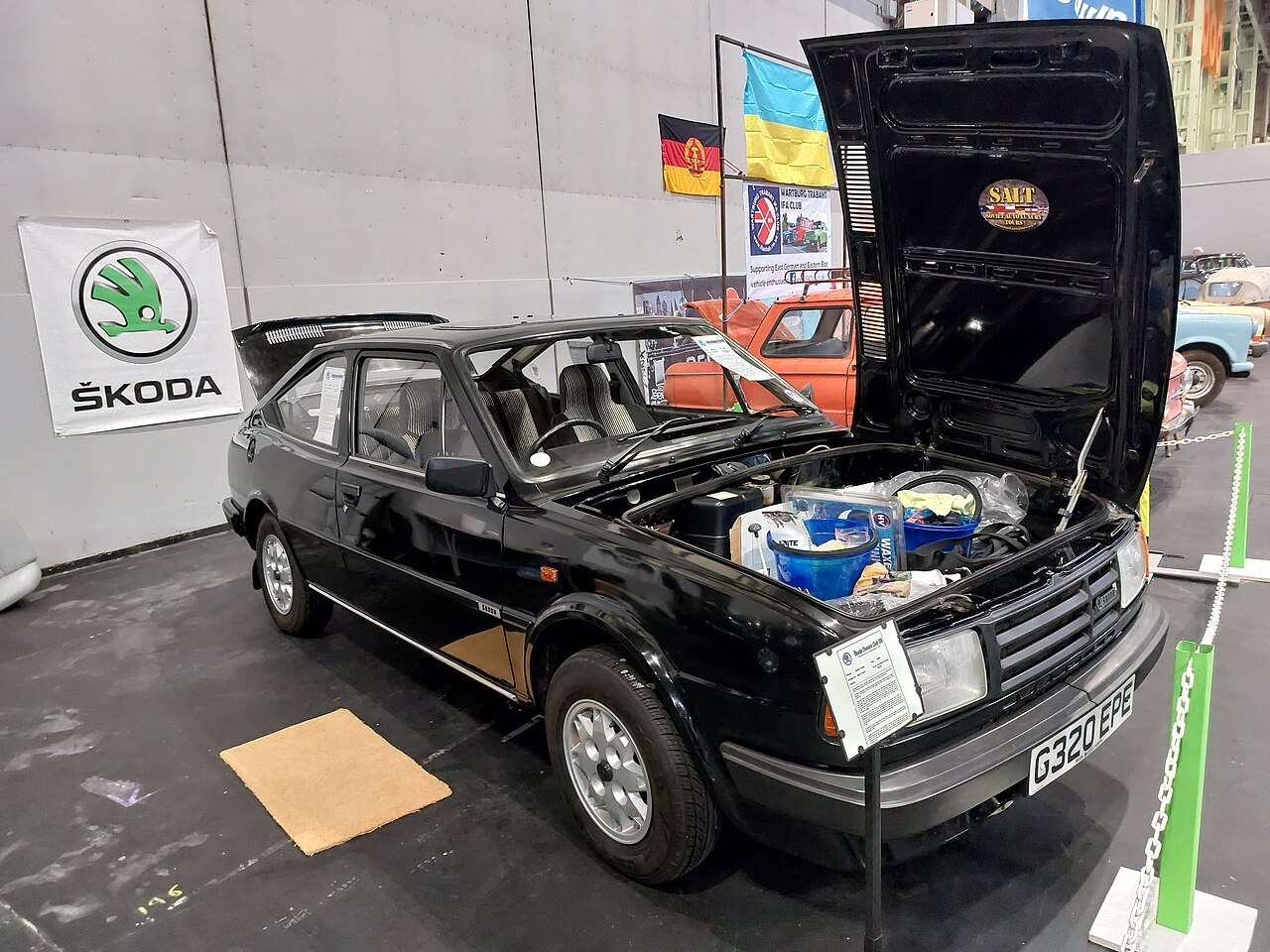
The arrangement left the nose free for a luggage bay. Its lid hinged sideways. The front luggage compartment makes more sense when you see a Rapid with both ends open and realise how the car is laid out.
3. It evolved from the Garde
The Garde of 1981 was the earlier member of the same coupé family. Škoda’s museum material groups the Garde and Rapid together. The 136 was a late development of the design, with its own model number and engine specification.
4. The 136 had a 1.3-litre pushrod four
It used a liquid-cooled, overhead-valve four-cylinder. Škoda links the later Rapid engines to the contemporary Favorit family. The connection is especially interesting because the Favorit carried its engine at the other end and drove the front wheels.
Love cars you don’t see every day?
Get forgotten cars, surprising motoring stories and the most interesting finds from Unusual Cars by email.
Free to join. No spam. Unsubscribe whenever you like. See our Privacy Policy.
5. The 135 and 136 were distinct versions
Both were roughly 1.3 litres, but Škoda’s archive gives the 136 the higher output at 46 kW, about 62 bhp. Checking the badge and model number matters more than trying to identify one from a generic Rapid photograph.
6. The coupé format still made room for luggage and passengers
The side-hinged front compartment was only part of the story. Period UK specification also included individually folding rear seats. The coupé retained a degree of everyday usefulness despite its unusual mechanical layout.
7. British dealers could sell you a cabriolet conversion
A December 1989 UK price list included cabriolet and Sport conversions alongside the regular coupé. The open cars are part of the British story and worth distinguishing from the factory-built closed car.

8. The museum records 9,708 Rapid 136s
Škoda’s historic model sheet gives that production total for the 136 and lists the 130 and 135 separately. The figure covers production of the variant. It cannot tell you how many British cars still survive.
9. A late UK registration can postdate production
The museum dates the end of the series to 1990, yet a UK dealer has documented a Southport-supplied 136 first registered in September 1991. That is a useful reminder that a registration plate dates the paperwork, while factory records date the build.
10. Škoda later put the Rapid name on a very different car
The modern Rapid launched in Europe in 2012 used the old badge on a compact family model. When hunting down photographs or parts for the coupé, add 136 or the 1980s date to the search.
Explore more 10 Things articles
Browse the Unusual Cars 10 Things hub.
Sources and further reading
- Škoda museum Garde and Rapid model sheet
- Škoda heritage press kit
- December 1989 UK price list catalogue record
- Southport-supplied Rapid 136 documentation
- Škoda’s modern Rapid launch
Featured image: Škoda Rapid 136 Coupé. Photo by James Wigger from Norwich, UK via Wikimedia Commons (CC BY 2.0, resized).
Join the Unusual Cars Club
Get more forgotten performance cars, surprising motoring stories and new 10 Things articles by email.
Free to join. No spam. Unsubscribe whenever you like. See our Privacy Policy.