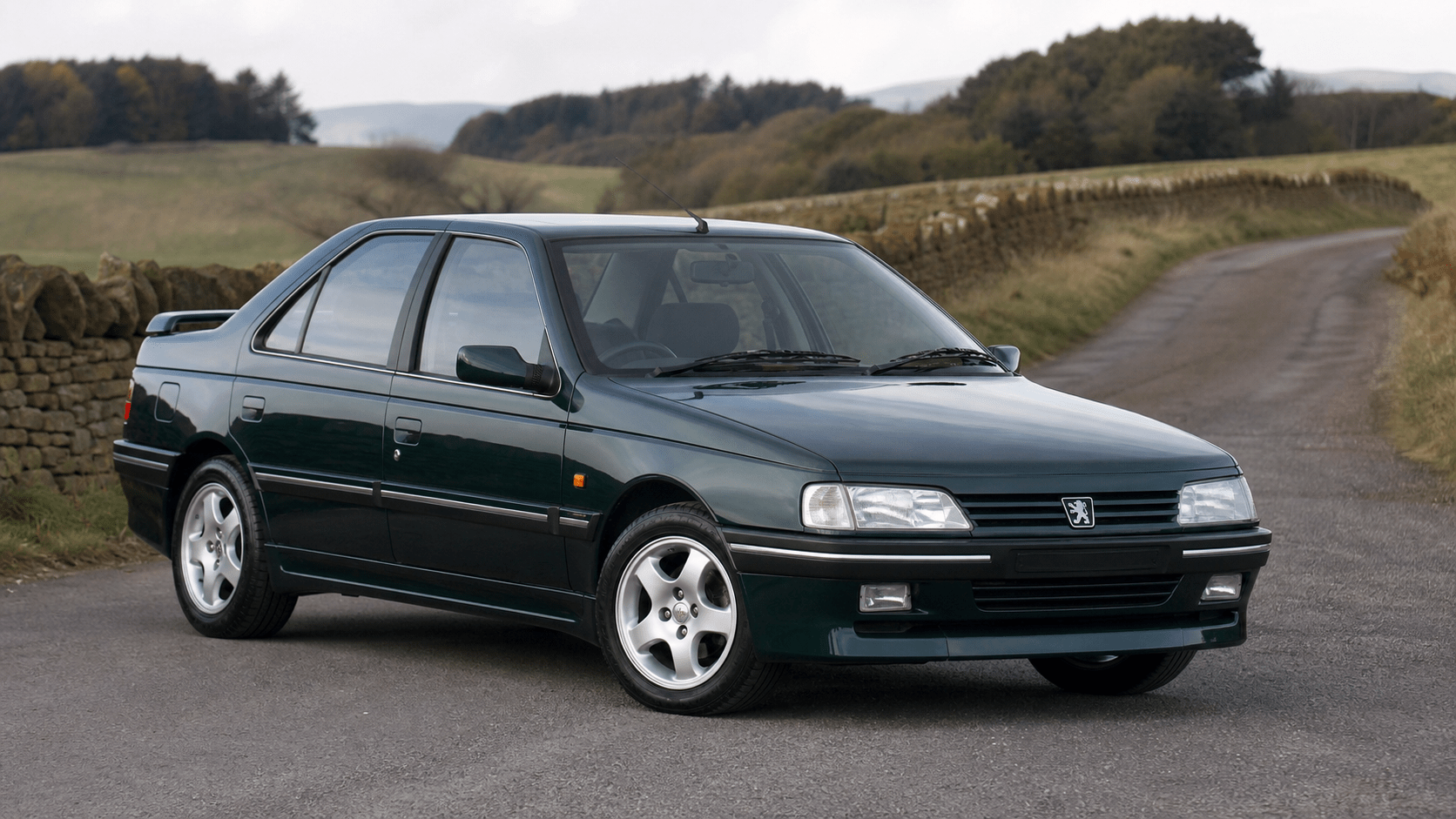
The Peugeot 405 T16 was the quiet super-saloon that arrived between eras: rally-bred in name, discreet enough to pass for a company car, yet armed with 220hp overboost and four-wheel drive. Only a little over a thousand were made.
Here are ten reasons Peugeot’s rarest 405 is far more interesting than its restrained styling suggests.
1. It arrived surprisingly late in the 405’s life
Peugeot launched the road-going 405 T16 in 1993, after the facelifted Phase 2 range had appeared. By then the 405 had already won European Car of the Year and established itself as a familiar family saloon.
That timing made the T16 feel like a secret final act: the practical four-door body was already well known, but the hardware beneath it belonged to a different category of car.
2. Its two-litre engine made 196hp in normal use
The XU10J4TE was a 1,998cc, 16-valve four-cylinder with a Garrett turbocharger. Peugeot quoted 196hp in its normal operating state—strong output for an early-1990s two-litre road car.
It was related in broad architecture to other XU-family engines, but the turbo installation, management and four-wheel-drive package made the T16 a very different ownership proposition from an ordinary 405.

3. Overboost briefly lifted output to 220hp
Under full throttle the engine management could raise boost and release a quoted 220hp for a limited period. This was not a separate model or aftermarket modification; it was built into the factory calibration.
The extra shove gave the T16 its headline character while allowing the engine to run at the lower 196hp level in normal use. Peugeot quotes 0–62mph in 7.0 seconds.
4. It could reach 147mph
Peugeot’s official figure was 147mph, an extraordinary top speed for a saloon that shared its silhouette with diesel taxis and family 405s.
The subtlety was intentional. Small badges, five-spoke wheels and a restrained body kit distinguished it, but the T16 did not advertise its ability with a huge wing or swollen arches.
Love cars you don’t see every day?
Get forgotten cars, surprising motoring stories and the most interesting finds from Unusual Cars by email.
Free to join. No spam. Unsubscribe whenever you like. See our Privacy Policy.
5. Four-wheel drive was standard
The five-speed manual sent power through a permanent four-wheel-drive system. In normal running the nominal split was 53 per cent to the front and 47 per cent to the rear.
That near-balanced distribution gave the T16 more traction than the front-wheel-drive 405 Mi16, particularly in poor conditions, without turning it into a nose-heavy off-roader.
6. It used a Torsen rear differential
A torque-sensing Torsen differential at the rear helped apportion drive across the axle. It was sophisticated equipment for a discreet Peugeot saloon of the period.
The combination of turbo torque, permanent four-wheel drive and a Torsen rear diff is why the T16 deserves to be judged as a complete engineering package—not merely an Mi16 with more boost.
7. The rear suspension could level itself
The T16 used an electro-hydraulic self-levelling arrangement at the rear. The system helped maintain the correct ride height when the car was loaded.
It is also one of the details that makes restoration expensive today. Ageing hydraulic components, sensors and model-specific parts can turn a superficially tidy car into a long search for unobtainable pieces.

8. Only 1,046 were built
Peugeot gives total production as just 1,046 cars. That makes the T16 dramatically rarer than the Mi16 and rarer than many celebrated homologation specials.
Most were left-hand drive, and Britain never received it as a normal right-hand-drive showroom model. UK sightings therefore usually involve imported continental cars.
9. It was not a road version of the Dakar car
The 405 T16 Grand Raid and Pikes Peak machines created some of Peugeot’s most spectacular competition images, but they were purpose-built prototypes. The road saloon shared a name and a halo, not their chassis or layout.
That distinction matters. The production T16’s achievement was different: packaging turbo power, four-wheel drive and everyday accommodation into a civilised saloon.
10. Peugeot now treats it as an ancestor of the 508 PSE
When Peugeot introduced the 508 Peugeot Sport Engineered, it publicly presented the 405 T16 as a predecessor—an earlier high-performance saloon that combined speed, traction and discretion.
The link shows how unusual the 405 was. Peugeot went nearly three decades before producing another road car that occupied quite the same understated flagship position.
Love cars you don’t see every day?
Get forgotten cars, surprising motoring stories and the most interesting finds from Unusual Cars by email.
Free to join. No spam. Unsubscribe whenever you like. See our Privacy Policy.
Research sources
Production, performance and historical details were checked against Peugeot/Stellantis heritage material and our referenced 405 T16 guide.