The Lotus Esprit Turbo looked like a supercar from another planet, yet beneath the wedge shape was a distinctly Lotus mixture of light weight, clever engineering and continuous development. From Giugiaro’s 1972 show car to the final V8, the Turbo chapter contains some of the model’s best stories.
1. The shape began as a 1972 Turin motor-show concept
Giorgetto Giugiaro’s Italdesign revealed the silver Lotus concept at Turin in 1972. It translated the folded-paper wedge style of contemporary Italian exotica into a compact mid-engined Lotus. The production Esprit appeared in 1975 and retained far more of the show car’s drama than most concepts ever do.
2. The Turbo was not the first Esprit—but it transformed the range
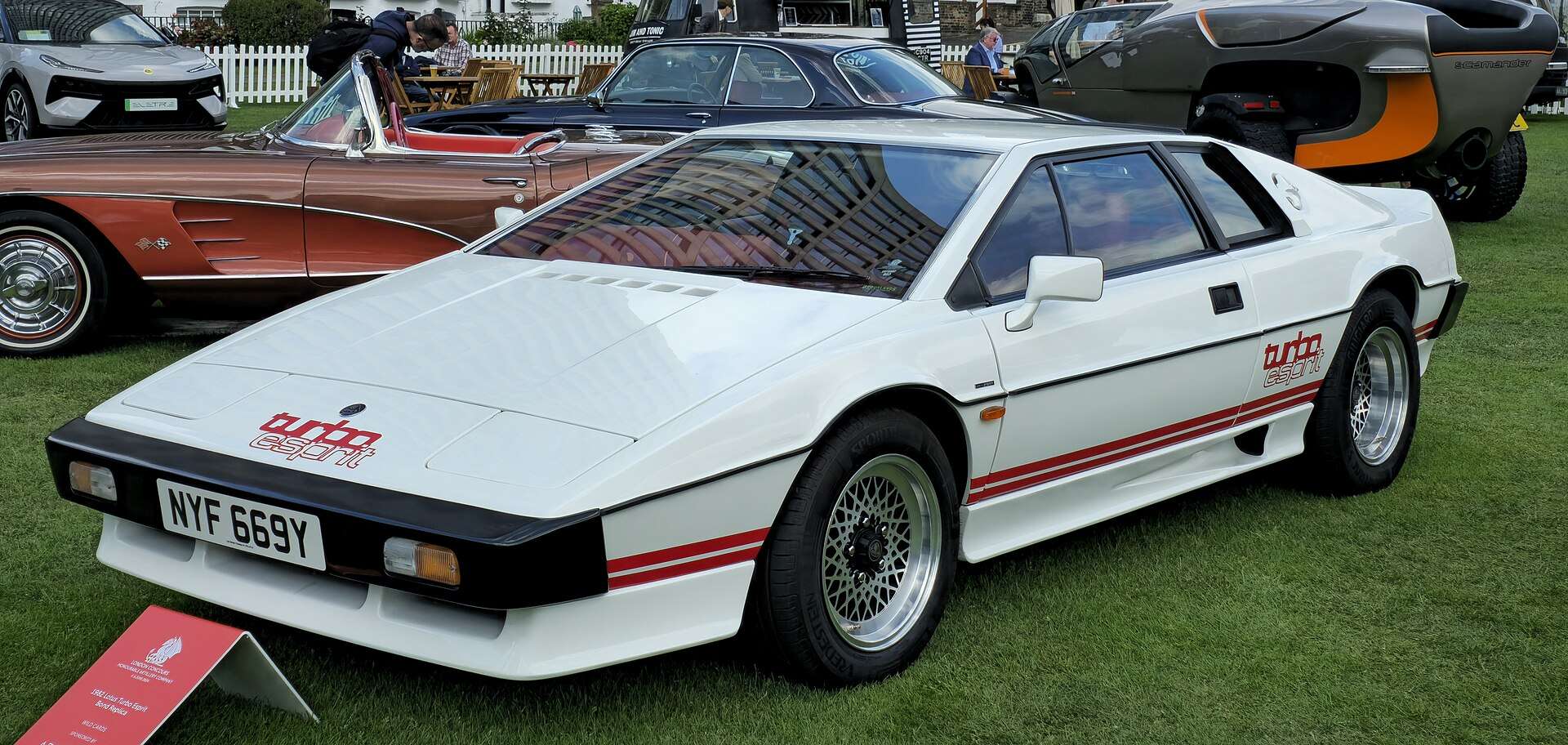
Early Series 1 and Series 2 cars used naturally aspirated versions of Lotus’s four-cylinder engine. The Type 82 Turbo Esprit arrived in 1980 with a 2.2-litre turbocharged 910 engine, making the car substantially faster while preserving the basic glassfibre-body, backbone-chassis layout.
3. Early Turbos used dry-sump lubrication
The first production Turbo Esprits used a dry-sump oiling system, helping maintain lubrication under hard cornering and allowing careful engine packaging. Lotus later moved to a wet-sump arrangement, so “dry sump” describes an important early specification rather than every four-cylinder Turbo built.
4. Its launch was tied to a glamorous ski-team special
Lotus first showed the turbocharged car in Essex Petroleum colours, creating the blue-and-red Essex Turbo Esprit. The limited, numbered edition connected the road car to Lotus’s Formula One sponsorship and remains one of the most collectable Giugiaro-bodied Esprits.
Love cars you don’t see every day?
Get forgotten cars, surprising motoring stories and the most interesting finds from Unusual Cars by email.
Free to join. No spam. Unsubscribe whenever you like. See our Privacy Policy.
5. The chassis was galvanised before the body shape changed
Lotus introduced a galvanised backbone chassis during the Giugiaro era, a major durability improvement for a car whose glassfibre body could disguise corrosion underneath. The later Stevens restyle changed the appearance dramatically, but structural condition remains essential on every generation.
6. Bond drove more than one kind of Esprit
The white Series 1 became a submarine in The Spy Who Loved Me. For Your Eyes Only featured two Turbo Esprits, including the copper-coloured ski-resort car. The screen appearances made the Esprit globally recognisable, but the road cars were conventional machines—not amphibious film props.
7. The Renault gearbox arrived before the V8
Four-cylinder Esprits evolved through several transmissions. The Renault UN1 transaxle became especially important in later cars and was retained when Lotus installed its own twin-turbo V8. That gearbox choice helped make the V8 possible but also imposed torque-management considerations.
8. The four-cylinder Turbo eventually reached 300 horsepower
The 1993 Sport 300 used developments from the X180R competition programme. Lotus quoted 300 horsepower from its 2.2-litre four-cylinder engine and pared weight, creating one of the most focused and rare road-going Esprits before the V8 era.
9. The V8 was designed in-house by Lotus
The Type 918 was not a bought-in engine. Lotus created a compact 3.5-litre, flat-plane-crank, twin-turbo V8, deliberately limiting road-car output to protect the transmission. It gave the Esprit new performance without abandoning the model’s light, compact philosophy.
10. Production lasted nearly three decades
From the first production cars in 1976 to the final Esprit in 2004, the model survived repeated restyles, power increases and ownership changes at Lotus. Its longevity came from continual engineering evolution beneath a basic concept that remained remarkably consistent.
The Esprit Turbo’s real achievement was not merely looking exotic. Lotus kept developing one lightweight mid-engined idea for decades, turning a four-cylinder wedge into a genuine V8 supercar without losing its character.
Love cars you don’t see every day?
Get forgotten cars, surprising motoring stories and the most interesting finds from Unusual Cars by email.
Free to join. No spam. Unsubscribe whenever you like. See our Privacy Policy.