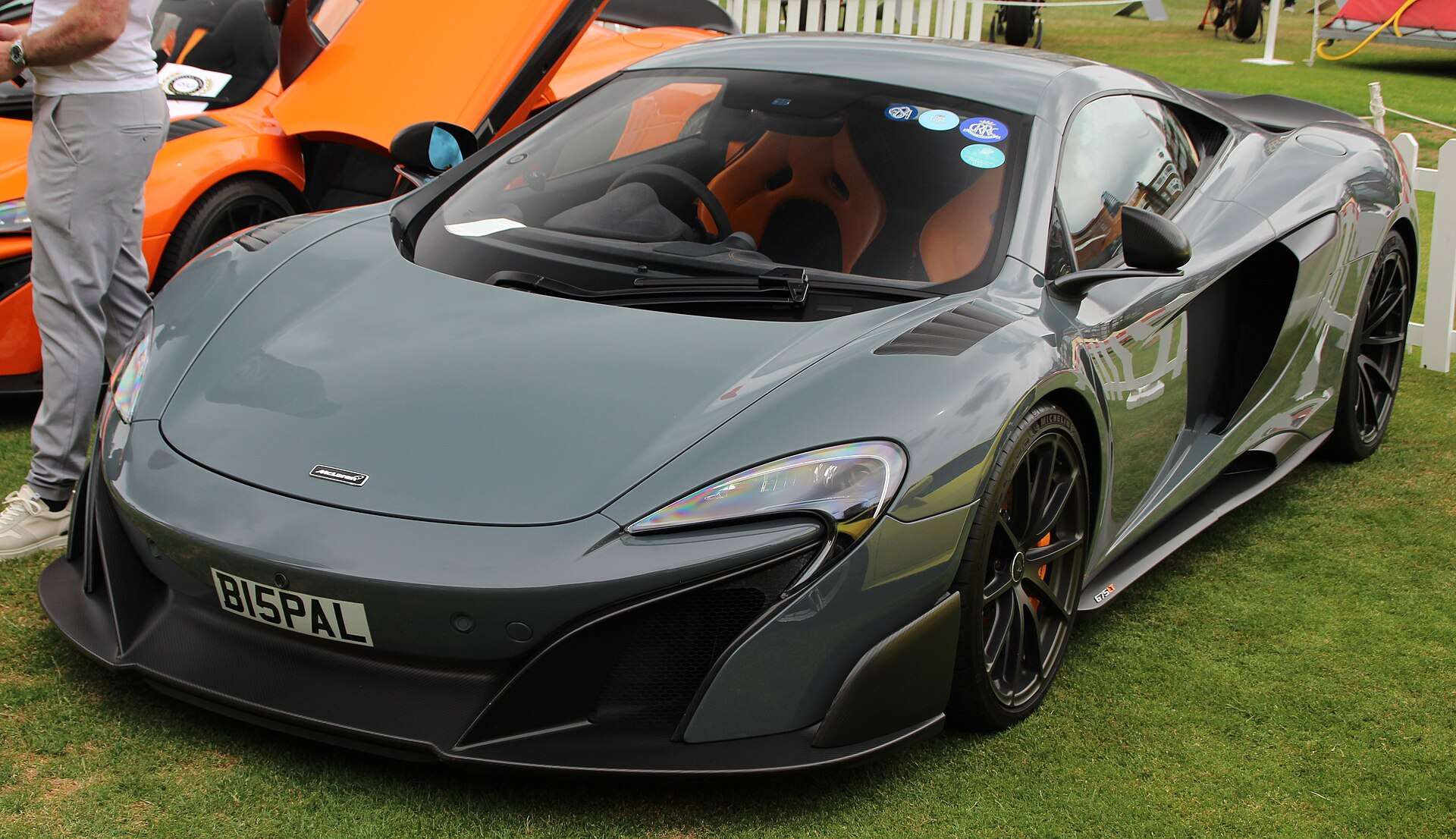
The McLaren 675LT was the car that proved McLaren’s modern road-car range could have a genuinely wild side. Introduced in 2015, it took the already rapid 650S and applied the philosophy of the 1997 F1 GTR Longtail: less weight, more aerodynamic stability, sharper responses and a stronger sense of occasion.
It was not simply a 650S with extra power. McLaren revised the body, cooling, suspension, electronics and exhaust, then removed weight from almost every area. The result was one of the most distinctive supercars of its era and the first modern McLaren road car to wear the LT badge.
Why McLaren built the 675LT
By the middle of the 2010s, McLaren Automotive had established itself with the 12C, 650S and hybrid P1. The 675LT created something more specialised: a limited-production Super Series model for drivers who wanted the immediacy of a track car without losing road legality.
The name referred to its 675PS output and to “Longtail”. Around one third of the 650S components were changed, with particular attention paid to mass, airflow and driver feedback.
Engine, performance and key specifications
McLaren’s 3.8-litre twin-turbocharged V8 received new turbochargers, lighter components, revised cylinder heads and freer-flowing exhausts. Power rose to 675PS (666bhp), while torque reached 700Nm. Drive went to the rear wheels through a seven-speed dual-clutch gearbox.
- Engine: 3.8-litre twin-turbo V8
- Power: 675PS / 666bhp
- Torque: 700Nm
- 0–62mph: 2.9 seconds
- Top speed: 205mph
- Dry weight: approximately 1,230kg
Carbon-fibre body panels, lightweight glass, reduced sound insulation and pared-back cabin materials helped remove roughly 100kg compared with the 650S. The titanium exhaust saved further weight and gave the LT a harder-edged soundtrack.
Design and aerodynamics
The extended front splitter, reshaped side intakes, louvred rear bodywork and larger active rear airbrake were functional rather than decorative. The rear deck was lengthened and the exhausts exited through a distinctive exposed central panel, improving cooling and high-speed stability.
Inside, carbon-shell seats inspired by the P1 and extensive Alcantara reinforced the car’s purpose. The driving position remained excellent, with unusually clear visibility for a mid-engined supercar.
675LT versus 650S
The 650S was astonishingly capable and relatively usable; the 675LT felt more urgent and communicative. Its steering, brake pedal and chassis transmitted more texture, while firmer spring rates and revised geometry reduced hesitation during rapid direction changes. The LT is not merely the faster car: it is the rarer and more intense interpretation.
Rarity and legacy
Production was limited to 500 coupés, followed by 500 675LT Spiders. Demand was immediate, and the project established LT as a recurring McLaren sub-brand. The later 600LT and 765LT developed the same formula for different generations.
The 675LT connected the F1 GTR’s competition history with McLaren’s modern showroom range and showed that Woking could build a car with character as well as extraordinary speed.
Ownership snapshot
A specialist history is essential. Buyers should pay attention to servicing, accident repairs, carbon bodywork, suspension condition, tyre age and completion of factory campaigns. This is not the full buying guide—our separate guide will examine inspections and running costs in detail—but provenance matters greatly on a limited-production car.
Image: “2015 McLaren 675LT Coupe LC22.jpg”, used under Creative Commons via Wikimedia Commons. Specifications referenced against McLaren’s published model information.