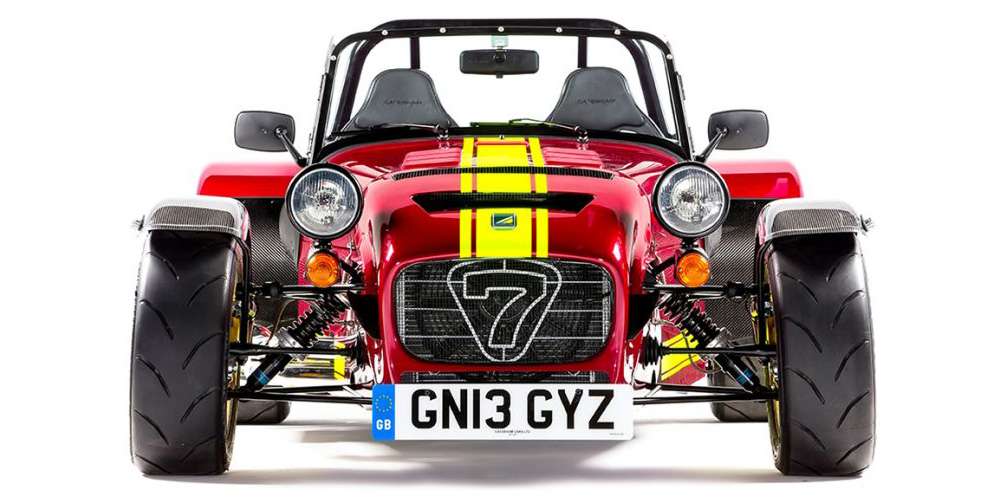
The Caterham Seven 620R is the point at which the traditional Seven became a modern supercar chaser. Introduced in 2013, it combined a supercharged 2.0-litre Ford Duratec engine with a sequential gearbox and a kerb weight of little more than half a tonne.

Successor to the R500
The 620R arrived as the spiritual successor to the Superlight R500. The name again referred to power-to-weight performance: Caterham quoted more than 620bhp per tonne. Rather than pursuing that figure with an ever more highly tuned naturally aspirated engine, the company fitted a supercharger to its 2.0-litre Duratec.
Output rose to 310PS, with 219lb ft of torque. Caterham’s figures gave 0–60mph in about 2.8 seconds and a top speed close to 155mph. Those numbers placed the car alongside machinery with several times the power—and several times the mass.
Built around response
The 620R was not simply an engine upgrade. A six-speed sequential transmission allowed rapid, positive shifts, while a limited-slip differential helped deploy the power. The suspension, brakes and cooling were developed for sustained hard use, and the wider SV chassis was also offered in some markets for drivers wanting additional cockpit room.
Even with the extra hardware, quoted weight was around 545kg. That meant every control retained the low-inertia feel that defines a Seven. Acceleration was violent, but the appeal lay equally in the unassisted steering, instant direction changes and the sensation of sitting close to the road.

The R in 620R
Caterham has often used R to denote its more focused specification. The 620R followed that tradition with the sequential gearbox, race-style equipment and a cabin designed around driving rather than touring. A 620S later offered a softer road-biased interpretation with a conventional manual gearbox and more comfort.
The R therefore represented the most intense version: quicker in its responses and less interested in compromise. It was road legal in the UK, but its design priorities were clearly shaped by circuit use and Caterham’s one-make racing experience.
Specifications
| Engine | Supercharged 2.0-litre Ford Duratec |
|---|---|
| Power | 310PS |
| Torque | 219lb ft |
| Transmission | Six-speed sequential |
| Weight | About 545kg |
| 0–60mph | Approximately 2.8sec |
| Top speed | Approximately 155mph |
Why the 620R matters
The 620R demonstrates the extraordinary development range of the Seven. Its basic proportions remain recognisable from the 1950s, yet its performance belongs to the modern hypercar era. Very few road cars deliver this much acceleration with so little structure between driver, engine and tarmac.
It also marks a philosophical high point. Where many fast cars use electronics, four-wheel drive and mass to control power, the 620R relies on lightness, mechanical grip and driver involvement. That makes it both an extreme Caterham and a clear statement of what the company believes a performance car should be.
Enjoy unusual British performance cars?
Join the Unusual Cars newsletter for new model histories, forgotten-car features and specialist guides.
Frequently asked questions
How fast is a Caterham 620R?
Caterham quotes approximately 2.8 seconds from 0–60mph and around 155mph at the top end.
What engine does the 620R use?
It uses a supercharged 2.0-litre Ford Duratec producing 310PS.
Was the 620R sold in the UK?
Yes. It has been offered as a road-legal UK-market flagship, with a strongly track-focused specification.
Research sources include Caterham specifications, HWM Caterham and contemporary road tests.