Love cars you don’t see every day?
Get forgotten cars, surprising motoring stories and the most interesting finds from Unusual Cars by email.
Free to join. No spam. Unsubscribe whenever you like. See our privacy policy.
Engine and cooling-system inspection
Ask for a cold start and leave time for a full warm-up. Listen for persistent mechanical noise, observe whether idle settles and look for warning messages. A full hybrid may start its petrol engine according to temperature, charge and heating demands, so have a competent technician interpret its behaviour instead of declaring a fault because it does not idle continuously.
Inspect fluid levels by the handbook procedure and look for oil or coolant staining, damaged hoses and signs of previous overheating. Ask about top-ups between services. A fresh service does not explain repeated coolant loss. Arrange a pressure test or other appropriate diagnosis if there is evidence of a leak, and never open a hot cooling system.
Check invoices for the correct oil specification, filter and dates. Repeated short journeys make a coherent maintenance history especially important. If the oil is unexpectedly high or smells strongly of fuel, have the cause assessed before buying. Do not treat an internet list of “common faults” as a diagnosis of this particular engine.
Watch for hesitation, misfire or loss of performance under a normal load. Ignition components, air leaks, fuel delivery and other faults can give similar symptoms. A seller who offers to replace a random sensor has not established the cause. Request a diagnostic report and proof of a successful cold and hot road test after repair.
Timing drive and scheduled maintenance
Do not apply an older Tucson’s timing-belt interval or parts kit to the NX4 petrol. Establish the exact engine and its timing-drive requirements with Hyundai or a knowledgeable specialist. A timing chain is not a licence to ignore oil history, persistent noise or fault codes; nor is speculative chain replacement an automatic service item for every car.
Obtain the correct schedule for the VIN, including time-based items and any additional requirements for demanding use. Ask separately about spark plugs, brake fluid, coolant and transmission-related work. A generic “major service” label does not prove every manufacturer-scheduled item was completed.
Manual, iMT, DCT and HEV automatic checks
With a conventional manual, check clutch take-up, clean engagement of all gears and sensible acceleration in a higher gear without slip. Do not deliberately overload the drivetrain to test it. Judder, a high or inconsistent biting point and noise when operating the clutch deserve a fitted repair quotation.
The intelligent manual’s electronically controlled clutch and coasting behaviour mean it should be assessed as its own system. Hyundai’s launch explanation describes engine decoupling and restart during coasting. Confirm the car’s functions with its handbook and ask a specialist to investigate warnings or erratic operation rather than comparing it blindly with a purely mechanical manual.
For the seven-speed DCT, test from cold, after warming and during gentle manoeuvring. Include reverse, a car-park ramp and repeated stops. Some change in feel from a conventional automatic is expected; repeated heavy shudder, delayed engagement, overheating messages or a persistent burnt smell should not be dismissed as normal. Check relevant software and repair records.
The full hybrid’s six-speed automatic is a different transmission. On a safe route, assess smooth take-up, steady acceleration and transitions between motor and engine. A change in engine sound as power demand rises is not by itself a defect, but harsh impacts, recurrent warnings or a mismatch between acceleration and engine speed need diagnosis. Recheck when hot.
Hybrid battery and electrical systems
Ask for a scan using equipment that can interrogate the hybrid and transmission modules, not merely a generic emissions-code reader. Establish what the report actually covers: stored and current faults, relevant readings and any recommended follow-up. A claim that the battery is “100%” is not meaningful without explaining the test and measurement.
Do not infer battery condition from the dashboard charge gauge. A full hybrid actively manages its state of charge and will not necessarily display a full battery at a viewing. Have unexplained rapid swings, loss of assistance or warning messages assessed in context. Leave high-voltage cables and covers untouched; inspection and repair belong with trained personnel.
Check the low-voltage system and the correct recovery procedure for the precise model. Battery arrangements differ across petrol, MHEV and HEV versions. Do not order a generic alternator or 12V battery because a search result lists “Tucson 2021”. Get the original component number and workshop diagnosis first.
Cabin, screens and family practicality
Test the infotainment with your own phone, including a call, navigation and the connection method available on the car. Try every part of the touch interface while parked. Check the instrument display, reversing camera, parking sensors and fitted blind-spot camera functions. A screen that works once but repeatedly reboots needs attention before sale.
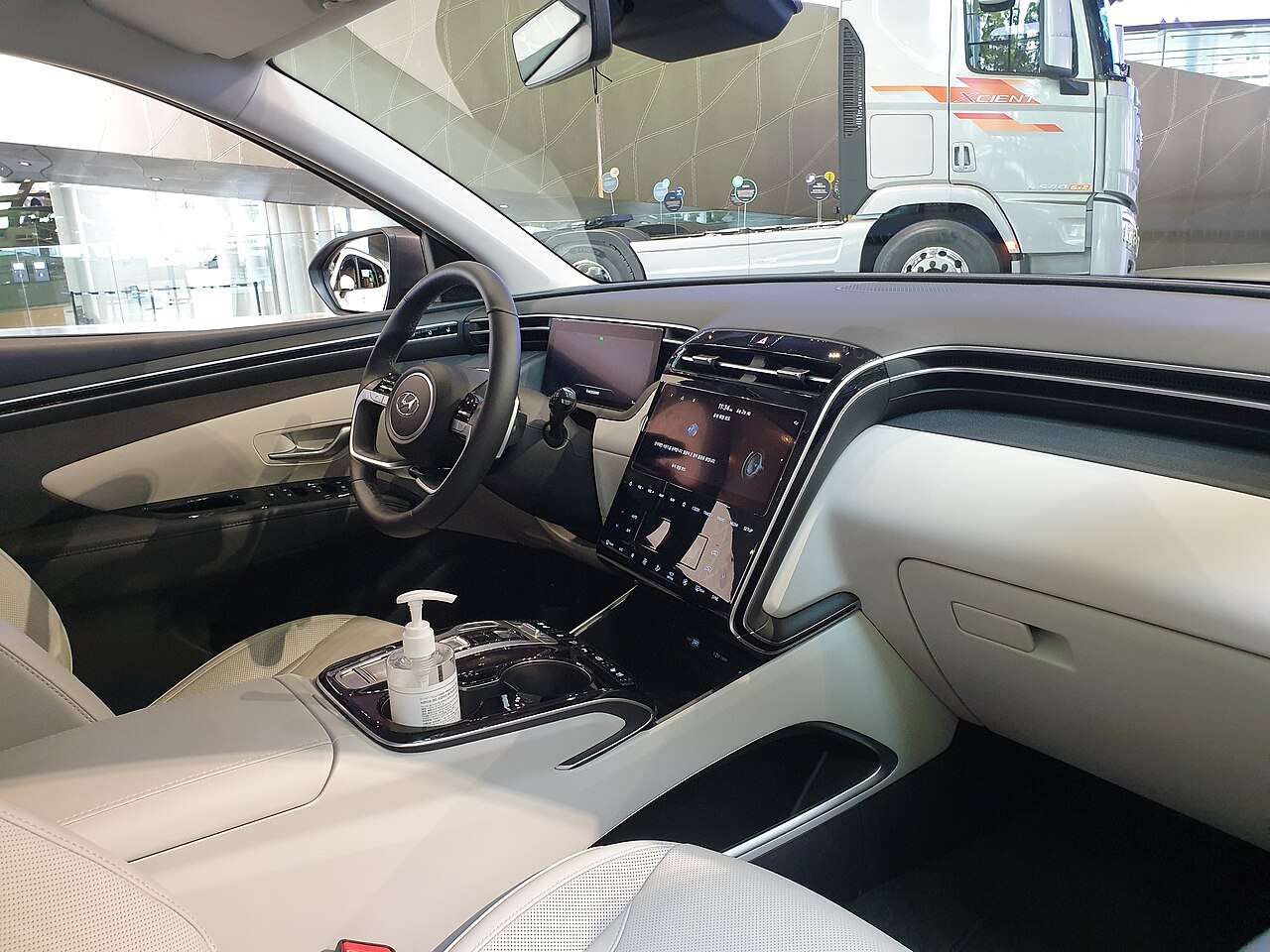
Operate the climate controls through cold and warm settings and confirm air reaches the rear as intended. Check heated or ventilated seats if fitted, all windows, mirrors, USB sockets and both keys. Ask the seller to remove their personal connected account and explain ownership transfer; do not assume a connected-service subscription continues indefinitely.
Fit your child seats and load your pushchair. Hyundai’s launch material quotes a maximum 620-litre boot, explicitly dependent on powertrain and trim. Do not assume every hybrid has the maximum figure. Check the load-floor arrangement, underfloor storage, parcel shelf and emergency tyre equipment on the car you are buying.
Inspect carpets, roof lining and the area beneath the boot floor for damp. On cars with a panoramic roof, check operation, seals and any history of leaks or drain work. Water ingress needs its cause resolved; fragrance and a freshly shampooed carpet can conceal it for a short viewing.
Brakes, suspension, tyres and body
Test braking progressively and feel for pulling, vibration or scraping. Regenerative assistance on a hybrid does not mean friction brakes cannot corrode or seize. Have inner disc faces and caliper movement checked during an inspection, especially on a car that has covered little mileage.
Listen for suspension knocks over uneven surfaces and check tyre wear across the full tread. Inspect wheels for cracks, buckles and repairs, including their inner faces. Price the exact tyre size and rating before choosing a large-wheel specification. A quiet, straight-driving car with sound tyres is more valuable than freshly refurbished wheels hiding poor rubber.
Check panel gaps and paint consistency, then look underneath on a lift for damage and leaks. Camera and radar warnings after bodywork or a windscreen replacement need calibration evidence. Do not deliberately test collision avoidance by creating a hazard. Confirm outstanding recalls and service campaigns with Hyundai against the VIN.
UK maintenance costs: parts, time and fitted work
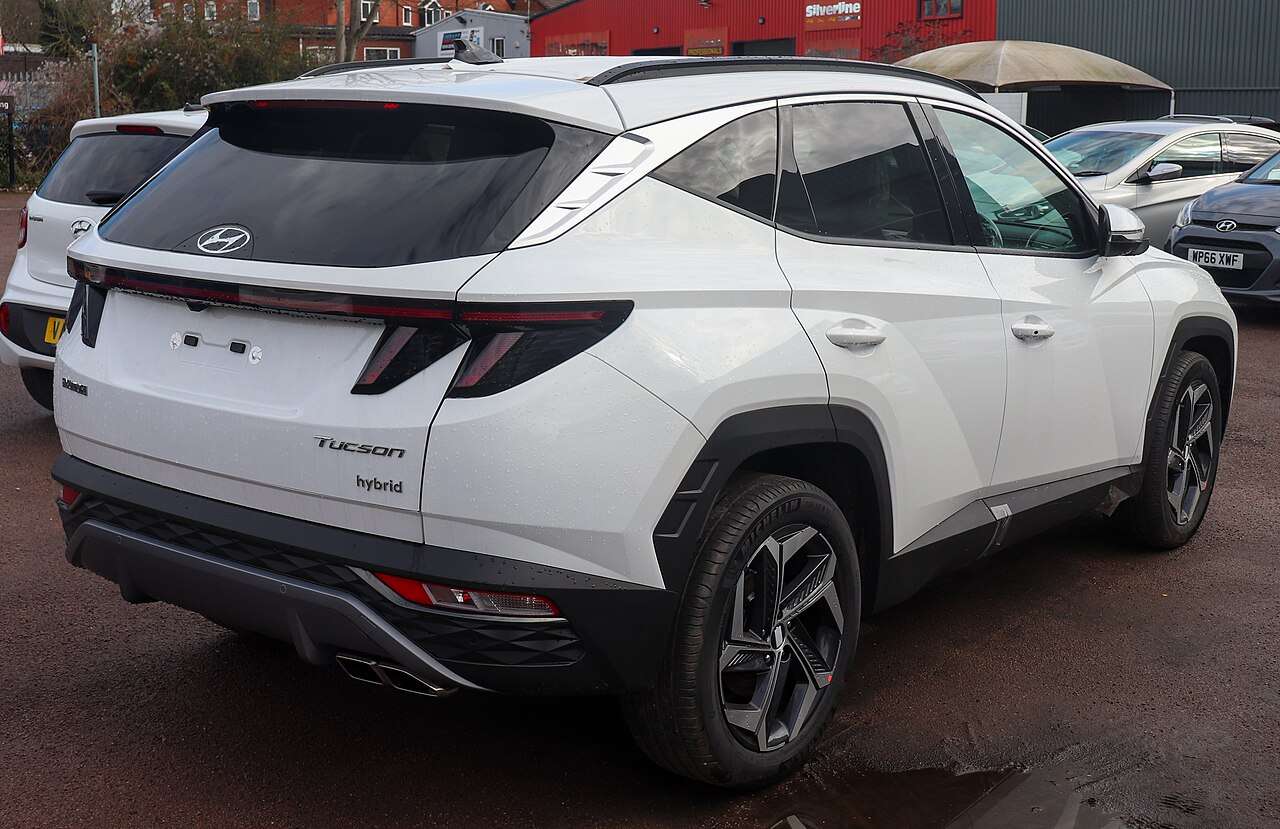
Online estimates help frame a budget but need confirming against the registration. Fixter has a specifically labelled 1.6 Premium T-GDi HEV Auto line, which is more useful than applying a generic Tucson price across several generations. Compare the written contents with Hyundai’s schedule and obtain confirmation of VAT and any additional work.
| Job | Parts-only reference | Labour and fitted reference |
|---|---|---|
| HEV full service | Filter kits are not automatically a complete manufacturer service. | Fixter £173–£271 fitted for Premium T-GDi HEV Auto. |
| HEV major service | Ask which filters, plugs and fluids the quote includes. | Fixter £245–£385 fitted for the same HEV line. |
| HEV front brake pads | Compare correctly specified pads; discs are separate. | Fixter £65–£102 fitted; confirm the actual car and scope. |
| HEV rear brake pads | Compare rear pads; confirm electronic parking-brake requirements. | Fixter £58–£90 fitted; a seized caliper or worn disc is additional work. |
| NX4 filter / oil-and-filter kits | Indexed eBay examples: £32.50 for a kit described as oil/air/cabin filters; £72.95 for a 5-litre oil-and-filter package. | Parts only. Check whether “oil” means an oil filter or includes lubricant, and confirm oil approval and required quantity. |
Do not subtract an unrelated kit price from a fitted service estimate to invent a labour charge. Fixter’s general 1.6 Premium servicing line lists 57 minutes–1h31, but it is not explicitly the HEV line and should not be presented as a guaranteed full-hybrid job time. Request the garage’s labour time and hourly rate for the specific work. These are budgeting references rather than binding quotes.
Model-specific eBay service-parts table
Search results can mix generations and electrification systems. A seller’s compatibility checker is a starting point; supply the VIN and original part number, and ask a workshop before ordering electrical or drivetrain components. Our manual affiliate links use campaign 5339238906.
| Service item | Model-specific eBay search | Before ordering |
|---|---|---|
| Petrol service filters | Compare petrol service filters | Confirm engine and kit contents. |
| HEV service kit | Compare hev service kit | Confirm HEV rather than 48V or PHEV. |
| Engine oil filter | Compare engine oil filter | Original number and supersession must match. |
| Cabin filter | Compare cabin filter | Correct housing and filter grade. |
| Spark plugs | Compare spark plugs | Match exact engine and heat specification. |
| Front discs and pads | Compare front discs and pads | Match diameter and brake specification. |
| Rear discs and pads | Compare rear discs and pads | Check parking-brake service procedure. |
| Auxiliary belt | Compare auxiliary belt | Petrol and hybrid layouts differ. |
| MHEV belt components | Compare mhev belt components | MHEV only; have diagnosis and original number. |
| Petrol alternator | Compare petrol alternator | Do not assume it fits MHEV or HEV. |
| Wipers | Compare wipers | Match arm fittings and body generation. |
| Air filter | Compare air filter | Check exact engine and housing. |
Hidden ownership costs
Warranty gaps: confirm the actual remaining cover and maintenance compliance. A warranty may not pay for wear, an undiagnosed noise or a fault that was already present. Ask who pays diagnostic costs if a claim is declined, and do not substitute a sales promise for written terms.
Wheels and tyres: a large-wheel Ultimate or N Line can cost more to keep on good rubber than a modest specification. Get a quote for all four fitted tyres, including suitable ratings and alignment if needed. On AWD, establish matching requirements before replacing only one tyre.
Convenience equipment: powered tailgate, cameras, seat systems and panoramic roof all add functions to check. Replacement parts may require fitting, programming or calibration. A cheap second-hand unit can become expensive when its compatibility and setup are uncertain.
Hybrid diagnosis: leave a reserve for proper investigation rather than buying speculative parts. A routine engine service does not necessarily include a detailed hybrid-system assessment. Ask the specialist to describe the test, its limitations and what any measured battery figure means.
Consumables and omitted work: brake fluid, plugs, cabin filters, coolant requirements and age-based items can sit outside a headline service price. Add missing keys, load covers and damaged interior fittings to the immediate ownership budget. Check insurance and tax for the actual registration.
A practical pre-purchase plan
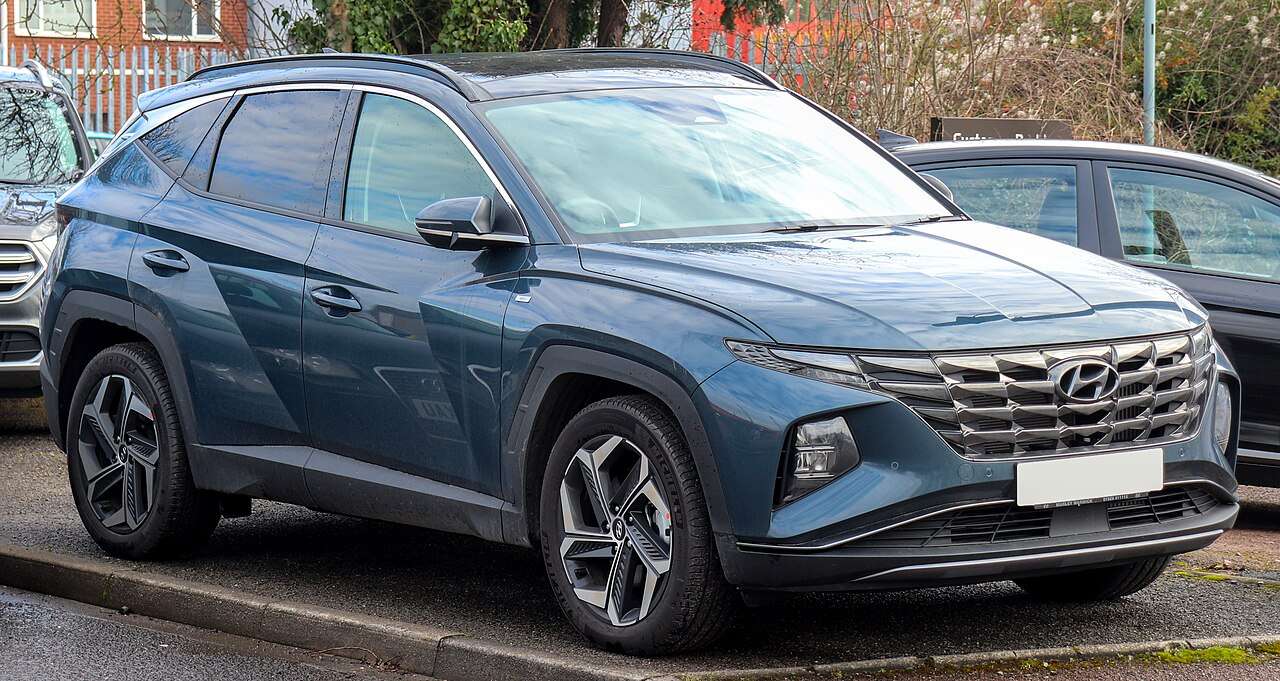
- Ask for the VIN, exact powertrain, service invoices, both keys and a cold viewing before travelling.
- Check identity, MOT history, outstanding campaigns and any warranty directly; verify mileage progression.
- Test every fitted screen, climate, camera, tailgate and seat function while stationary.
- Drive from cold to hot, including parking, a gentle hill and an open-road section. Pay particular attention to the actual gearbox type.
- Arrange a lift inspection and model-capable diagnostic scan before purchase; get repair commitments itemised in writing.
Negotiate on wear that has a clear diagnosis and price. A tyre set or an ordinary service can be costed. Recurring hybrid warnings, unexplained coolant loss, serious transmission symptoms or contradictory history should stop the purchase until a competent inspection establishes the cause.
Frequently asked questions
Does the full hybrid need plugging in?
No. The HEV manages its battery through the engine and energy recovery. The PHEV is a separate version with charging hardware and different battery checks.
Is every hybrid Tucson fitted with a DCT?
No. The launch full hybrid uses a six-speed automatic; the seven-speed DCT appears in other powertrain combinations. Identify the exact version before applying buying advice or a service procedure.
Is N Line worth the extra?
Only if you value the styling and equipment, the ride suits you and the consumable costs fit your budget. Condition and documented maintenance take priority over the badge.
Which Tucson would we shortlist?
A full hybrid with a coherent history, smooth operation and useful equipment is our preferred automatic family choice. A good conventional petrol remains worth comparing when its lower price outweighs the likely fuel saving. Buy the individual car after inspection.
Sources and further checks
- Hyundai: the all-new Tucson, December 2020 — contemporary architecture, gearbox distinctions and powertrain-dependent luggage capacity.
- Hyundai: N Line announcement, January 2021 — equipment context and UK qualifications.
- Fixter Tucson service estimates and brake-pad estimates.
- Auto Trader Tucson listings — changing asking prices.
Checks described here are inspection priorities, not evidence that every NX4 suffers a listed fault. Obtain the applicable handbook, maintenance schedule and campaign status from Hyundai using the VIN.
Featured image: Vauxford / Wikimedia Commons, CC BY-SA 4.0. Resized for web.